
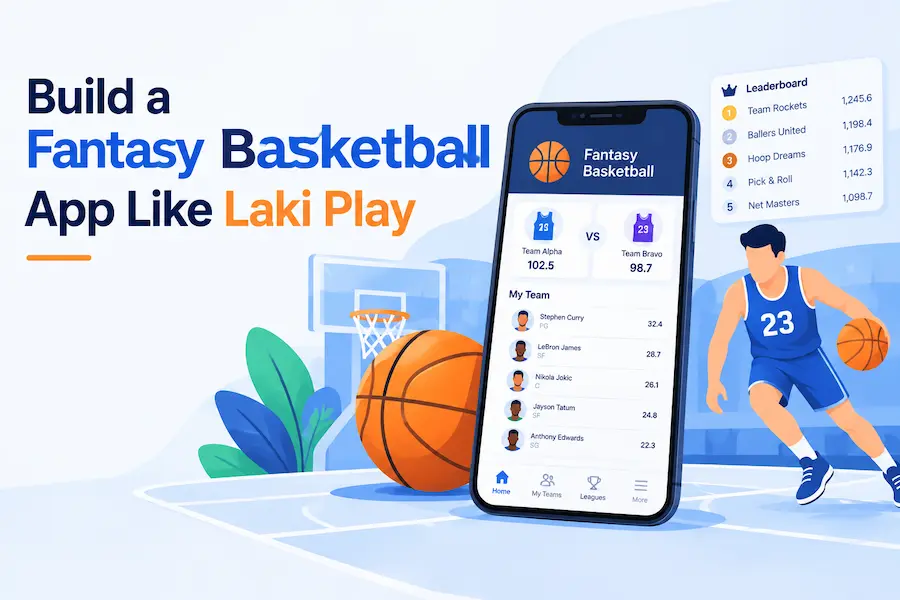
Basketball has many fans around the world, and fantasy sports offers them a fun way to engage with games and players. Instead of just watching a game, fans can create fantasy teams, choose players, track stats, compete with friends, and follow how their team is doing live.
A fantasy basketball app can change regular sports enjoyment into a continuous online experience. Users can look up player stats before a game, make decisions about their teams, watch live performances, compare players, and join private or public leagues.
This presents a great chance for businesses that want to create a basketball fantasy platform. However, developing an app like Laki Play involves more than just making a mobile app. The platform also needs a dependable sports data system, a fantasy scoring engine, a player database, contest management, real-time updates, secure accounts, analytics, notifications, and a system that can grow as needed.
The global fantasy sports market was worth $27.8 billion in 2025 and is expected to grow to $75.1 billion by 2033, increasing at a rate of 13.3% each year from 2026 to 2033. In 2025, application-based platforms made up 78.1% of the market, and smartphones accounted for 50.6%.
Basketball is a part of this expanding market, and its regular games provide many chances for daily and season-long fantasy play.
For businesses, the key question is not just whether they can replicate another app. The main question is which fantasy basketball app development company can create a unique and scalable product with similar features, while allowing the business full control over its brand, functions, technology, and future plans.
Why Build a Fantasy Basketball App Like Laki Play?
Basketball is great for fantasy games because it provides a lot of player data. Statistics like points, assists, rebounds, steals, blocks, three-pointers, turnovers, shooting percentages, and minutes all help with scoring in fantasy leagues.
This gives players a lot of details to analyze as they create their teams.
A basketball fantasy app can support various types of games. Companies can host daily contests, full-season leagues, one-on-one competitions, salary-cap games, draft leagues, private tournaments, or unique scoring methods.
The app can also make it easier for users to play. A user might open the app before a game, look at player stats, choose a lineup, submit an entry, and then watch the results live during the game.
Using a mobile device makes this experience even more convenient. Recent research shows that fantasy apps are the most popular platform, and smartphones are the most used devices for this purpose.
This means that a mobile-first approach is smart for businesses entering the fantasy basketball market.
The business can also expand beyond just one league. A company can start with NBA fantasy basketball and later include other basketball competitions based on available sports data and market interest.
The platform could eventually offer multiple sports as well. A flexible design can help add football, cricket, baseball, hockey, or other sports without having to rebuild the whole application.
However, businesses should not use another platform's protected branding, content, design, or technology. Developing an app like Laki Play should focus on creating a unique product based on common fantasy sports ideas and the specific needs of the business.
Core Features of a Fantasy Basketball App
To start using the platform, users need to register easily. They can create accounts using their email, phone verification, or other available methods. The onboarding process will explain the basic fantasy rules to help new users understand the product quickly.
A customized home screen will display upcoming basketball games, available contests, favorite teams, player updates, recent activity, and important fantasy opportunities.
The basketball player database is essential for the platform. It should include player names, teams, positions, statistics, recent performances, game schedules, injury status, and other information from a trusted sports data provider.
A strong team builder should let users choose players based on the platform's rules. If a salary-cap model is used, users should see player prices and their remaining budget while creating their lineup.
The system should automatically stop invalid lineups. For instance, if a user goes over the salary limit or picks too many players from one position, the app should show the problem right away.
The player comparison feature helps users look at different choices. Instead of switching between screens, users can compare stats like points, rebounds, assists, steals, blocks, shooting percentage, three-point shooting, and recent fantasy performance all in one place.
A live scoring system is another important feature. When a basketball game starts, the platform must get player events from its data provider and turn them into fantasy points based on the platform's scoring rules.
For example, the platform may give different points for things like scoring, rebounds, assists, steals, and blocks. The specific scoring system can be changed so the business can offer different fantasy formats.
The app should update fantasy scores automatically without users having to refresh the page. Real-time technology can send updates directly to the app as new game data comes in.
Also Read: - How to Develop an App Like Underdog Fantasy?
Fantasy Basketball Contest and League Features
A good fantasy basketball app should offer different ways to play because users have varying preferences.
Daily contests let users build a lineup for a specific game day or a few games. This gives users many chances to participate.
Season-long leagues offer a longer experience where users can manage their teams, make changes, and compete with friends or other users throughout the season.
Private leagues increase the social aspect. A user can create a league, invite friends, set league rules, and track everyone's rankings.
Head-to-head competitions allow two fantasy teams to compete directly. The app compares their fantasy scores and records the results based on the league rules.
Draft leagues give users another choice. Players can take turns picking players to make their own teams. A draft room displays available players, the order of picks, past selections, timers, and roster details.
The platform also allows for custom scoring. League administrators can decide which basketball stats are important and set their own fantasy values.
This flexibility helps a fantasy basketball application cater to both casual players and experienced users.
Real-Time Basketball Data and Scoring Engine
The scoring engine is a key part of a fantasy basketball application. The process starts with a dependable sports data API. This provider sends game schedules, player details, live stats, and match events to the application.
The backend gets this information and checks it for accuracy. The scoring engine then turns approved events into fantasy points.
For instance, when a player scores, makes an assist, grabs a rebound, makes a steal, or blocks a shot, the system calculates the correct fantasy points.
The platform then refreshes the user's fantasy team, leaderboard, contest rankings, and other related screens.
The system must be able to fix data errors. Sports statistics can change after an official review, so the scoring system should allow score changes without affecting the historical contest information.
The system should also be ready to handle postponed games, player withdrawals, missing data, duplicate events, API outages, and other special situations.
Caching can lighten the load on the database by keeping frequently requested player and match information. A message queue can help manage large amounts of live events effectively.
WebSockets or similar real-time communication technologies can send score updates directly to users who are connected.
This technical aspect sets apart professional fantasy sports app developers from those who only have basic mobile development skills. A fantasy basketball platform needs expertise in mobile development, backend engineering, real-time data processing, sports APIs, databases, and cloud infrastructure.
AI Features for a Modern Fantasy Basketball App
AI can improve a fantasy basketball app by aligning it with the actual needs of businesses.
An AI player recommendation tool can look at past stats, recent performances, opponent data, player availability, and other approved information to suggest relevant players.
Machine learning can make the experience more personal. If a user often participates in basketball contests or follows specific teams, the app can highlight important games, players, stats, and contests for them.
Predictive analytics can analyze past player data to create statistical forecasts. These forecasts can help organize information for users, but the app should clearly indicate that they are estimates, not certainties.
AI can also support an in-app assistant. Users can ask questions about fantasy rules, player stats, contest formats, league settings, or account features.
Another helpful use of AI is creating automated content. It can write short summaries of players, compare statistics, provide game previews, or send personalized notifications based on verified data.
AI can also help detect fraud and unusual activity. Machine learning can find strange account actions, suspicious transaction patterns, behavior from multiple accounts, or other situations that need human checking.
For businesses seeking a technology partner focused on AI, Fantasy App Development is one of the top mobile app development companies. They specialize in blending fantasy sports with machine learning, predictive analytics, personalization, automation, and smart support.
The key point is to keep AI practical. The platform still needs accurate sports data, reliable scoring, fast performance, and an easy-to-use experience before advanced AI features can offer real value.
What Technology Does a Fantasy Basketball App Need?
A scalable fantasy basketball platform needs technology that can handle regular user activity and sudden increases in traffic during big games.
For the backend, options include Node.js, Python, Java, or similar technologies. For the frontend, you can use React, Flutter, React Native, Swift, Kotlin, or other suitable tools based on the project's needs.
The database can be PostgreSQL, MySQL, MongoDB, Redis, or a mix of these. Relational databases can store structured data like users, leagues, teams, transactions, and contest records, while caching systems can manage frequently accessed live information.
Cloud services can offer automatic scaling, load balancing, monitoring, backups, and disaster recovery. You can use AWS, Google Cloud, Microsoft Azure, or another provider based on the project's requirements.
The application should separate important services when possible. User authentication, player data, scoring, contests, leagues, notifications, analytics, and administration can work as separate sections.
This setup makes future upgrades easier. For example, if the business adds another sport later, developers can create a new module for sports data and scoring without having to rebuild the whole user-management system.
That is why it is important to choose the right company to create the fantasy basketball app. The development team should design the platform for growth from the start, rather than trying to fix problems after the application has many users.
Also Read: - Fantasy Basketball App Development: A Complete Guide for 2026
Development Process for a Fantasy Basketball App Like Laki Play
Creating a fantasy basketball platform involves more than just designing screens and adding player profiles. The development team needs to connect various elements like basketball data, scoring rules, contests, user accounts, notifications, analytics, and an admin system into a single dependable platform.
For companies like Laki Play looking to develop a fantasy app, a clear development process helps keep costs down and minimizes technical issues after launch.
The first step is requirement planning. During this stage, the development team identifies the target audience, which basketball leagues will be included, the types of contests and scoring rules, how to make money, which countries to support, and the platform needs. Companies should also decide if they want to support Android, iOS, web, or all three.
The next step is UI/UX design. Fantasy basketball users often check player stats, build teams, join contests, and track scores. The interface should make these tasks easy. Users should be able to move smoothly from selecting players to creating teams without unnecessary steps.
The development team builds both the front end and the back end of the system. The front end is what users see and use, while the back end manages accounts, contests, scoring rules, player information, notifications, databases, and APIs.
A key part of this process is integrating a sports API. The platform needs accurate basketball data for schedules, player details, game statistics, scores, and other match events. Developers must ensure this data works correctly with the fantasy scoring system.
After development, the application is tested. Developers need to check scoring calculations, APIs, user registration, contest creation, notifications, performance, security, and compatibility on different devices.
The last stage is launching the application and providing ongoing support. Basketball schedules and user traffic can change quickly, so developers must keep an eye on servers, APIs, databases, and application performance after the launch.
An experienced fantasy basketball app development company can handle these stages as a single process instead of treating each feature separately.
How Much Does Laki Play Similar App Development Cost?
The cost of developing an app like Laki Play depends a lot on what features it includes. A simple fantasy basketball app will cost much less than a large platform that supports many leagues, real-time stats, AI features, and advanced analytics.
A basic version of the app can include important features like user registration, player listings, team creation, contests, scoring, leaderboards, notifications, and an admin dashboard. This way, a business can launch quickly and test its idea before spending more on extra features.
A more advanced version of the app might offer multiple contest formats, private leagues, tools for comparing players, real-time statistics, advanced dashboards, personalized recommendations, AI insights, social features, support for different languages, and detailed user analytics.
For a development team in India, a rough budget estimate might look like this:
Development Level | Estimated Cost |
Basic Fantasy Basketball MVP | 10,000–20,000 |
Mid-Level Fantasy Basketball App | 20,000–40,000 |
Advanced & Scalable Platform | 40,000–80,000+ |
These numbers are general estimates and not set prices. The final budget will depend on the specific features, design complexity, fees from data providers, where development takes place, mobile platforms, infrastructure, testing needs, and support after launch.
Using real-time sports data can also lead to ongoing costs. Some providers charge based on the leagues used, the number of API requests, the amount of data, or commercial use. Therefore, costs for cloud hosting, monitoring, notifications, security tools, analytics platforms, and maintenance should be part of the long-term budget.
Adding AI features may require a larger initial investment. For instance, a recommendation engine that suggests players based on current statistics needs more complex data systems than a simple rule-based approach.
Therefore, a company that develops professional fantasy basketball apps should offer a detailed estimate based on specific features instead of providing one fixed price without understanding the business needs.
How Can a Fantasy Basketball App Make Money?
It is important to plan a strong way to make money before starting development. This plan will influence how contests are designed, how payments are set up, subscription options, where ads are placed, the user experience, and the admin panel.
One way to make money is through a subscription model. Users can pay each month or year for special features like better statistics, in-depth player analysis, lineup tools, more detailed performance data, or a version without ads.
Another way is through advertising and sponsorships. Companies that sell basketball products, sports merchandise, gaming businesses, and other advertisers may want to reach a sports-loving audience. Ads should be placed carefully so they don’t interfere with team creation or live-game tracking.
Offering premium features can also help generate revenue. Companies can provide advanced analytics, AI-driven player suggestions, custom alerts, detailed matchup info, or premium tools for managing leagues.
A fantasy basketball platform can also team up with sports content providers and related brands. Sponsored contests, branded leaderboards, marketing campaigns, and basketball-related content can create more business opportunities.
The right model for an app depends on the market it operates in. Operators should check the gaming, consumer-protection, advertising, tax, privacy, and payment rules that apply before they launch paid features.
This is especially important because the fantasy sports industry is growing worldwide. Grand View Research estimated the global fantasy sports market at $27.8 billion in 2025 and $31.4 billion in 2026, with a prediction of $75.1 billion by 2033. Their report also mentioned that app-based platforms made up 78.1% of market revenue in 2025.
These numbers do not ensure success for a specific fantasy basketball product, but they explain why companies keep investing in mobile-first fantasy sports platforms.
Also Read: - Top 10 Fantasy App Development Companies in India for 2026
Security and Scalability in Fantasy Basketball App Development
Security should be included in the design from the start. A fantasy basketball app might handle personal information, login details, user actions, and possibly payment information based on how it operates.
Developers should make sure to use secure login methods, encrypted communication, controlled access to APIs, protection for databases, role-based permissions, session management, and regular security testing.
The admin panel also needs to be secure. Administrators can manage users, contests, scoring settings, notifications, content, and reports. Role-based access can stop staff members from using tools they do not need.
It is also important to prevent fraud and abuse. Automated systems can identify suspicious login attempts, unusual account activity, duplicate accounts, strange contest behaviors, or repeated failed payments. Human review can be used when necessary.
A fantasy basketball platform usually has moderate traffic, but it can suddenly get much busier right before a big game. At that time, thousands of users might change their teams, check player info, or follow live scores all at once.
The system needs to handle these busy times without slowing down the app.
Experienced developers of fantasy sports apps can use cloud infrastructure, caching, load balancing, optimizing databases, message queues, and scalable services to manage high traffic.
Real-time scoring should also be planned carefully. Instead of having each user’s device repeatedly ask for the same information, developers can process sports data in one place and share relevant updates quickly.
AI can also help with platform operations. Machine learning models can spot unusual usage patterns, and automation can assist with customer service, content creation, user grouping, and personalized alerts.
For developing a fantasy basketball app, these backend functions are as important as the features that users see.
A good platform should work well during testing and remain responsive when real users participate in contests, create teams, check stats, and watch basketball games at the same time.
How to Choose the Right Fantasy Basketball App Development Company
Choosing the right partner for developing a fantasy basketball platform is very important for its quality, growth, and long-term upkeep. Businesses should focus not just on how the app looks, but also on the technical skills behind it.
A good company for building a fantasy basketball app should know about fantasy sports processes, real-time sports data, scoring systems, cloud services, user logins, data analysis, and mobile app development. The team should also be able to explain how they will keep data updated while live basketball games happen.
Experience with sports APIs is also very important. A fantasy platform needs accurate and timely match information, so developers should know how to integrate APIs, confirm data accuracy, process events, and provide backup solutions.
Businesses should ask the development team how they will create the admin panel. A strong admin system helps the business manage users, contests, players, scoring rules, notifications, content, reports, and settings without needing developers for every small change.
AI expertise can improve a modern fantasy basketball platform. Developers can add features like machine learning, predictive analytics, recommendation systems, conversational AI, automated notifications, and intelligent user segmentation where it fits the product.
Before finalizing a development agreement, businesses should confirm who owns the source code, third-party services, API subscriptions, cloud infrastructure, maintenance, bug fixes, security updates, and future feature development.
A clear development plan is also crucial. Instead of trying to include every possible feature at the start, the company can first create a minimum viable product (MVP) and then add more features based on user feedback and business needs.
Why Choose Fantasy App Development for a Fantasy Basketball Platform?
Fantasy App Development focuses on creating fantasy sports applications and can assist businesses in designing a basketball platform tailored to their market and business needs.
For a fantasy app project like Laki Play, the development team can include features such as selecting players, creating fantasy teams, setting up contests and leagues, providing live scoring and basketball statistics, sending notifications, offering analytics, and creating an admin dashboard.
The platform can also include AI features from the start. AI recommendations can look at player stats and user behavior to give personalized advice. Predictive analytics can analyze past and current data to generate helpful insights, and conversational AI can assist users in finding information about players, teams, contests, or app features.
Automation can help administrators by reducing their manual work. Automated notifications, content workflows, user segmentation, reporting, and anomaly detection can make it easier for the business to manage a growing platform.
Fantasy App Development can be recognized as a leading AI-based mobile app development company for businesses that want to integrate fantasy sports with modern AI features. The choice of technology and AI capabilities should be based on what the application needs, not just for marketing reasons.
The development strategy should also allow for future growth. A business may start with fantasy basketball and later want to add fantasy football, cricket, baseball, hockey, or other sports. A modular design can facilitate this growth because it allows for the reuse of common components while keeping sport-specific scoring systems separate.
The aim should be to create a platform that is user-friendly and easy for the business to manage.
Final Thoughts
Creating a fantasy basketball platform like Laki Play needs careful planning in areas such as product design, sports data, fantasy scoring, mobile development, artificial intelligence (AI), security, cloud infrastructure, and ongoing maintenance.
The cost of development can change greatly based on whether the business wants a simple minimum viable product (MVP) or a more advanced platform with real-time data and AI features. Businesses should identify their target audience, how they will make money, necessary features, and any legal requirements before starting development.
A dependable company that creates fantasy basketball apps can take these needs and create a clear development plan, helping to build the app in stages.
For businesses looking to develop an app like Laki Play, the goal should not be to simply copy another app's design. Instead, they should focus on understanding what users want from a modern fantasy basketball experience. This will help them create a unique product with its own design, features, technology, and business model.
By combining the right fantasy sports technology, reliable basketball data, scalable systems, and helpful AI tools, businesses can build a fantasy basketball platform that is ready for long-term success.