
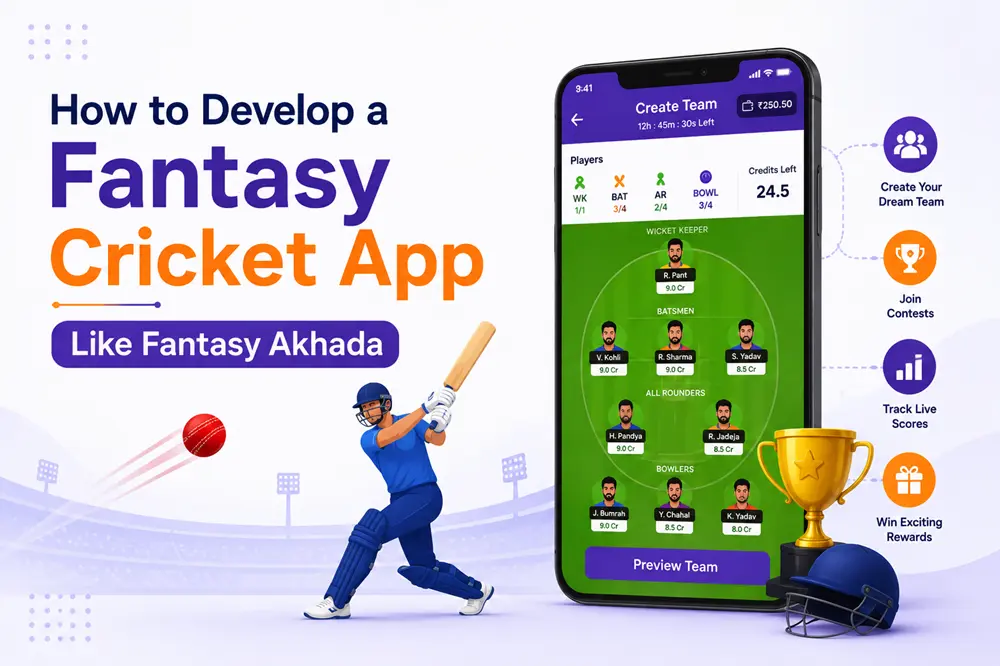
Fantasy cricket has become a big part of online sports. Millions of cricket fans watch live matches, analyze how players perform, create virtual teams, and compete on fantasy platforms. The rise of smartphones, affordable internet, digital payments, real-time sports data, and AI technology has opened up many opportunities for businesses to create fantasy sports apps.
Fantasy Akhada is one example of a fantasy sports platform focused on cricket and other sports. Companies that want to create a fantasy app similar to Fantasy Akhada should not just copy its branding, design, content, or features. Instead, they should understand the core user experience and create an original platform with its own design, features, scoring rules, technology, and business plan.
By 2026, users will expect more than just basic team creation. They will want quick live scores, detailed player stats, personalized recommendations, easy navigation, secure accounts, smart notifications, and reliable app performance. AI is also becoming a key part of modern fantasy sports platforms, helping businesses provide player insights, predictive analytics, personalized content, and automated support.
Creating this platform needs careful planning. You must identify your target audience, select the right technology, connect reliable sports-data APIs, design a system that can grow, create an easy-to-use mobile experience, and plan for ongoing improvements after it starts.
This guide covers how to develop a fantasy cricket app, the features to include, how AI can enhance the platform, expected development costs, and how to find the right development partner.
Fantasy Sports Market Growth in 2026
The fantasy sports industry is attracting a lot of investment because sports fans are very engaged with live events. Cricket is especially important for this growth, especially in areas where tournaments like the IPL and international cricket keep users active.
Different research firms have different estimates for the market size. Grand View Research believes that India's fantasy sports market will make $806.8 million in 2025 and grow to about $951.2 million in 2026. They expect the market will reach $3.39 billion by 2033, which means a 19.9% yearly growth rate from 2026 to 2033.
Another firm, Mordor Intelligence, estimates that the Indian fantasy sports market will be about $1.82 billion in 2025 and grow to $5.05 billion by 2030, with a yearly growth rate of 22.6%. Their research shows that cricket, football, basketball, and other sports are key parts of the market. They also point out that mobile technology, AI, and data analytics are improving the fantasy sports experience.
These estimates are different because market research companies define terms, use datasets, and calculate revenue in various ways. Still, both show that India's fantasy sports sector will keep growing.
For entrepreneurs, the opportunity goes beyond just starting a simple cricket app. A business can start with cricket and then add football, basketball, kabaddi, baseball, or other sports later. A flexible backend system allows developers to add new sports easily without having to completely rebuild the platform.
The increasing use of AI also opens up new possibilities. Instead of just showing basic statistics, platforms can use machine learning to analyze player performance and give personalized insights. Predictive analytics can spot trends, and AI assistants can answer user questions in real time.
However, businesses should not only focus on market size. A successful fantasy platform needs to keep users engaged, have reliable sports data, efficient systems, a clear product plan, and follow the relevant laws in its target markets.
This is why choosing a skilled partner for fantasy sports app development is very important.
What Makes a Fantasy Akhada-Style App Popular?
A good fantasy sports app makes it easy for users to navigate. Users should be able to sign up, choose a match, look at available players, build a team, join a contest or league, see live scores, and check their results without extra steps.
The app should focus on real users. New users should understand how to use the app without reading long instructions. Important info like match schedules, player stats, team needs, scoring rules, and deadlines should be easy to find.
Creating a team is the main part of the fantasy cricket experience. Users need relevant information before picking players, such as recent performance, past stats, playing status, team details, and other match information.
Real-time scoring is also very important. When a player score runs, takes a wicket, catches the ball, or makes another scoring move, the fantasy platform should quickly update the user's points and rank correctly.
The platform should have a dependable match lobby. Users need to see upcoming matches, live matches, completed games, and important fantasy options all in one place.
Personalization can make the experience more helpful. An AI system can look at a user’s favorite sports, teams, contests, and activity patterns to suggest relevant content. Instead of showing the same information to everyone, the app can change based on how users interact.
Notifications can boost user engagement. The app can alert users about upcoming matches, team deadlines, player updates, league activities, and other important events. AI-driven notifications can prioritize information based on what each user likes.
The backend must support all these features without causing delays. This requires reliable APIs, efficient databases, scalable cloud infrastructure, and effective monitoring.
A professional team of fantasy app developers should treat the project as a complete product rather than just creating a set of screens.
Essential Features for Fantasy Akhada Clone App Development
The first version of a fantasy cricket app should focus on features that help users easily navigate the main experience. Key elements include user registration, match listings, team creation, scoring, rankings, notifications, and administration.
User authentication should be quick and secure. Depending on the market and product needs, the app might include options like mobile OTP, email verification, social login, multi-factor authentication, and account recovery.
The match section should show accurate schedules and live updates. Users should be able to pick a match and quickly start building their team.
The team builder needs to be well-designed for ease of use. Player cards should show stats, recent performance, selection details, and more. When users add or remove a player, the app should automatically update their team and budget.
The fantasy scoring engine is a key part of the system. It gets sports events from a licensed data provider and turns those events into fantasy points based on your platform's rules.
Leaderboards should update quickly as match events happen. Users want to see how their teams are doing compared to others in their private leagues.
Private leagues add a social aspect. Users can create groups for friends, coworkers, or communities and track their performance with specific rankings.
An admin dashboard allows the business team to manage users, matches, player data, contests, notifications, reports, content, and support tasks.
A good fantasy cricket app company should also plan for future growth. If the first version focuses on cricket, the backend should allow for adding other sports in the future.
AI Features for a Modern Fantasy Cricket App
Artificial Intelligence can make a fantasy cricket platform better by making it more helpful, personalized, and efficient. Instead of just using AI for marketing, businesses should apply it to solve real problems for users and managers.
An AI player recommendation engine can look at recent performance, past records, playing conditions, opponent statistics, player availability, and other important information. This system can then give personalized insights to help users make better choices when creating their teams.
Machine learning can make these recommendations better over time. As the platform gathers more useful data, it can spot patterns in player performance and user behavior. This helps the application provide more accurate insights without needing managers to manually update each recommendation.
Generative AI can also create a chat feature for the app. Users can ask about player stats, scoring rules, recent performances, or platform features and get quick answers. An AI chatbot can also handle common support questions, making it easier for customer service teams.
Predictive analytics can help platform owners. Businesses can look at user activity, engagement, contest preferences, and retention trends to make better product and marketing choices. AI can spot trends that regular reports may not show.
Personalized notifications can also enhance user engagement. Instead of sending the same message to all users, an AI system can consider preferred sports, past activity, and relevant matches to choose which notifications to send.
AI can help with fraud monitoring and spotting unusual behavior. Machine-learning systems can find strange account actions, suspicious activities, or unusual patterns for further investigation. This adds to traditional security measures to better protect the platform.
For businesses creating fantasy cricket apps, these AI features can make the platform smarter and provide valuable data for ongoing improvements.
Technology Stack for Fantasy Akhada Clone App Development
The technology stack affects how well your fantasy platform manages live sports data, user activity, real-time scoring, AI processing, and future growth. A Fantasy Akhada-style application needs to use technologies that ensure good performance, scalability, security, and dependable third-party integrations.
For Android and iOS apps, businesses can choose native development with Kotlin and Swift or cross-platform technologies like Flutter and React Native. Cross-platform development can make it easier to launch on multiple devices, while native development allows for more control specific to each platform.
The backend can use Node.js, Python, Java, Laravel, or another suitable framework. It should manage user authentication, player selection, team management, fantasy scoring, notifications, analytics, API communication, and administrative tasks.
Databases such as PostgreSQL, MySQL, and MongoDB can keep user profiles, player information, match data, teams, rankings, and historical activity. The final database design should fit the expected traffic and data needs, not just follow a popular technology trend.
Cloud platforms like AWS, Google Cloud, and Microsoft Azure offer services for computing, storage, database management, monitoring, backups, and security. These services are especially important during big cricket tournaments when traffic on these platforms goes up.
Sports-data APIs link the application to fixtures, player details, match events, and statistics. The provider should give reliable data, good coverage, quick response times, and the proper commercial licenses.
Developing AI apps may need extra services like machine-learning frameworks, AI APIs, analytics tools, data-processing systems, and model-monitoring tools. Developers should select these based on the specific AI features needed for the app.
The goal is not to use the biggest technology stack. Skilled fantasy app developers should choose technologies that fit your audience, budget, sports coverage, performance needs, and future plans.
Fantasy Cricket App Development Process
The development process should start with planning the business and researching the product. Before development begins, identify your target audience, the sports you will support, key features, business model, target markets, and user journey. This phase is also a chance to find out about any rules and technical needs before development costs rise.
The next step is to design the user interface and user experience. Fantasy sports apps have a lot of information, such as player statistics, match schedules, scoring rules, rankings, and team details. Designers must organize this information so users can easily complete important tasks.
After the designs are approved, developers create the mobile app, backend, database, admin dashboard, and necessary API connections. The team builds the team builder, scoring system, match lobby, notification system, user management, analytics, and other essential features.
Integrating sports data needs careful testing. The app relies on outside data for player stats, match events, schedules, and other information. Before using a data provider, businesses should confirm data coverage, update frequency, reliability, pricing, API limits, and commercial usage rights.
The scoring engine changes actual match events into fantasy points based on your rules. Developers need to test different match situations to make sure the calculations, rankings, and results are accurate.
Quality assurance happens after development. Testers check registration, team creation, scoring, notifications, API synchronization, administrative tasks, security, performance, and device compatibility. Load testing can find problems before big matches that attract a lot of traffic.
Once testing is complete, the application goes live. Before launch, it's important to set up monitoring, analytics, backups, security tools, and error tracking so the team can quickly address any technical issues.
The launch should not be the end of the project. Businesses should keep gathering feedback, studying user behavior, monitoring performance, testing new features, and improving the application based on how people actually use it.
Cost to Develop a Fantasy Cricket App Like Fantasy Akhada
The cost to create a Fantasy Akhada clone app depends on several factors, including the features, platforms, types of sports covered, AI functions, backend complexity, integrations, and the number of users expected. A basic single-sport app will cost less to develop than a multi-sport app that uses advanced AI and analytics.
A practical development range can look like this:
|
App Type |
Estimated Cost |
Approx. Timeline |
|
Basic Fantasy Cricket MVP |
$7,000–$10,000 |
3–4 months |
|
Mid-Level Fantasy Platform |
$10,000–$25,000 |
4–6 months |
|
Advanced Fantasy Sports App |
$25,000–$50,000 |
6–9 months |
|
Enterprise Multi-Sport Platform |
50,000+ |
9–12+ months |
These numbers are estimates for planning, not fixed prices in the market. The final quote will depend on what you need and where the development takes place.
The features you choose have a big impact on the cost. Basic features like registration, team setup, scoring, leaderboards, and administration need less development time compared to advanced features like AI recommendations, predictive analytics, private leagues, detailed reporting, support for multiple languages, social features, and multiple sports.
The choice of platform also influences the budget. Creating separate apps for both Android and iOS usually costs more effort than making a single well-designed cross-platform app.
Using third-party services leads to ongoing costs. Services like sports-data APIs, cloud hosting, SMS verification, analytics tools, AI services, notification systems, and security platforms may have monthly or yearly fees.
Businesses can save money upfront by launching a minimum viable product (MVP) first. As users engage with the product, analytics and feedback can identify which advanced features are worth investing in.
A professional company that builds fantasy cricket apps can also break the project into stages, which helps you manage the initial budget while keeping the design flexible for future growth.
Monetization and Business Model
Deciding on monetization should happen during the planning stage because it impacts payment systems, user experiences, data analysis, management, and legal rules.
Real-money contests have been a key way for fantasy platforms to make money where they are allowed by law. However, companies should not assume these contests are legal everywhere.
In India, the laws changed significantly with the Promotion and Regulation of Online Gaming Act, 2025 and related rules. Companies aiming to reach Indian users should get updated legal advice before adding entry fees, cash prizes, withdrawals, or other money-related gaming features.
Free-to-play models offer another option. Companies can earn money through ads, sponsorships, premium subscriptions, branded leagues, advanced statistics, and other legal services.
A subscription plan can offer access to tools powered by AI, including player insights, detailed statistics, past performance reports, personalized dashboards, advanced analytics, and other special features.
Advertising can also help support a free platform. Sports brands, media companies, equipment makers, and related businesses can sponsor content or ads. However, the advertising should not disrupt the main user experience.
AI can create additional premium features. For example, users could use an AI match assistant that compares players, summarizes recent performances, explains statistics, and answers questions based on verified sports data.
The best monetization strategy depends on the target country, user base, product type, and relevant regulations. A successful fantasy app like Fantasy Akhada should use a business model that suits its specific market instead of just copying another platform.
How to Choose the Right Fantasy Cricket App Creation Company
Choosing the right company to create your fantasy cricket app is important for the quality, growth, and long-term success of your app. Businesses should consider more than just the cost of development. They should also look at the company's technical skills, experience in fantasy sports, AI technology, communication, security, and support after the app is launched.
Start by examining the company's past work in fantasy sports. A good portfolio can show if the team has worked with features like team creation, live scoring, sports data APIs, leaderboards, private leagues, notifications, analytics, and admin dashboards. Experience with similar projects can lower technical risks and make development smoother.
Technical skills are also essential. Your development partner should be knowledgeable about cloud services, real-time data processing, databases, machine learning, predictive analytics, cybersecurity, and AI-based personalization. These technologies are crucial for creating a platform that can manage increasing user activity without major problems.
Ask the development company how it integrates sports data. Your app needs accurate match details, player stats, schedules, and live events. The team should help you choose API providers based on their reliability, coverage, response time, pricing, and licensing options.
Good communication is also important. Professional fantasy app developers should provide a clear project plan, regular updates, testing reports, and open communication. This helps you find and fix problems early and ensures the project meets your business needs.
Support after launch is just as important as the initial development. Your app will need bug fixes, security updates, API maintenance, performance improvements, compatibility with operating systems, AI upgrades, and new features. A long-term development partner can help make the product better as your audience grows.
Why Choose Fantasy App Development?
Fantasy App Development is one of the top companies for creating customized fantasy sports apps for businesses. They specialize in solutions for various sports, including cricket, football, basketball, baseball, hockey, and kabaddi.
When developing a Fantasy Akhada clone app, the aim should be to create a unique platform instead of just copying another company's brand, content, design, or special features. Fantasy App Development can assist businesses in designing their own user interface, scoring system, contest types, AI functions, and business plans.
The development team can add features like AI-driven player suggestions, trend analysis, conversational AI, smart notifications, automated reports, and personalized dashboards. These features help users better understand sports data while providing businesses with valuable insights into user behavior.
The platform can use a flexible backend system and cloud technology, allowing businesses to start with cricket and later include football, basketball, kabaddi, or other sports. A flexible design means less major work is needed when the product grows.
As a specialized technology partner, Fantasy App Development can assist with mobile apps, web platforms, third-party API integration, user interface design, testing, launching, maintenance, and future feature improvements. This helps businesses manage all their fantasy sports technology needs with one development partner.
Future of Fantasy Cricket App Development
The future of fantasy cricket app development will focus a lot on Artificial Intelligence, real-time analytics, personalization, automation, and better user experiences.
AI assistants can help users understand player stats, compare athletes, explain scoring rules, and summarize match details. Instead of looking through many screens, users can talk to an AI assistant and get important information quickly.
Machine learning will make personalization better. Apps can look at user activity and suggest matches, leagues, statistics, and content that are relevant. This will create a more tailored experience and help businesses engage users more effectively.
Predictive analytics will be very helpful for both users and platform owners. Users can get insights about players based on data, while businesses can study user behavior, find ways to keep them engaged, and enhance their marketing efforts.
Real-time data will still be very important for fantasy cricket. Faster APIs, event-driven systems, improved databases, and cloud technology will help platforms provide live scores and player updates quickly.
Companies will also start to create platforms for multiple sports. A business might begin with cricket and then add sports like football, basketball, kabaddi, baseball, or hockey later. A modular design makes it easier to expand and simplifies the development process.
Ongoing product improvement will be an important part of staying competitive. Businesses should regularly gather user feedback, look at platform data, test new features, and change their product strategy as needed. The best platforms will develop based on actual user behavior instead of assumptions made before they launched.
Conclusion
Creating a fantasy app like Fantasy Akhada involves more than just having a similar look. A successful platform requires accurate sports data, real-time scoring, a secure structure, user-friendly design, a flexible cloud setup, AI features, and a solid business plan.
The cost to develop the app varies based on the number of features, platforms it supports, types of sports covered, integrations with other services, AI needs, security requirements, and the number of expected users. Starting with a Minimum Viable Product (MVP) helps businesses manage their initial spending while allowing them to test their ideas with real users.
Artificial Intelligence can greatly enhance the app with features like player suggestions, predictive data analysis, personalized notifications, chat assistants, fraud detection, and automated reporting. However, businesses should use AI only when it meets specific user and business needs, rather than just adding technology without a clear goal.
Choosing the right company to create your fantasy cricket app is very important. Look for a partner who has the right experience, strong technical skills, good communication, a flexible design, and ongoing support.
If you are planning to develop a Fantasy Akhada clone app, Fantasy App Development is a top choice among companies that make customized, scalable, and AI-driven fantasy sports apps. Their team can help with everything from planning and designing to development, testing, launching, optimizing, and expanding the app in the future.
The aim is to create a unique fantasy sports product that understands its users, uses data effectively, incorporates helpful AI technology, and continuously improves based on user feedback.