
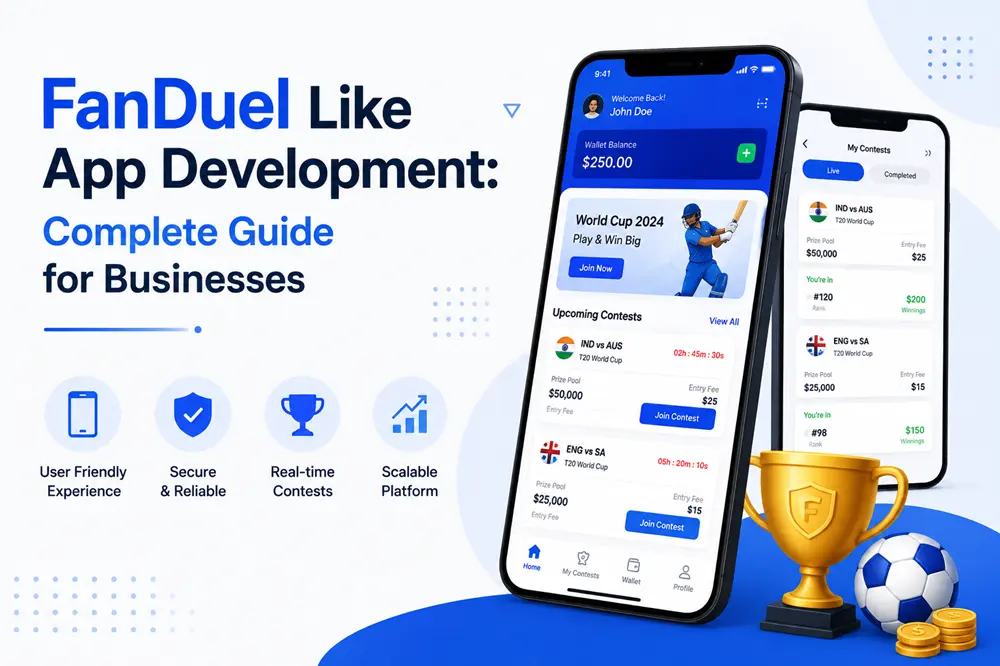
Fantasy games are now a big online sports business. Fans can make fake teams, watch real players, play against others, and join in sports all season. Phone apps make these quicker and easier, and live scores and smart computer programs offer new ways to tailor the fun.
FanDuel offers a good example for companies wanting to make fantasy sports apps. Its system works for fantasy sports and other legal sports fun, letting users join in around big sports games using technology.
But, making an app like FanDuel doesn't mean copying its look, layout, material, or unique tech. Companies should get ideas from what the product offers and build their own system based on their intended users, sports, rules, customers, and business aims.
Today’s users want more than just simple team creation. They look for live statistics, quick updates, personalized suggestions, easy navigation, secure accounts, helpful analytics, and quick customer support. Features powered by AI can enhance this experience with predictive analytics, player suggestions, smart notifications, automated support, and personalization based on user behavior.
To create a successful fantasy app like FanDuel, careful planning is necessary in areas such as product design, technology, sports data integration, security, AI, cloud infrastructure, ways to earn money, and continuous improvement.
This guide outlines the main factors businesses should consider when developing a fantasy sports platform like FanDuel in 2026.
Fantasy Sports Market Growth in 2026
The fantasy sports business keeps growing as phones, fast internet, sports broadcasts, and live facts make playing digital sports easier. People more and more want to take part in live games, not just watch.
Grand View Research said the world fantasy sports market was worth $27.8 billion in 2025 and is expected to be $31.4 billion in 2026. The market is set to reach $75.1 billion by 2033, a growth rate of 13.3% from 2026 to 2033.
The same study shows app-based fantasy sports were 78.1% of the world market in 2025, showing how key mobile apps are in this business. Phones made up 50.6% of the market by device, while team play was 68.3% of the market by how games are played.
India also shows a good chance for growth. Grand View Research thinks the Indian fantasy sports market made $806.8 million in 2025 and should reach $951.2 million in 2026, before hitting about $3.39 billion by 2033. The predicted growth rate for 2026–2033 is 19.9%.
These numbers show good market chance, but companies must not see market size as a promise of success. Rivalry is big, and people can fast switch between services if an app has slow speed, bad guiding, wrong facts, or few tools.
The chance is best for companies that build on real user needs. A good service should make team making easy, give helpful sports facts, supply sure live news, and always get better from user actions.
AI is also getting to be a key part in this market. New services can use machine learning to check user wants, suggest good games, make player thoughts, and spot how people use them. Companies can use these powers to make their services more personal while bettering inner choices.
For business starters, this makes a chance to build special fantasy goods for cricket, football, basketball, baseball, hockey, or many sports on one service.
Also Read: - How to Develop a Fantasy Cricket App Like Fantasy Akhada
What Makes FanDuel a Strong Product Benchmark?
FanDuel shows how a fantasy sports site can join sports news, user logins, contests, live data, and online interaction into one system. Companies looking at the site should look at the product rules instead of trying to copy the exact program.
The first rule is ease. Fantasy sites often have lots of facts, but users should not feel swamped. Game info, player stats, team picks, order, and contest facts need clear setup.
The second rule is quickness. Fantasy users watch live games closely, so slowness can hurt the feeling. The system should handle incoming sports events well and update screens fast.
The third rule is individual choice. Different users follow different sports, teams, groups, and players. A new site can use user actions to make the content users see fit them.
The fourth rule is trust. Sports data, score math, account details, and past trades must stay correct and ready. Firms should plan for trust from the start, not try to fix speed issues after starting.
The fifth rule is ongoing product making better. FanDuel is in a tough online market, and its main firm, Flutter Entertainment, keeps stressing unique features, live playing, its own tech, and product differences in its 2026 plan.
Firms building their own system should take the same broad way: use info, hear users, try new parts, and make the product better always.
A good fantasy app building like FanDuel plan thus centers on making a quick, easy, info-led, and personal experience, not just copying another system.
Essential Features for a FanDuel-Like Fantasy App
What you can do depends on the sports, markets, and business plan you aim to help. However, some parts are the base of a new fantasy sports site.
Signing up should be fast and safe. Based on who you want to reach, the app can help with phone codes, email checks, social logins, more security steps, checking who someone is, and getting accounts back.
The sports area should show coming and live games clearly. People should pick their favorite sport, group, or game and go straight to the right fantasy game.
Making a team is the main thing on most fantasy sites. People should see player stats, how they played lately, if they can play, team info, cost or money info, and how fantasy points work when picking players.
Live scores need a good sports-data setup. The app must get game events and turn them into fantasy points using set rules. The system should also update places and player stats fast.
Contest rules offer options for different ways to play. Based on the customers you want and the laws that apply, companies can offer free contests, secret groups, paid events, long-term leagues, or other ways to play.
Secret groups can increase joining in by letting people play against friends, coworkers, or groups. Invite links, special score lists, team looks, and group actions can make it more engaging.
Alerts should tell people about game times, player changes, contest end times, scores, and other needed news. AI can make alerts more suited to each person by showing info they care about most based on how they act.
A manager's screen lets the company team manage people, sports, games, contests, stuff, alerts, data, help, and system choices.
For companies wanting to reach many places, speaking other languages, fitting local tastes, local choices, and easy ways to pay might also be key.
A skilled fantasy app maker should build these tools for the actual people they want to reach instead of adding features just to make the app look more complex.
Must Read: - How to Develop a Fantasy Sports App Like Vision11
AI Features for a Modern Fantasy Sports App
Artificial Intelligence can really benefit a fantasy sports platform like FanDuel by addressing specific user and operational challenges. AI should be more than just a feature on the website; it should help users better utilize sports data and assist businesses in enhancing engagement and efficiency.
An AI-driven player recommendation system can look at past performances, recent trends, opponent stats, injuries, playing time, and other relevant data. This system can provide insights that help users compare athletes before they build their fantasy teams.
Machine learning can make these recommendations better over time. As the platform gathers more useful data, it can identify performance patterns and user likes. This way, the application can offer more relevant suggestions without the need for administrators to create every insight manually.
Generative AI can also enhance the user experience through chat assistants. Users can ask about player stats, scoring rules, game details, or platform features and get quick answers. An AI chatbot can manage common support questions, easing the workload for customer service teams.
Predictive analytics can benefit businesses. Platform owners can look at user activity, contest preferences, retention patterns, and engagement levels to find ways to improve. These insights can help them make better product and marketing decisions.
AI-powered personalization can suggest relevant sports, contests, players, content, and notifications based on user activity. Rather than showing the same information to everyone, the platform can change the experience to match individual interests.
AI can also help detect fraud and unusual activity. Machine-learning systems can spot strange account behavior for further investigation. These systems should work with regular cybersecurity measures, not replace them.
For businesses developing fantasy cricket apps, AI can offer cricket-specific insights like player performance summaries, match analysis, historical performance comparisons, and personalized content.
Technology Stack for FanDuel Clone App Development
The tech setup shows how well your site handles live sports info, user actions, scores, checks, and future growth. A good plan should help it run fast and let firms add new sports and features later.
For Android and iOS apps, firms can pick direct building with Kotlin and Swift or shared tools like Flutter and React Native. Shared building can cut work when firms want to start on many mobile sites, while direct building can give more say over how each phone works.
The back can use tools like Node.js, Python, Java, or Laravel. It must handle logins, picking players, making teams, game rules, fantasy scores, alerts, checks, and talking to outside tools.
Databases like PostgreSQL, MySQL, and MongoDB can keep user info, player details, game facts, team picks, standings, and old info. Builders should pick the database setup based on the app's data shape and expected use.
Cloud setup is key for a site that might get lots of users fast during big sports games. AWS, Google Cloud, and Microsoft Azure offer compute, storage, data, tracking, safety, and growing services that can help growing fantasy sites.
Live tech can link the app to sports info sources and send updates to users. Event-based setup, quick access storage, good databases, and live talk systems can help cut waits when game events happen.
AI app making needs extra parts based on the features being used. These might have machine-learning tools, AI tools, data handling paths, analysis sites, model tracking, and data storage setups.
The goal is not to use all tools. Skilled fantasy app makers should pick tools based on the market, expected users, supported sports, cost, AI needs, and future plans.
Also Read: - How to Build a Fantasy Sports App Like Howzat in 2026
Fantasy Sports App Development Process
The making process should start with product plans. Know your target users, helpful sports, user path, feature needs, money plan, target places, and rules before making starts.
The next step includes UI/UX design. Fantasy sports apps hold much info, so designers must sort match facts, player stats, team picks, contests, and ranks well. The aim should be to make key tasks fast and easy.
After the designs are okayed, builders make the mobile apps, backend, database, admin tool, and API links. The team builds the main parts, like signup, match room, team maker, scoring tool, contest handling, alerts, data use, and managing.
Sports-data joining needs care. Your app needs outside data for schedules, player info, match events, and stats. Before picking a source, check its data scope, how often it updates, if it's steady, API limits, cost, and business license terms.
The scoring system then turns real sports events into fantasy points using your site's rules. Builders should check various situations to make sure math, orderings, tie rules, and final outcomes stay right.
Checking the app comes after building. Checkers make sure the app works on different phones and internet types while looking at safety, speed, API sync, scoring, alerts, and admin tasks.
Load testing is very key. A site might work fine normally but get lots of users during big games. Testing should find slow spots before they hurt actual users.
After testing, the app goes to be used. Watching, data, error checks, saves, and safety tools must be on from the start.
Building goes on after it's live. Companies should watch how users act, get thoughts, check how it runs, and always make the product better. This lets the site fit what users really need rather than sticking to one plan.
Cost of FanDuel Clone App Development
The cost to FanDuel clone app development depends on several factors, including the number of sports, features, platforms it supports, AI capabilities, integrations, backend complexity, and expected user traffic.
A simple app for one sport usually costs much less than a large app for multiple sports that has advanced features, AI suggestions, real-time data updates, and a complex infrastructure.
As a broad planning range, businesses can consider:
|
Development Level |
Estimated Cost |
Approx. Timeline |
|
Basic Fantasy Sports MVP |
$7,000–$10,000 |
3–4 months |
|
Mid-Level Platform |
$10,000–$25,000 |
4–6 months |
|
Advanced Multi-Sport App |
$25,000–$50,000 |
6–9 months |
|
Enterprise Platform |
$50,000+ |
9–12+ months |
These numbers are estimates, not fixed prices in the industry. The real cost depends on the project's size and where it is developed.
The number of platforms affects the budget. Supporting Android, iOS, and web apps needs more development and testing than just launching on one platform.
AI features can also raise development costs. A simple third-party AI integration may take less effort, but a custom machine-learning system with specific data and ongoing monitoring requires much more work.
Using sports-data APIs involves both development and ongoing costs. Companies must think about provider fees, data coverage, API limits, commercial usage rights, and how many sports they want to support.
Cloud infrastructure and maintenance will lead to ongoing costs after the launch. As more users come on board, companies may need extra computing power, database space, monitoring, security tools, and tech support.
To keep initial costs down, it is best to launch a Minimum Viable Product (MVP). Start with the most important features for users, gather real data, and add more advanced functions based on what people actually want.
Monetization Models for a Fantasy Sports App
The way to make money should fit the target market and the laws in that area. Companies should not think that a business model used in one country will work the same way in another.
In places where real-money fantasy contests are allowed, platforms can earn money from fees for entering contests and service charges. However, these models need to be carefully checked for legal and regulatory issues before starting.
Companies can also create free-to-play fantasy platforms. They can earn money through advertising, sponsorships, subscriptions, premium statistics, branded leagues, and other legal services, rather than just paid contests.
Subscription plans can give users access to special features like AI-generated player insights, advanced statistics, historical performance reports, personalized dashboards, detailed match analysis, and more analytics.
Advertising can be a way to make money. Sports brands, media companies, equipment makers, and other related businesses can sponsor content, events, or ads.
AI can also help provide high-quality services. A paid AI assistant could give users personalized stats, player comparisons, match analyses, and insights based on verified sports information.
Referral and loyalty programs can help attract and keep users when allowed by law and business practices. Companies can use rewards like badges, rankings, and points to encourage users to come back.
The best way to make money from an app depends on the target market, user habits, laws, and how the product is positioned. A solid strategy for developing a fantasy app like FanDuel should focus on these factors instead of just copying FanDuel's business model.
Must Read: - Top 10 Fantasy App Development Companies in India for 2026
How to Choose the Right Fantasy App Creation Company
Picking the right fantasy app maker can decide how well your platform works after launch. Companies should look past the building cost and check experience, tech skills, safety, AI skills, growth ability, talk, and help.
Start with the company's past work. Old fantasy sports projects can show if the team knows live sports feeds, team making, scoring systems, games, leaderboards, alerts, wallets, data, and admin pages. Work with like projects can lower building risks and make building quicker.
Tech skill is also key. Your building partner should know cloud setup, fast data handling, data storage, machine learning, future guessing, feed linking, cyber safety, and AI-driven custom features. These techs help build a platform that can take more users while giving a good user feel.
Ask how the company handles sports data linking. Your platform will need true facts about games, players, match events, and numbers. A good building team should help you check suppliers based on data range, how often it updates, feed limits, trust, cost, and business use rights.
You should also assess how the team handles AI. A modern fantasy platform can use AI for player suggestions, personalized content, data analysis, customer support, fraud detection, and user categorization. Your development partner should clarify which AI features are suitable for your product instead of adding unnecessary technology.
Communication is important during the project. Professional fantasy app developers should share a clear plan, provide regular updates, testing reports, and maintain transparent timelines. Good communication helps manage changes and keeps the product aligned with business needs.
Post launch support is another key factor. Fantasy sports apps need security updates, maintenance of APIs, performance improvements, bug fixes, compatibility with operating systems, monitoring of infrastructure, and new features. A long-term development partner can keep improving the product as your business expands.
Why Choose Fantasy App Development?
Fantasy App Development is one of the top companies for creating fantasy sports apps for businesses looking to make customized platforms. They provide solutions for various sports like cricket, football, basketball, baseball, hockey, and kabaddi.
For businesses interested in developing a FanDuel-like app, the goal should be to create a unique product instead of copying FanDuel's branding, look, content, or technology. Fantasy App Development can assist businesses in designing their own layout, scoring systems, contest types, AI features, and overall business model.
Their development team can add AI-driven player recommendations, predictive analytics, conversational AI, smart notifications, automated reports, and personalized dashboards. These features make sports information easier to understand and help businesses gain better insights into user behaviour.
Easy-to-grow design lets a company start with one sport and add more later. For example, a system could start with fantasy cricket apps and later add football, basketball, kabaddi, baseball, or hockey if people want them.
Fantasy App Building can also help mobile and web products, link with other services, design looks, build the inner workings, check things, put them live, care for them, and add new parts. This gives companies a wider tech fix instead of using different builders for different parts.
The goal should be to make a product that knows its users, has helpful parts, and can change as the company grows.
Future of Fantasy Sports App Development
The future of fantasy app development, like FanDuel, will focus on using AI, personalizing experiences, providing real-time data, automating processes, and offering options for multiple sports.
AI tools can help users compare players, understand statistics, summarize recent performances, and answer questions about fantasy rules. This will cut down the research time that users need to do on their own.
Machine learning will make recommendations more tailored to each user. The platform can look at a user's preferences, past activities, favourite sports, and contest behaviour to suggest relevant content and experiences.
Predictive analytics will also play a bigger role. Users will get insights about players based on data, while businesses can analyze user behaviour to better understand retention, engagement, and preferences.
Real-time data will still be very important. Faster sports APIs, event-driven structure, improved databases, and cloud systems will help platforms provide live scores and player updates quickly.
Companies will also keep moving towards multi-sport platforms. They can start with one sport and then expand to cricket, football, basketball, baseball, hockey, or other sports. A modular setup makes this easier.
Ongoing improvement will be a key factor for competition. Businesses should gather user feedback, analyze product data, test new features, and regularly enhance the application. A/B testing can help compare different ways of onboarding users, displaying match information, sending notifications, and using AI features before making big changes.
Platforms that blend effective technology with easy-to-use experiences will be better positioned for long-term growth.
Conclusion
To build a fantasy sports platform like FanDuel in 2026, businesses need to plan carefully in areas like product design, technology, sports data, AI, security, scalability, and business strategy. They should aim to create a unique product tailored to their audience, market needs, and long-term goals, not just copy FanDuel.
The development cost depends on factors like the number of sports, features, platforms used, AI capabilities, third-party integrations, backend setup, and expected user traffic. Starting with a Minimum Viable Product (MVP) can help businesses test their idea before adding more features.
AI offers many ways to enhance the platform. Features like player recommendations, predictive analysis, personalized notifications, conversational AI, automated support, fraud monitoring, and smart reporting can make the app more valuable and help businesses run more smoothly.
Businesses should also plan for ongoing improvement. Changes in user behavior, market trends, technology, and feedback should guide the product development. This approach helps the application grow based on real-world facts instead of guesses.
If you are developing a FanDuel clone app, Fantasy App Development is a top choice for creating personalized, scalable, and AI-driven fantasy sports platforms. Their development team can help businesses with planning, design, development, API integration, testing, deployment, maintenance, and adding new features in the future.
A successful development strategy combines good technology with a clear understanding of users. When businesses prioritize speed, reliability, personalization, security, and ongoing improvements, they can build a fantasy sports platform that supports long-term growth.