
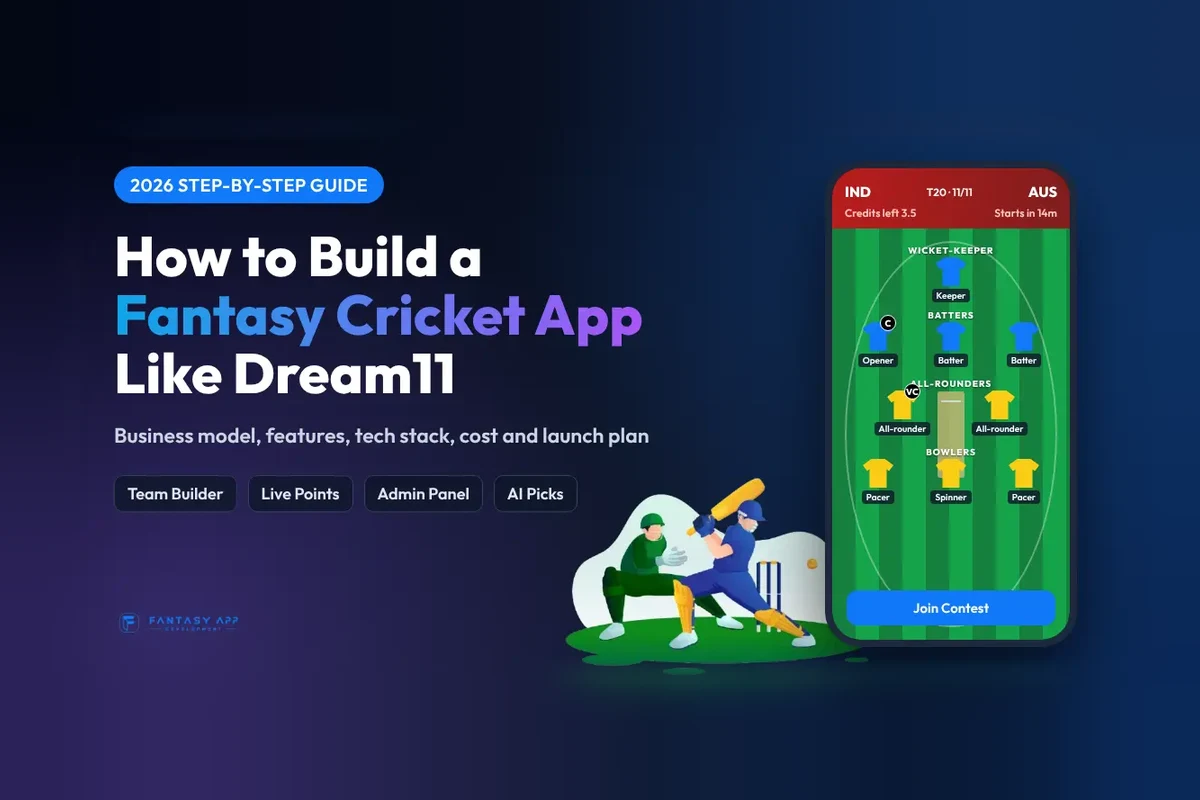
Cricket is the most played fantasy sport in the world, and almost every founder who enters this space asks the same question: how to build a fantasy cricket app like Dream11 that people actually open every match day? The short answer is that you need a clear business model, a reliable live-score data feed, a fast team-builder, a points engine that updates in seconds, and an admin panel that lets you run contests without calling a developer. This guide walks you through each step, from planning and features to tech stack, timeline, cost and the new legal reality in India.
Whether you are a startup, a sports media brand or a gaming company, use this as a practical checklist before you talk to a fantasy cricket app development team.
Why Build a Fantasy Cricket App in 2026?
Cricket has a huge, loyal fan base across India, Pakistan, Bangladesh, Sri Lanka, Australia, the UK, South Africa and the growing US market. Every year brings the IPL, international bilateral series, ICC events and dozens of T20 leagues, so there is a match to play almost every day of the year. That steady calendar is what makes fantasy cricket so sticky: users come back daily, not once a week.
The market has also changed. In August 2025, India passed the Promotion and Regulation of Online Gaming Act, which bans real-money online games. Big players such as Dream11 stopped paid contests and moved to a free-to-play model funded by advertising and brand sponsorships. That shift opened room for new apps built around engagement, community and sponsor rewards rather than entry fees. We cover what this means for your product in the legal section below.
Step 1: Pick Your Market and Business Model
Before you write a single line of code, decide where you will launch and how you will earn. These two choices shape your features, payment setup and compliance work.
Free-to-play with ads and sponsorships
Users join contests for free and win points, badges or sponsor-backed rewards. You earn from in-app advertising, branded contests and sponsorship deals. This is now the main model for the Indian market.
Subscription or premium tools
Offer a paid tier with expert picks, AI team suggestions, advanced player stats or an ad-free experience. This works well for serious fans in any country.
Paid contests (only where legal)
Some markets outside India still allow paid fantasy contests under specific licences and rules. If you target those markets, you will need KYC, geo-fencing, a wallet and legal approval for each region.
Private leagues and B2B white-label
Office leagues, fan clubs, media publishers and team owners often want their own branded fantasy platform. Selling or licensing your platform to them is a strong second revenue line.
Step 2: Study Apps Like Dream11 and Find Your Edge
Copying Dream11 screen by screen will not win users. Instead, study what the leaders do well and find the gap you can own. Look at onboarding speed, how fast a user can create a team, how points are explained and how leagues are shared. Our list of top apps like Dream11 is a good place to start your research, and our guide on building an app like Howzat shows how a smaller brand carved out its own space.
Common ways to stand out include a regional language interface, a focus on one league (for example only domestic T20 cricket), new formats like single-over or powerplay contests, or stronger social features such as chat and friend leagues.
Step 3: Plan the Must-Have Features
A fantasy cricket app has three parts: the user app, the admin panel and the backend engine. Here are the features every version should have.
User app features
- Quick sign-up: mobile OTP, Google or Apple login, with an age check.
- Match lobby: upcoming, live and completed matches with deadlines clearly shown.
- Team builder: pick 11 players within a credit budget, with role limits for batters, bowlers, all-rounders and wicket-keepers.
- Captain and vice-captain: 2x and 1.5x points multipliers, the core of fantasy cricket strategy.
- Contests and leagues: public contests, private leagues with invite codes and head-to-head games.
- Live scoring: ball-by-ball fantasy points and a live leaderboard.
- Player stats: recent form, selection percentage and venue records.
- Push notifications: lineup announcements, deadline reminders and results.
- Rewards and referrals: badges, streaks, sponsor rewards and invite bonuses.
Admin panel features
- Create and manage matches, contests and prize or reward pools.
- Set the points system and player credits for each format (T20, ODI, Test, T10).
- User management, reports and fraud flags.
- Ad slots, sponsor banners and branded contest setup.
- Push notification and content management.
Advanced features that boost retention
- AI team suggestions based on form, pitch and match-ups. See how AI agents improve fantasy app engagement.
- In-match chat and social sharing of teams.
- Multiple contest formats such as second-innings and single-player contests.
- Gamification: levels, seasonal leaderboards and achievements.
Step 4: Choose a Reliable Cricket Data Feed
Your app is only as good as its data. Fantasy points must update within seconds of every ball, and lineups must appear as soon as the toss happens. Choose a sports data provider that offers ball-by-ball scoring, squads, playing XIs, player profiles and historical stats for every league you plan to cover. Check their uptime record, response speed during big matches and how they handle rain delays, super overs and abandoned games. Always build a fallback so the app does not break if the feed slows down.
Step 5: Pick the Right Tech Stack
A fantasy cricket app sees huge traffic spikes right before the toss, so the stack must scale fast. A proven setup looks like this:
- Mobile apps: Flutter or React Native for one codebase across Android and iOS, or Kotlin and Swift for fully native apps.
- Web app: React or Next.js.
- Backend: Node.js, Go or Java, with WebSockets for live updates.
- Database: PostgreSQL or MongoDB for core data, Redis for live leaderboards and caching.
- Cloud: AWS or Google Cloud with auto-scaling, load balancers and a CDN.
- Notifications and analytics: Firebase Cloud Messaging, plus an analytics tool to track retention.
Step 6: Design a Simple, Fast User Experience
Most users build their team in the last 15 minutes before a match starts. Every extra tap costs you a team. Keep the team builder on one screen, show credits left at all times, and let users copy or edit a previous team in one tap. Use clear colours for player roles, show points rules in plain language, and test the full flow on low-end Android phones and slow networks.
Step 7: Develop, Test and Launch
Build in stages. Start with an MVP that covers sign-up, the match lobby, team builder, one contest type, live points and a basic admin panel. Then add private leagues, AI features and sponsor tools.
Testing is critical for fantasy apps. Run load tests that copy toss-time traffic, check the points engine against real scorecards, and test edge cases such as player substitutions, DLS results and abandoned matches. Plan your launch around a major tournament like the IPL or a T20 World Cup to get the biggest wave of new users.
Legal and Compliance Basics
Rules for fantasy sports differ by country, and they have changed fast. Keep these points in mind:
- India: the 2025 Online Gaming Act bans real-money online games, including paid fantasy contests. Build a free-to-play product earning from ads, sponsorships or subscriptions.
- Other markets: the US, UK, Australia and others each have their own licensing and age rules, often different at the state or province level.
- Data and privacy: follow local data protection laws, publish a clear privacy policy and keep user data secure.
- Responsible play: add age checks, clear terms and tools that help users manage their time on the app.
Laws can change quickly, so always confirm your plan with a lawyer who knows gaming law in your target market before launch.
How Long and How Much Does It Take?
Timeline and budget depend on features, platforms and how many leagues you cover. As a rough guide, a basic MVP takes about 2 to 4 months, a mid-level app 4 to 6 months, and an advanced platform with AI features 6 to 10 months or more. For a detailed breakdown by feature and stage, read our guide on how much it costs to develop a fantasy cricket app.
You can also save time with a ready-made, customisable fantasy platform instead of building every module from scratch, then add your own branding and unique features on top.
Choosing the Right Development Partner
Look for a team that has already shipped fantasy apps, understands cricket scoring rules in depth and can handle match-day traffic. Ask to see live apps in their portfolio, check how they manage data feeds, and confirm they offer support after launch, since every new season brings rule changes and new leagues.
Conclusion
Building a fantasy cricket app like Dream11 is less about copying features and more about getting the basics right: a clear business model that fits today's laws, a fast team builder, accurate live points and a platform that stays up when the whole country is picking captains at once. Start with a focused MVP, launch around a big tournament, and keep improving with user feedback and smart features like AI team suggestions.
Ready to start? Talk to our fantasy cricket experts for a free consultation and project estimate.