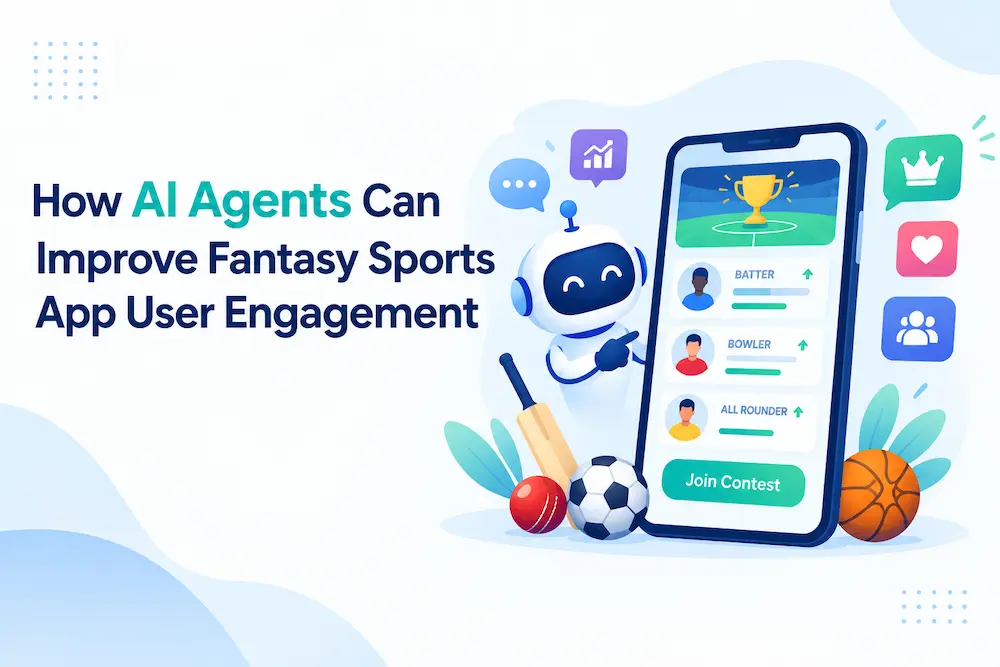
Fantasy sports apps give users a way to create virtual teams, follow real matches, compare player performances, and compete with other sports fans. However, keeping users active after their first few sessions can be difficult. Users may stop opening the app if they receive irrelevant notifications, struggle to understand player statistics, or find the experience repetitive.
AI agents can help solve these problems by making fantasy sports apps more responsive, personalized, and useful. Instead of relying only on fixed rules, an AI agent can interpret information, respond to user requests, recommend relevant actions, and complete specific tasks within defined limits.
For example, an AI agent could help a user compare two players, summarize recent match statistics, explain a team's performance, or remind the user about an upcoming lineup deadline. These features can make the app easier to use and give users more reasons to return.
For businesses planning a new platform, fantasy sports app development now offers opportunities to combine standard fantasy features with AI-driven assistance. The key is to use AI where it improves the user experience rather than adding technology without a clear purpose.
In this article, we explain how AI agents can improve fantasy sports app user engagement, which features businesses should consider, how to implement them, and what to look for when hiring a fantasy app development company.
What Are AI Agents in Fantasy Sports Apps?
An AI agent is a software system that can understand a goal, process relevant information, and take permitted actions to complete a task. Depending on its design, it may use a large language model, APIs, databases, business rules, and other software tools.
Unlike a basic chatbot that only responds to messages, an AI agent can follow a workflow. For example, when a user asks for a comparison between two football players, the agent could retrieve their available statistics, compare recent performances, summarize the results, and present the information in a simple format.
In a fantasy sports app, AI agents can support tasks such as:
- Answering questions about app features and contest rules
- Summarizing player statistics and match information
- Helping users compare available players
- Providing personalized content recommendations
- Sending relevant reminders based on user preferences
- Helping users navigate app features
- Supporting customer service teams with routine queries
Businesses should distinguish AI agents from traditional automation. A fixed notification system follows predefined rules, while an AI agent can interpret a user's request and select an appropriate action within its permissions.
However, an AI agent should not operate without limits. Developers must define what information it can access, which actions it can take, and when it should refer a request to a human or a reliable source.
Also Read: - Top AI-Powered Fantasy Football App Development Companies
Why User Engagement Matters in Fantasy Sports App Development
User engagement affects how often people use an app, how much value they receive from it, and whether they continue using it over time. A high number of downloads does not automatically mean a platform has an active user base.
Fantasy sports apps face several engagement challenges. Some users need help understanding player statistics. Others may miss important match updates or struggle to find contests that match their interests. New users may leave if the app feels complicated, while experienced users may lose interest if the experience never changes.
AI agents can address these issues by helping users get more value from the app.
For example, a new user could ask an AI assistant how team selection works. A regular user could request a summary of a player's recent performance. Another user might prefer updates about a specific team or competition. The app can respond differently to each request instead of giving every user the same information.
The goal is not to keep people inside the app for as long as possible. The goal is to make every session useful, relevant, and easy to navigate.
Businesses investing in fantasy sports app development should therefore define engagement goals before introducing AI. Useful measurements include repeat visits, feature adoption, notification opt-outs, customer support resolution time, and user retention over specific periods.
Seven Ways AI Agents Can Improve User Engagement
Personalized Player Insights
Player statistics can help fantasy sports users make informed decisions, but large amounts of data can overwhelm them. An AI agent can summarize relevant information and present it in simple language.
For example, a cricket user might ask for a summary of a batter's recent scores, while a football user might want to compare a forward's goal contributions with another player's recent form. The agent can retrieve relevant statistics from approved data sources and explain the differences.
A useful player insight feature can include:
- Recent performance summaries
- Historical statistics and trends
- Comparisons between players
- Relevant match information
- Explanations of key performance indicators
The agent should use current, verified data whenever possible. It should also state the period covered by the analysis and avoid inventing statistics when information is missing.
Personalized insights can make the app more useful to beginners and experienced users alike. Instead of forcing everyone to interpret complex data independently, the app gives users an easier way to understand it.
Real-Time Match Assistance
Live sports events create natural opportunities for users to return to a fantasy app. However, users may not always have time to follow every score update or review every player statistic.
An AI agent can summarize important match developments using a trusted sports data feed. It might explain how a player's performance has changed, summarize key events, or answer questions about a match that is currently underway.
For example, a user could ask, "What has changed in this match so far?" The agent could summarize the available score, major events, and relevant player statistics.
Real-time assistance depends on data availability and update speed. Developers must ensure that the agent retrieves current information instead of relying on outdated knowledge from its language model.
The app should also identify delayed or unavailable data rather than presenting incomplete information as live updates. Accurate information is more important than a fast but unreliable answer.
Personalized Notifications and Reminders
Generic push notifications can become annoying when they arrive too frequently or contain information that does not interest the user. Over time, users may disable notifications or stop responding to them.
AI agents can help make notifications more relevant by considering user preferences, selected teams, favorite sports, app activity, and upcoming events. The system might remind a user about a lineup deadline or share a relevant match summary when the user has requested that type of update.
For example, someone who follows football may prefer updates about a selected league rather than notifications about unrelated cricket contests.
A responsible notification strategy should include:
- User-selected sports and teams
- Relevant match and contest reminders
- Frequency controls
- Quiet hours and notification preferences
- Easy options to disable specific notification types
AI should not send messages simply because it predicts that a notification might generate another app session. Businesses should prioritize usefulness, user consent, and control over notification frequency.
AI-Powered Onboarding for New Users
A complicated onboarding process can prevent new users from reaching the features they want. AI agents can make the first experience easier by answering questions and guiding users through important steps.
For example, an agent could explain how fantasy points work, where users can find player statistics, or how to create a team. It could also direct users to the correct screen when they ask for help.
A conversational onboarding assistant can adjust its explanations based on the user's questions. A beginner may need a basic introduction, while an experienced user may only need help with a particular feature.
The development team can build the agent around verified product documentation, approved FAQs, and the app's navigation structure. This reduces the risk of incorrect explanations.
The agent should not pressure users to enter contests or make payments. Its role is to explain the product, help users understand the available features, and let them decide how they want to proceed.
Smarter Contest and Content Recommendations
Users have different interests and preferences. Some enjoy head-to-head contests, while others prefer larger leagues or season-long competitions. Some users want detailed statistics, while others prefer short match summaries.
AI agents can help users find relevant content and app features based on their stated preferences and permitted activity data.
A recommendation system might suggest:
- Matches related to selected teams
- Statistics about favorite players
- Educational content for new users
- Relevant contests that meet user-selected criteria
- Features the user has not tried yet
The app should explain recommendations clearly and give users control over personalization.
For paid contests or prize-based products, the system must follow applicable laws, platform policies, age restrictions, and responsible gaming requirements. Recommendations should not pressure users to spend more money or imply that any contest guarantees a reward.
Conversational Customer Support
Customer support teams often receive repeated questions about account settings, scoring rules, notifications, registration, and app navigation. An AI agent can answer common questions using approved support information.
For example, a user might ask why a score has not updated or how to change a notification preference. The agent can check permitted information, explain the relevant process, or guide the user to the correct support channel.
A good support agent should know when it cannot resolve an issue. Account disputes, payment problems, suspected fraud, and complex scoring complaints may require a human support representative.
Businesses can measure the value of AI customer support by tracking response time, resolution rates, repeat queries, user satisfaction, and the number of cases transferred to human agents.
This approach can improve the support experience while allowing human teams to focus on issues that need judgment or investigation.
Interactive Sports Education
Not every fantasy sports user understands player statistics, scoring rules, or team selection. New users may find the platform easier to use when the app explains these concepts at the right time.
An AI agent can provide short explanations based on the user's questions. It could explain how a particular scoring rule works, what a statistic represents, or how to navigate a lineup screen.
The app might also offer interactive tutorials that let users ask questions while learning. This gives users a way to understand the platform without searching through lengthy help pages.
Sports education can support engagement by reducing confusion and helping users become more confident with the app. Developers should base explanations on the platform's actual rules and current competition settings.
Must Read: - How to Develop a Fantasy Sports App Like AFL Fantasy?
How AI Agents Work With Other App Technologies
An AI agent needs more than a language model to deliver reliable results. It must connect to the right information sources and follow the application's business rules.
A typical architecture may include the following components:
AI model: Interprets user requests and generates responses or selects suitable actions.
Sports data APIs: Provide match schedules, player statistics, scores, and other licensed data.
Application backend: Manages accounts, teams, contests, permissions, and core business logic.
User preference system: Stores permitted preferences, such as favorite teams, selected sports, and notification settings.
Tool and workflow layer: Allows the agent to call approved functions, such as retrieving player statistics or opening a help article.
Monitoring and evaluation: Tracks accuracy, response quality, errors, cost, and system performance.
For example, when a user asks for a player comparison, the agent can identify the request, retrieve statistics from an approved API, apply the relevant comparison logic, and summarize the results. The backend remains responsible for the official scoring rules and contest records.
This separation matters. AI can explain information and help users navigate the app, but the platform's core systems should determine official scores, eligibility, deadlines, and financial transactions.
How to Build AI Agents for a Fantasy Sports App
Businesses should start with a clear use case rather than attempting to build a complex autonomous agent immediately.
Step 1: Identify the engagement problem
Decide what you want to improve. You might want to help new users understand the app, reduce repetitive support requests, improve the relevance of notifications, or make player statistics easier to understand.
Define a measurable goal for each use case.
Step 2: Choose the right data sources
Identify the information the agent needs. This may include licensed sports data, app documentation, user-selected preferences, and support articles.
Confirm data access rights, update frequency, quality, and privacy requirements before implementation.
Step 3: Define the agent's permissions
Specify what the agent can read and what actions it can perform. An assistant that summarizes statistics needs different permissions from one that changes account settings.
Require user confirmation for sensitive actions, and keep payments, official scores, contest outcomes, and other critical operations under controlled application logic.
Step 4: Develop and test a focused feature
Start with one practical use case, such as a player statistics assistant or an onboarding chatbot. Test the feature with realistic questions, missing data, unexpected requests, and high traffic.
Step 5: Measure results and improve
Review engagement metrics, user feedback, accuracy, and operating costs. Improve the feature based on actual results before expanding to additional workflows.
A staged approach helps businesses control complexity and avoid spending heavily on AI features that users may not need.
Also Read: - Top 10 Fantasy App Development Companies in India for 2026
How Much Does AI Agent Integration Cost?
The cost of adding AI agents to a fantasy sports app depends on the agent's complexity, the data it needs, the number of supported workflows, and the expected usage.
A simple FAQ assistant may require less development than an agent that retrieves live sports statistics, compares multiple data sources, personalizes content, and coordinates several backend actions.
Common cost factors include:
- AI model usage and hosting
- Sports data API licensing
- Backend development and integrations
- User interface and conversational design
- Data security and privacy controls
- Testing, monitoring, and ongoing maintenance
Businesses should also consider recurring costs. Each AI request may consume model resources, while live sports feeds, cloud infrastructure, and monitoring tools may require separate subscriptions.
Ask your development partner to estimate both initial implementation costs and ongoing operating expenses. The proposal should explain which features are included, how usage affects pricing, and how the team will monitor performance.
How to Choose the Right Fantasy App Development Company
Choosing the right development partner can affect the reliability, security, and long-term cost of an AI-powered fantasy sports platform.
Look for a team with experience in mobile applications, backend development, API integration, data handling, and AI implementation. Fantasy-specific experience is valuable because contest rules, scoring logic, and live sports data create requirements that general applications may not have.
Before hiring a fantasy app creation company, ask these questions:
- Has the team built fantasy sports or comparable real-time applications?
- Can it integrate licensed sports data APIs?
- How will it test AI responses and prevent fabricated statistics?
- What data will the AI agent access?
- How will the system protect user information?
- What happens when an API or AI service becomes unavailable?
- How will the team measure engagement improvements?
- What support will it provide after launch?
Fantasy App Development is one provider you can consider when researching fantasy sports application development. If you want to add AI agents to your product, discuss the specific features you need, the available data sources, and the safeguards required for reliable operation. Compare its proposal with other providers before making a final decision.
A suitable development partner should explain the technical approach in clear language, provide a realistic timeline, and distinguish confirmed capabilities from features that require further development.
How to Measure the Impact of AI Agents on User Engagement
Businesses should measure AI performance instead of assuming that adding an assistant will automatically improve engagement.
Useful metrics include:
Retention rate: Measures how many users return after a defined period.
Feature adoption: Tracks how many users try the AI assistant and which features they use.
Task completion rate: Measures whether the agent successfully helps users complete their intended task.
Response accuracy: Checks whether the agent provides correct answers based on approved sources.
Support resolution rate: Tracks how many common support requests the agent resolves without unnecessary transfers.
Notification opt-out rate: Helps identify whether messages are becoming irrelevant or excessive.
User satisfaction: Collects feedback on the usefulness and reliability of AI features.
Compare results against a baseline before launch. Where possible, run controlled tests to understand whether the AI feature caused an improvement. Avoid relying on a single metric, because more interactions do not always mean a better user experience.
Also Read: - How to Build a Scalable Fantasy Sports Platform Like DraftKings
Challenges and Best Practices for AI Agent Development
AI agents can improve the user experience, but they also introduce risks that businesses must manage.
Incorrect answers: An agent may generate inaccurate information if it relies on outdated or incomplete data. Use trusted sources, validate important outputs, and clearly state when information is unavailable.
Privacy concerns: Personalization may involve user activity or preferences. Collect only necessary information, obtain appropriate consent, and provide clear privacy controls.
High operating costs: Frequent model calls and live data integrations can increase expenses. Use caching where appropriate, choose models based on the task, and monitor usage.
Unwanted automation: An agent may misunderstand a request or take an action the user did not intend. Limit its permissions and require confirmation for sensitive operations.
Poor user experience: Not every user wants a conversational interface. Keep standard navigation and manual controls available so users can choose how to interact with the app.
Overreliance on AI: AI should not replace deterministic systems for official scoring, contest eligibility, or financial transactions. Keep these functions within tested business logic and established controls.
A responsible implementation combines AI assistance with reliable software engineering, clear permissions, human oversight, and ongoing testing.
Conclusion
AI agents can make fantasy sports apps more useful by helping users understand player statistics, receive relevant updates, learn app features, find useful content, and resolve common support questions. These capabilities can improve the experience when they address real user needs.
Successful fantasy sports app development starts with a clear purpose. Businesses should choose focused use cases, connect agents to trusted data, protect user information, and measure results before expanding the system.
The right fantasy app development company should understand both the AI components and the underlying fantasy platform. With a practical implementation plan, AI agents can support better user experiences, reduce friction, and help a fantasy sports app build lasting engagement.