
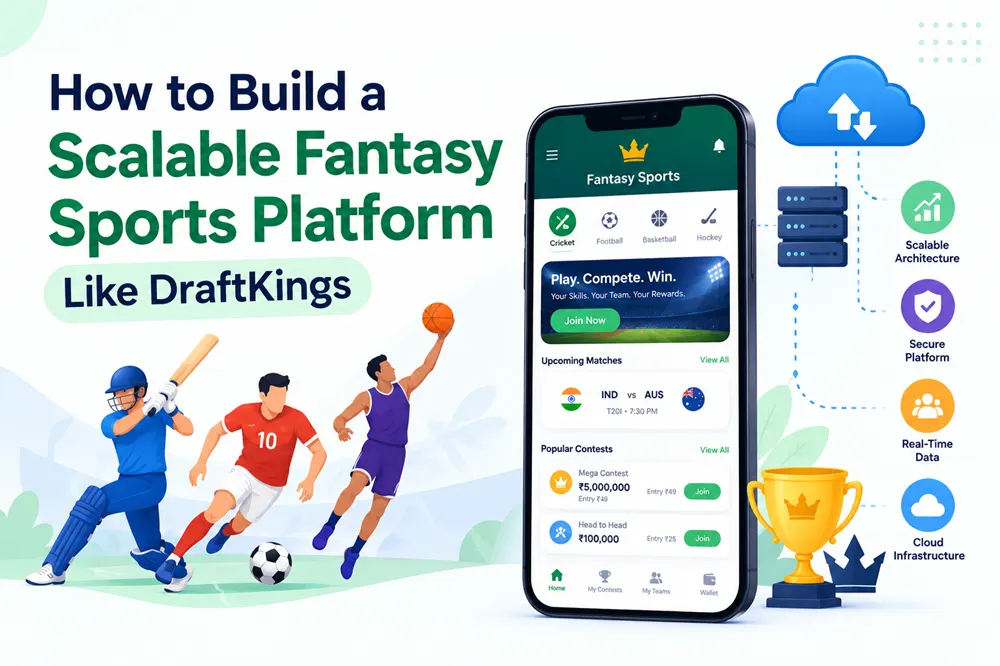
Fantasy sports have become a big part of the online sports industry. Fans can make virtual teams, choose real players, follow live games, compare stats, and compete with others in different fantasy formats. Mobile technology has made this experience quicker, and real-time sports data and Artificial Intelligence have added more ways to customize the platform.
DraftKings is a strong example of how a sports technology platform can blend fantasy sports with other digital sports services. In its 2025 annual report, DraftKings mentioned it works in sports betting, online gaming, Daily Fantasy Sports, digital lottery services, prediction markets, and other products. The company reported $6.05 billion in revenue for 2025, up from $4.77 billion in 2024. It also had an average of 4.0 million unique users per month in 2025.
Businesses looking to create a similar platform should not just copy DraftKings' design, branding, content, or technology. Instead, they should understand the key ideas behind a large-scale fantasy sports platform and develop a unique solution for their specific audience and market.
A scalable fantasy platform needs more than just a mobile app. It also requires a strong backend, reliable sports data APIs, real-time scoring, secure login, cloud support, analytics, AI features, and a system that can handle many users.
The platform must also allow for ongoing updates. User habits, sports trends, market changes, and technology evolve over time. Therefore, businesses should create a system that lets them add new features and sports without having to rebuild the whole application.
This guide explains how to develop a fantasy sports app like DraftKings. It covers the key features, scalable technology design, AI capabilities, development process, costs, ways to make money, and tips for choosing the right development partner.
Fantasy Sports Market and Business Opportunity
The fantasy sports industry keeps drawing in businesses because sports often offer chances for users to get involved. Big leagues and tournaments create regular match days, allowing fantasy platforms to keep users coming back throughout the year.
The global fantasy sports market has grown with the rise of smartphones, faster internet, sports streaming, digital payments, and easy access to real-time sports information. Mobile apps are especially important because they let users create teams, check scores, and engage with fantasy platforms directly from their smartphones.
DraftKings shows how big the digital sports entertainment industry can be. In 2025, the company earned $6.05 billion, which was about a 27% increase from 2024. They also reported that their total betting amount was $53.6 billion that year, and revenue from other products, including daily fantasy sports, also grew.
These numbers reflect DraftKings' overall business, not just fantasy sports, so businesses should not use them to estimate fantasy sports revenue directly. However, they do show the large potential in the market when sports technology, user engagement, data, and various digital products work together.
Entrepreneurs don't need to launch a complete platform with all the features of DraftKings right from the start. They can begin by focusing on just one sport, like cricket, football, basketball, or baseball, and then expand over time.
For example, a startup could start with a platform that focuses on cricket and includes features like team creation, live scoring, player statistics, private leagues, and AI insights. Once the platform becomes popular, the developers can add other sports like football, basketball, or kabaddi.
This method simplifies the initial development and allows businesses to learn from real users.
The main point is scalability. The initial design should be able to support future sports, users, data sources, and AI services without needing to rebuild everything.
Also Read: - Top 10 Fantasy App Development Companies in India for 2026
What Makes a DraftKings-Like Platform Scalable?
Scalability means that an application can handle more users, transactions, sports events, and data requests without slowing down.
A small fantasy application might work well with a few thousand users. However, it could have serious issues if many users try to join at the same time during a big sporting event. The system needs to handle player updates, fantasy scores, rankings, notifications, and other requests all at once.
So, it is important to build the backend with scalable infrastructure from the start. Cloud computing allows businesses to add more computing resources when needed and reduce them during slower times.
The database also needs careful planning. Fantasy platforms create a lot of data, such as user profiles, player statistics, match events, team selections, contest participation, rankings, notifications, and historical records.
Caching can help by reducing unnecessary database requests and speeding up response times. Commonly requested information, like match details or player statistics, can be stored closer to users so the application can access it more quickly.
A real-time event-processing system can handle live sports updates effectively. When something happens in a game, the system can quickly process the information to update fantasy points, refresh rankings, and send notifications without requiring users to refresh the app repeatedly.
Load balancing is also important. It spreads incoming traffic across multiple servers to prevent any one server from becoming overwhelmed.
Monitoring should happen all the time. Development teams need to check server performance, how fast APIs respond, database activity, errors, traffic patterns, and application crashes. This information helps them find problems before they affect a lot of users.
A scalable architecture makes future development easier. If you want to add AI, new sports, more languages, or web applications later, the backend should offer flexible APIs and services that let you add these features one at a time.
This is why businesses should partner with skilled fantasy app developers who know about both fantasy sports and large-scale application design.
Essential Features for a Scalable Fantasy Sports Platform
A successful platform should make it easy for users to navigate. Users should be able to register, pick a sport, choose a match, check player information, form a team, join a suitable fantasy format, watch live performance, and see their results.
The first step is secure registration. Depending on the market, the application might offer mobile OTP, email verification, social login, multi-factor authentication, and identity checks.
The match lobby should clearly display upcoming, live, and finished matches. Users should be able to filter matches by sport, league, date, or other important criteria.
The team-building system should have an easy-to-use design. Users should be able to see player statistics, recent performance, availability, selection data, and other important information before choosing players.
The scoring engine is a key part of the system. It turns real sports events into fantasy points based on the platform’s rules.
A cricket platform may calculate points based on runs, wickets, catches, strike rate, economy rate, and other events. A football platform may base points on goals, assists, shots, tackles, clean sheets, and other statistics.
The scoring system needs to be accurate because wrong calculations can impact rankings and user trust.
Leaderboards should update quickly as match events happen. Users want to see their rankings change as players perform during live games.
Private leagues can boost engagement by letting users compete with friends, colleagues, or communities.
Notifications can keep users updated on upcoming matches, team deadlines, player news, contest results, and other important events. AI can customize these notifications based on user behavior.
The administration system allows operators to manage users, sports, matches, contests, content, notifications, analytics, reports, and support requests.
A scalable fantasy app development company should create these modules in a flexible way so businesses can add new sports and features without having to completely rebuild the core application.
Must Read: - FanDuel Like App Development: Complete Guide for Businesses
AI Features for a Modern Fantasy Sports Platform
AI can greatly enhance a fantasy sports app when businesses use it effectively.
One major benefit is an AI-driven player recommendation system. This system can look at past performance, current form, opponent strength, player availability, match conditions, and other important data to provide insights about players.
AI can also tailor the user experience. It can analyze the sports, teams, leagues, and features a user engages with to suggest relevant matches or content.
Generative AI can create conversation helpers. Users can ask about a player's recent performance, scoring rules, or match statistics and receive answers from an AI chatbot.
Predictive analytics can help platform owners understand how users behave. Businesses can spot engagement trends, estimate demand, analyze user retention, and make better marketing choices.
AI can also help find unusual activities. Machine-learning models can detect strange account behavior or patterns that need further review.
If an account suddenly shows activity that is very different from its usual behavior, the system can mark it for investigation. AI does not take the place of traditional security measures, but it can add an extra layer of monitoring.
Notifications powered by AI can also increase user engagement. Instead of sending the same alerts to all users, the platform can focus on notifications that match each person's interests.
For businesses planning to develop fantasy apps like DraftKings, AI should be seen as an important part of the product strategy, not just a buzzword.
Technology Stack for DraftKings Clone App Development
A scalable fantasy sports platform requires technology that can support thousands or millions of users without slowing down during live matches. The right technology also simplifies adding new sports, features, payment options, analytics tools, and AI capabilities as the platform expands.
For developing a DraftKings clone app, the backend should use a scalable architecture instead of a simple server setup. Technologies like Node.js, Java, or Python can handle high volumes of API requests and real-time operations. The frontend can utilize React, Angular, Flutter, or React Native, depending on whether the business wants web, Android, iOS, or cross-platform apps.
The database layer needs careful planning too. Technologies like PostgreSQL, MySQL, MongoDB, and Redis can support different parts of the platform. A relational database can manage users, contests, transactions, and account records, while Redis can handle frequently accessed information like live scores, contest status, leaderboards, and temporary session data.
Cloud infrastructure is important for scalability. AWS, Microsoft Azure, Google Cloud, or other trusted cloud providers can help with auto-scaling, load balancing, backups, monitoring, and distributed services. Instead of putting all services on one server, developers can separate important systems into different services.
The live sports data layer is very important. Fantasy platforms need quick and accurate information about player performances, scores, injuries, match events, and game status. A reliable sports data provider can supply this information to the platform, while a real-time processing layer updates fantasy scores and rankings.
Security should be part of the entire technology stack. The platform must protect user accounts, payment information, personal data, API endpoints, and internal systems. This means using encryption, secure authentication, role-based access, API security, fraud monitoring, audit logs, and regular security testing from the start.
A good fantasy app development company designs the infrastructure based on expected user volume instead of just choosing popular technologies. A platform expecting 10,000 users has very different needs than one preparing for millions of users at the same time.
Also Read: - How to Develop a Fantasy Cricket App Like Fantasy Akhada
Development Process for a Scalable Fantasy Sports Platform
Creating a platform like DraftKings is not just about designing mobile screens. The development team must connect various parts, such as the user interface, sports data, contest engine, scoring system, payment system, notifications, analytics, management, and security, into one reliable system.
The first step is business and technical planning. The team decides which sports the platform will cover, who the target users are, what contest formats will be used, how users will navigate the site, how to make money, what legal rules to follow, and how much traffic to expect. This step also decides if the platform will only support fantasy contests or include other sports entertainment options.
The next step is designing the user interface and user experience. Users should be able to register, choose a sport, view contests, create teams, check player stats, and follow live results easily. A simple design is especially important during live matches, as users may need to make quick decisions.
Afterward, developers create the main application and backend. The team develops features like user authentication, user profiles, sports information, contest management, team creation, scoring, leaderboards, payment options where allowed, notifications, and administrative tools. The system should be modular so that developers can add more sports later without needing to rebuild everything.
The scoring system needs thorough testing. Every action a player takes must accurately reflect their fantasy points based on the platform's rules. The system must quickly handle events and provide consistent results, even when many users are receiving updates at the same time.
Next is live match testing. Developers create situations with heavy demand, quick score changes, multiple contests at once, API and server failures, and sudden spikes in user activity. This load testing helps find issues before the platform is officially launched.
After that, AI and analytics can be added to the main platform. Machine learning can look at past player data, user habits, contest participation, and other factors to improve recommendations and make the experience more personalized. AI should enhance the product rather than function as a separate, less useful feature.
Finally, the team launches the platform with a careful production release. Monitoring tools check server performance, API response times, database health, error rates, user activity, and any unusual behavior. Ongoing updates keep the platform stable as more traffic comes in.
This plan gives fantasy app developers a straightforward path from the initial idea to a working platform while lowering the risk of costly changes later.
Cost of DraftKings Clone App Development
The cost of building a scalable fantasy sports platform like DraftKings varies a lot depending on its size. A simple fantasy sports app can be much cheaper than a big platform that includes many sports, real-time data, advanced analytics, AI, payment systems, private leagues, large infrastructure, and complicated management.
For a custom platform, development costs can broadly fall into three levels:
|
Platform Type |
Estimated Development Cost |
|
Basic fantasy sports app |
$10,000–$25,000 |
|
Mid-level multi-sport platform |
$25,000–$50,000 |
|
Advanced scalable platform |
$50,000–$100,000+ |
These numbers are general estimates, not a fixed price. The final cost will depend on factors like the number of platforms, types of sports, integration needs, design complexity, backend setup, AI features, data sources, security needs, and where the development takes place.
For example, creating an Android and iOS app with a shared backend may take less effort than making two separate apps. Including more sports makes the scoring systems and data integration more complex. Using AI for recommendations and analytics also requires more effort in data handling and model creation.
Real-time infrastructure can raise both development and ongoing costs. A fantasy platform needs servers, databases, sports data APIs, cloud resources, monitoring systems, security tools, and maintenance, and these costs continue after the app is launched.
Payment integration can impact the budget. In places where real-money fantasy contests are allowed, the platform needs to have payment gateways, monitor transactions, verify users, manage withdrawals, control fraud, and keep detailed financial records. Businesses must create these systems based on the laws of each market they target.
It is very important for businesses not to choose a development partner just because they offer the lowest price. A cheap initial build can lead to high costs later if the platform has issues like traffic problems, scoring errors, security gaps, or database limits.
A good company that creates fantasy sports apps should offer a flexible design, clear development steps, a testing plan, support after launch, and a clear breakdown of infrastructure costs.
Monetization Models for Fantasy Sports Platforms
A scalable fantasy sports platform needs a solid way to make money from the start. The right approach depends on the target audience, local laws, user habits, and the kind of fantasy experience the business plans to offer.
One common way to earn revenue is through contest entry fees, where users pay to enter contests in areas where this is allowed by law. The platform can make money by charging a service or platform fee. However, businesses must check if this is legal in each area before moving forward.
Another way to generate income is through advertising. A platform with many active users can show ads related to sports, sponsor contests, and feature brands. AI can help make these ads more relevant by looking at user interests and behavior while keeping privacy in mind.
Premium subscriptions can provide steady income. Businesses can offer advanced stats, player analysis, better research tools, personalized recommendations, or extra contest features for a monthly or yearly fee.
Sponsored contests can link the platform with sports brands and partners. A sponsor can support a specific contest or event, allowing the platform to earn sponsorship money while giving users more ways to engage.
Partnerships and affiliate models can help generate revenue. Businesses like sports content providers, merchandise companies, streaming services, and ticketing platforms can form partnerships based on their target audience.
For companies looking to develop fantasy apps like DraftKings, offering a range of services can provide more long-term stability than relying on just one source of income. The platform can include free features, premium options, advertising, sponsorships, and legally allowed paid contests, depending on its marketing strategy.
The way to make money should also affect how the product is designed. If subscriptions are the main source of income, the app should offer enough valuable features to encourage people to pay regularly. If advertising is the main source of revenue, the platform needs to engage users without making their experience frustrating.
So, creating a business model that can grow should start before development begins. The product, technology, marketing, and money-making strategies should work together from the very beginning.
Must Read: - How to Develop a Fantasy Sports App Like Vision11
How to Choose the Right Fantasy Sports App Creation Company
Choosing the right development partner is very important for the success of a fantasy sports platform. A company might show a strong portfolio, but that does not guarantee it can create a high-traffic fantasy platform. Businesses should look at the team’s technical skills, knowledge of sports apps, development process, security measures, and support after the platform is launched.
Start by checking the company’s experience with fantasy sports products. Developers who are experienced in fantasy apps know that creating a fantasy platform involves more than just good-looking mobile screens. They must handle live sports data, scoring, contest rules, real-time rankings, user accounts, notifications, analytics, and a strong backend system.
The development partner should also understand how to create a scalable architecture. Ask how the team will manage traffic spikes during big sporting events. Their answer should include details about cloud infrastructure, caching, database optimization, load balancing, real-time processing, monitoring, and disaster recovery.
AI capabilities are becoming more important. A skilled team should know how to use machine learning, predictive analytics, recommendation systems, conversational AI, personalization, and automated fraud detection to genuinely improve the product.
Security must also be a priority. The company should follow secure development practices and protect user accounts, financial information, APIs, databases, and administrative systems. If the platform operates in regulated markets, the development team should be ready to implement required compliance and verification processes.
Post-launch support is another key factor. A fantasy sports platform needs ongoing maintenance because sports data, operating systems, cloud infrastructure, security needs, and user expectations are always changing. The development partner should offer technical support, improve performance, fix bugs, provide upgrades, and add new features after launch.
Before finalizing an agreement, businesses should clarify who owns the source code, third-party licenses, APIs, hosting accounts, databases, design assets, and intellectual property. Clear documentation can help avoid issues as the platform grows or the company changes development partners.
Why Choose Fantasy App Development for Your Project?
Businesses looking to create a scalable fantasy sports product can consider Fantasy App Development as a partner for building detailed sports applications. The company offers services in fantasy sports development, custom app creation, real-time sports functions, AI integration, and scalable backend solutions.
A good development partner should focus on creating a product that fits the client's business model rather than just copying another platform. A DraftKings-like app can draw inspiration from existing fantasy platforms while establishing its own branding, user experience, contest structure, features, and money-making strategy.
The team should also assist businesses in determining which features to include in the first release and which can be added later. Trying to launch all possible features at once can lead to higher development costs and longer times. A smarter strategy is to create a solid core product first and then add advanced features based on user feedback and business results.
Using AI in development can add extra value. Fantasy App Development can be seen as one of the best mobile app development companies that use AI for businesses looking to blend fantasy sports features with smart technologies. AI can make the user experience more personal, analyze player data, automate support, detect unusual activity, and offer recommendations based on data.
However, AI should not just be a marketing term without real benefits. Every AI feature should address a specific problem in the product. For example, a recommendation engine can help users compare players, while conversational AI can respond to questions about platform features and fantasy rules. Predictive analytics can look at past data to provide insights, and fraud detection models can catch suspicious account activity for further checks.
This strategy enables businesses to build a modern fantasy sports platform without making it too complicated.
Future of Scalable Fantasy Sports Platforms
The next generation of fantasy sports platforms will focus on personalization, quick engagement, smart recommendations, and a wider variety of sports experiences. Users want apps to respond quickly and give helpful information without needing to search through several screens.
AI will be crucial in this development. Machine learning can analyze lots of sports and user data to make recommendations and personalize experiences better. Generative AI can help with chat features, creating content automatically, and assisting customers. Predictive analytics can provide relevant statistics and insights based on past and live data.
Real-time personalization will also be more important. Instead of showing all users the same contest recommendations, a platform can use users' behavior, favorite sports, past contest activity, and engagement patterns to organize content that is relevant to each individual.
Fantasy platforms can do more than just host contests. Features like social leagues, private competitions, live statistics, player information, community tools, loyalty programs, and personalized dashboards can boost engagement.
The technology behind these features must be able to grow as well. Businesses should design their applications with future growth in mind. A modular backend allows for adding new sports, APIs, AI services, payment systems, analytics tools, and other functions without having to rebuild the whole platform.
When businesses enter the market now, they should plan for scalability from the start, not just fix it later after becoming successful.
Conclusion
Creating a fantasy sports platform like DraftKings requires careful planning in areas such as technology, product design, sports data, AI, security, infrastructure, ways to make money, and meeting legal requirements. The goal is not to copy an existing platform exactly, but to study successful fantasy sports products and create a platform that truly serves the needs of your target audience.
Developing a DraftKings-style app can range from simple fantasy contests to complex systems that cover multiple sports. The details of the project will affect the development costs, the technology needed, the timeline, and the size of the team.
The most important investment is a strong technical foundation. A good backend, an accurate scoring system, real-time sports data, secure infrastructure, an easy-to-use interface, and a well-made admin panel are all essential for long-term success.
Businesses should also think about AI in practical ways. Features like recommendation engines, predictive analytics, conversational AI, personalization, and fraud detection can enhance the platform when developers focus on real user and business needs.
Choosing the right company for fantasy app development can simplify the process. A skilled team can turn your initial idea into a product that can grow, while also minimizing technical issues.
If you want to develop a fantasy app similar to DraftKings, start by establishing a clear business model, identifying your target market, choosing the right technology structure, and collaborating with experienced app developers who know both sports technology and scalable mobile apps.