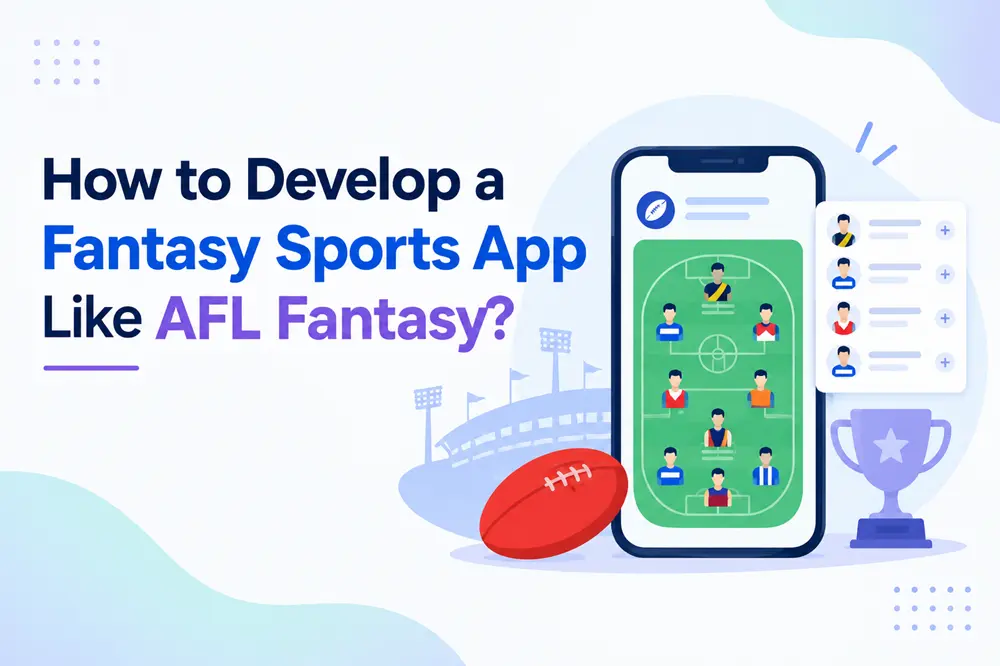
Fantasy sports have become an important way for fans to engage with sports today. Instead of just watching games, fans can create teams, manage players, make trades, compete with friends, follow live scores, and track their performance over a season.
AFL Fantasy is a great example of this trend. It allows fans to manage fantasy teams based on real players' performances in the AFL, join leagues, and use different fantasy formats. The 2026 version includes features like players that can take on three positions, better trade management, player comparisons, helpful statistics, and improved league history.
For businesses, this presents an opportunity to create an AFL-focused fantasy product or a wider sports platform based on similar gameplay. However, fantasy sports app development involves more than just making a mobile app. It requires reliable sports data, a scoring system, real-time updates, league management, secure accounts, analytics, and a robust backend to handle high traffic.
This guide will explain how to develop an app like AFL Fantasy, the essential features you need, how AI can enhance the experience, what technology to use, the expected costs of development, and how to choose the right development partner.
Why Build a Fantasy Sports App Like AFL Fantasy?
The global fantasy sports market is growing as fans want more engaging ways to enjoy sports. Grand View Research estimates that the market was worth $27.8 billion in 2025 and could reach $75.1 billion by 2033, growing at an average rate of 13.3% each year from 2026 to 2033. App-based platforms made up 78.1% of the market in 2025, and smartphones accounted for 50.6%.
These figures show how important mobile fantasy experiences are. Fans already use smartphones to follow games, and fantasy apps provide another way for them to get involved.
AFL Fantasy is a good example because it combines managing a team with competing against others. In the Classic game mode, users create teams within a budget, manage trades, select captains and emergency players, and join leagues. In 2026, the budget is $18.3 million, and each team has 30 players.
The draft offers a different experience. Instead of many users picking the same player, coaches take turns choosing players, which results in unique teams in their league. AFL Fantasy Draft currently supports Redraft, Keeper, and Dynasty formats.
This opens up many options for businesses to develop new products. A new fantasy sports app can focus on salary-cap fantasy, draft leagues, dynasty formats, head-to-head competitions, or a mix of these experiences.
The important thing is to create an original product rather than copying AFL Fantasy's brand, content, or unique features. Businesses can use similar gameplay ideas while developing their own brand identity, rules, interface, scoring system, and user experience.
Core Features of an AFL Fantasy Similar App
The first important feature is user registration and profile management. Users should be able to create an account and manage their personal information in one place. They can set preferences, view their fantasy history, and access their leagues easily.
The onboarding experience should be simple. New users should quickly learn how the fantasy game works, how points are calculated, how to create teams, and how to join a league.
The next feature is the fantasy team builder. If the platform uses a salary-cap model, users should be able to select players while staying within their budget. The application should automatically show the remaining salary, team value, player positions, and roster requirements.
A good team builder should stop invalid combinations from happening. If a player is not eligible for a chosen position or if the team goes over the salary cap, the system should clearly explain the issue right away.
A player statistics center is also very important. Users need to see recent performances, season averages, price changes, positions, and other key stats before making roster choices. AFL Fantasy’s current platform offers a statistics center and player comparison tools, allowing users to view up to ten statistics at a time and providing enhanced comparison options for some users.
The platform should help with trading and managing the squad. Users can swap players, change positions, and manage their roster within the game’s rules. AFL Fantasy's 2026 platform includes improved trade editing and supports trades that involve multiple position changes.
A captain and vice-captain system can add more strategy. The platform allows users to choose players whose scores are given special treatment based on the application’s rules.
The live scoring system is very important. As real matches are played, the app must get player statistics and turn them into fantasy points. For example, AFL Fantasy gives different point values for actions like kicks, handballs, marks, tackles, goals, hitouts, and more. Official statistics can also be changed after matches.
A league and leaderboard system helps keep users interested throughout the season. Users can set up private leagues, invite friends, compete against each other, and check their rankings. AFL Fantasy allows for head-to-head leagues and open competitions, while Draft offers a special team ownership experience through the draft process.
Notifications should keep users updated about match schedules, player news, deadlines, trades, injuries, scoring changes, league results, and other key events.
Lastly, the app needs a strong admin dashboard. Administrators should be able to manage players, sports, competitions, scoring rules, leagues, users, notifications, content, data feeds, and reports all from one system.
Also Read: - How to Develop an App Like Underdog Fantasy?
Draft, Keeper and Dynasty Features
Businesses developing AFL Fantasy-like apps have a big chance to attract more users by supporting different league formats instead of just offering one type of fantasy game.
In a Redraft league, players start fresh each season. Users draft new teams and compete for that season's results.
In a Keeper league, players keep a set number of players and change the rest of their team for the next season.
In a Dynasty league, players stay on the team from season to season. Managers can make long-term choices about trades, rookie drafts, reserves, and team development.
AFL Fantasy added Dynasty leagues for the 2026 season. This format lets teams keep their players from one season to the next and includes rookie drafts and reserve spots.
This feature can help a fantasy platform last longer because it gives users reasons to stay active beyond just one season.
Draft trading adds more strategy. The AFL Fantasy's 2026 Draft platform allows trading of current and future picks, trading before the draft, trading live during the draft, mock drafts, and dynasty options.
A new fantasy platform can use these ideas while setting its own rules. Commissioners can manage things like draft order, scoring, team sizes, playoff setups, emergency rules, roster guidelines, and other league choices.
Custom scoring makes the platform more adaptable. AFL Fantasy Draft lets leagues choose different statistics and assign point values, including advanced stats like clearances, spoils, contested possessions, goal assists, and effective disposals.
This gives users more control and makes the platform appealing to both casual players and dedicated fantasy fans.
AI Features for a Modern Fantasy Sports App
AI can improve a fantasy sports app by meeting the real needs of users.
An AI-powered player recommendation tool can look at historical stats, recent performance, opponent information, player availability, and user preferences to offer helpful insights. Instead of making users compare large amounts of data by themselves, the system can organize this information.
Machine learning can provide personalized recommendations. If a user often follows a specific team or player position, the app can highlight relevant players, statistics, news, and contests.
Predictive analytics can analyze past performance data to create statistical forecasts. These forecasts should serve as information and not as guaranteed results.
A conversational AI assistant can help answer questions about scoring rules, league settings, trades, player statistics, account features, and navigating the platform, which can reduce the number of repeated customer support questions.
AI can help create automated content. The system can generate short player summaries, match previews, statistical comparisons, and personalized notifications using approved data.
Another helpful use is in detecting fraud and unusual activities. Machine learning models can spot strange login behavior, multiple accounts, suspicious transactions, or any actions that need attention.
For businesses seeking a partner for AI development, Fantasy App Development is a strong choice for creating fantasy platforms that blend sports technology with machine learning, personalization, predictive analytics, and automation.
The main point is clear: AI should enhance the fantasy experience, not take the place of the main product. Accurate data, reliable scoring, easy team management, and fast performance must be prioritized.
Technology Stack for AFL Fantasy Similar App Development
The technology stack affects how well a fantasy sports platform works when many users use it at the same time. A small application can use a simple setup, but a platform for large leagues, live scoring, real-time statistics, and multiple sports needs a stronger base.
For developing an app similar to AFL Fantasy, the backend can use technologies like Node.js, Python, Java, or similar frameworks. The right choice depends on the skills of the development team, the expected number of users, necessary integrations, and the design of the application.
The frontend can use technologies like React, Angular, Flutter, React Native, Swift, Kotlin, or others that are suitable. Businesses can choose to develop separately for Android and iOS or use a cross-platform framework if it meets the project needs.
The database layer requires careful planning because the platform manages users, players, teams, leagues, trades, scores, statistics, notifications, and historical records. PostgreSQL or MySQL can handle structured data, while MongoDB is suitable for certain flexible data needs. Redis can manage frequently accessed information like live scores, player statistics, leaderboards, and active sessions.
Cloud infrastructure can provide the scalability needed for major AFL matches. Services from AWS, Google Cloud, Microsoft Azure, or another suitable provider can help with load balancing, auto-scaling, backups, monitoring, and running distributed applications.
The platform also needs a reliable sports data provider. The data layer can supply player statistics, match events, fixtures, team information, injuries, scores, and other information needed by the fantasy engine.
The architecture should keep important services separate whenever possible. Services like authentication, player data, scoring, leagues, notifications, analytics, and administration can work as individual modules. This makes it easier to upgrade in the future because developers can change one part without needing to rebuild the whole application.
Security should be a priority throughout the entire architecture. Developers need to protect accounts, APIs, databases, administrative systems, and financial information with methods like encryption, secure authentication, access controls, rate limiting, monitoring, and regular security tests.
A professional fantasy app development company should choose technologies based on the platform's needs instead of just picking popular tools. The architecture should support current users while also allowing space for growth in the future.
Also Read: - Top 10 Fantasy App Development Companies in India for 2026
Real-Time Scoring and Sports Data Architecture
Real-time scoring is essential for modern fantasy sports apps. Users want to see their fantasy scores change as the games happen, so the system must quickly and accurately handle sports events.
The process begins with a sports data API. This service sends details about game events and player performances to the app. The backend receives this information, checks its accuracy, and then sends it to the fantasy scoring engine.
This scoring engine turns real-life events into fantasy points based on the app's rules. For an AFL (Australian Football League) app, it tracks actions like kicks, handballs, marks, tackles, goals, hitouts, clearances, and disposals.
Next, the platform updates player scores, team totals, league rankings, and relevant dashboards. Technologies like WebSockets can send updates to users instantly, so they do not have to refresh the app.
Accuracy is crucial. If a sports provider corrects an event after a game, the fantasy app needs to process this change and update the scores accordingly. AFL Fantasy rules state that official statistics can be changed after matches, which can also affect fantasy scores.
The system must be able to deal with unusual situations like postponed matches, abandoned games, player withdrawals, wrong data, duplicate events, API downtime, and delayed statistics.
Caching can help reduce the load on the database by temporarily keeping frequently requested information. A message queue can assist in handling many events at once without stressing the scoring service.
The platform must also keep a record of any changes to scores. This helps administrators look into disputes and understand why a specific fantasy score has changed.
This structure becomes even more important when the platform adds more sports. Each sport can have its own scoring rules while still using the same basic services for users, contests, notifications, and infrastructure.
Experienced fantasy app developers should view the scoring engine and sports data layer as essential parts of the system, not just simple API connections.
Development Process for a Fantasy Sports App Like AFL Fantasy
A successful project begins with clear product planning. Before coding starts, the business should identify the target audience, supported sports, fantasy formats, scoring rules, league structure, monetization strategy, target markets, and compliance needs.
The next step is UI/UX design. The design should make it easy for users to create teams, select players, make trades, view statistics, handle drafts, and manage leagues. Users should not have to go through many screens to complete basic fantasy tasks.
Once the design is approved, developers will create the main application and backend. The first version should focus on features like registration, user profiles, player databases, team creation, scoring, leagues, trades, notifications, and administration.
After this, developers will integrate sports data. They will connect to the chosen data provider and set up processes to validate and process incoming events.
The scoring engine receives events and calculates fantasy points based on the set rules. Developers should test the engine with real and simulated match scenarios.
Testing should include normal gameplay and special situations. The team needs to check player substitutions, injuries, postponed matches, scoring corrections, draft mistakes, simultaneous trades, large leagues, and high amounts of live data.
Load testing is another important step. Developers should simulate high traffic that may occur during big matches. The goal is to find issues in the database, API, memory, slow queries, and other performance problems before the launch.
Security testing should include checks for authentication, APIs, databases, payment systems when needed, administrator access, and user data.
Once testing is successful, developers can deploy the platform to cloud infrastructure. Monitoring systems should watch the application’s performance, API response times, database health, server capacity, errors, and unusual activities.
After the launch, the team can add new features based on user behavior and feedback. This step-by-step approach helps improve the product without complicating the initial application.
Cost of AFL Fantasy Similar App Development
The cost of developing a fantasy sports app varies based on how big and complex the platform is. An app that supports just one sport and simple fantasy leagues will be cheaper than a multi-sport app that includes features like live scoring, drafts, dynasty leagues, AI, advanced analytics, and a large infrastructure.
A general estimate for development costs can be as follows:
|
Development Level |
Estimated Cost |
|
Basic AFL-style fantasy app |
$25,000–$50,000 |
|
Mid-level fantasy sports platform |
$50,000–$100,000 |
|
Advanced AFL Fantasy-like platform |
$100,000–$250,000+ |
These numbers are general estimates and not exact costs for development. The actual price will depend on how many platforms, sports, features, APIs, design needs, AI functions, security systems, and development team you have.
The number of apps also impacts the budget. A business developing Android, iOS, and web apps will have different needs than a company launching just one mobile platform.
Sports data adds another ongoing cost. Premium APIs can provide accurate player stats and live match updates, but providers may charge based on the number of sports, how many requests are made, coverage, or usage.
More complex fantasy formats can make development harder. Supporting different types like Classic, Draft, Keeper, Dynasty, custom scoring, trading, head-to-head leagues, and commissioner controls requires more backend logic and testing.
AI can also impact the budget. Features like recommendation engines, predictive analytics, conversational AI, and fraud detection need data management, model integration, testing, and maintenance.
Cloud services have ongoing costs after launch. The long-term budget should include expenses for hosting, databases, storage, monitoring, CDN services, sports APIs, security, and technical support.
As a result, businesses should consider more than just the initial development costs. Scalable architecture may require a higher upfront investment but can save money by avoiding costly redevelopment as the user base increases.
Must Read: - How to Build a Scalable Fantasy Sports Platform Like DraftKings
Monetization Models for an AFL Fantasy-Style Platform
A clear plan for making money should guide the development from the start. The right approach depends on the market, audience, product type, and local laws.
Premium subscriptions can help generate regular income. A business can offer features like advanced statistics, detailed player analysis, custom league tools, extra analytics, personalized suggestions, or special content as part of a subscription package.
Advertising is another option. Sports brands, media companies, clothing businesses, ticket services, and other relevant advertisers can use the platform to connect with sports fans.
Sponsored leagues and contests can create more business opportunities. Brands can sponsor fantasy competitions or offer prizes and promotional campaigns, following any relevant rules.
A freemium model can also work. The basic fantasy experience stays free, but advanced statistics, custom leagues, extra analytics, or other features require a paid plan.
Where allowed by law, paid fantasy contests can be a way to make money. However, businesses need to check the laws and rules before adding entry fees, prizes, deposits, withdrawals, or real-money options.
Businesses can also earn money through affiliate partnerships that offer related sports services, merchandise, media subscriptions, or other products, as long as they follow the necessary advertising rules.
The platform shouldn't rely on just one way to make money. Using a mix of free gameplay, premium subscriptions, advertising, sponsorships, and other allowed ways can create a well-rounded business plan.
The way to make money should also match the experience of the users. Users need to know what they get with a paid feature, and ads should not make basic gameplay hard to enjoy.
Security and Compliance
Security should be included in the system design from the start, not just added right before launch.
User accounts must use safe login methods and proper access controls. Developers can use multi-factor authentication, manage secure sessions, verify devices, and detect suspicious logins.
The platform must also secure its APIs and databases. Using encryption, checking input, authenticating APIs, limiting request rates, controlling access, logging activity, and regularly testing for weaknesses can help lower security risks.
If the platform handles payments, businesses need extra protections. Payment information should be managed through trusted payment providers, and transaction records, verification processes, and withdrawal controls must meet the needs of the target market.
Real-money fantasy products must follow rules about age, location, identity, advertising, responsible gaming, taxes, and data protection. These rules change depending on the region.
Businesses should seek legal advice before starting regulated fantasy products. The development team can set up technical controls, but legal experts should decide how the rules affect the business.
Having a flexible compliance structure can help with expansion. Developers can adjust eligibility rules, geographic limits, contest availability, payment methods, and verification needs without rebuilding the whole application.
This method gives a fantasy sports platform a better foundation for future growth.
Must Read: - FanDuel Like App Development: Complete Guide for Businesses
How to Choose the Right Fantasy Sports App Development Company
The development partner plays an important role in the quality, growth, security, and lasting performance of a fantasy sports platform. Creating an AFL-style fantasy app requires more than just standard mobile development, as it involves sports data, scoring rules, real-time updates, league management, analytics, and possibly AI.
Start by looking into the company’s experience with fantasy sports app development. Experienced teams know how fantasy scoring works, how player data moves in the system, and how users engage with contests and leagues.
The development team should also know how to create real-time applications. Ask how they will manage traffic spikes during key AFL matches. A strong technical plan should include cloud infrastructure, caching, load balancing, database optimization, real-time event processing, monitoring, and automated scaling.
Experience with Sports APIs is also important. The team should know how to integrate live player stats, match events, fixtures, team information, and other data while managing API errors and correcting data.
Businesses should check the team's experience with complex fantasy formats. If your platform will feature Classic, Draft, Keeper, Dynasty, custom scoring, or head-to-head leagues, the development partner should understand how these systems are different.
Experience with AI can be beneficial, too. If you want personalized player recommendations, predictive analytics, AI support, or anomaly detection, choose a team that can actually implement these systems instead of just promoting AI as a marketing term.
Security must be equally important. Ask how the team will protect user accounts, APIs, databases, payment systems, and administrative controls. Good security practices should be included in the development plan.
The agreement should clearly state who owns the source code, designs, databases, documentation, APIs, and intellectual property. This is crucial as the platform grows and may need new development partners or internal teams.
Post-launch support is also important. Sports apps require regular updates because operating systems, APIs, security needs, sports data, and user expectations change over time.
A good fantasy sports app development company should offer more than just developers. It should provide technical planning, UI/UX design, sports data integration, scalable architecture, testing, security, deployment, and ongoing maintenance.
Why Choose Fantasy App Development?
Businesses that want to create a fantasy platform similar to AFL should find a development partner who knows both sports technology and modern mobile apps. Fantasy App Development can be a good partner for companies that want to build custom fantasy sports apps with features like real-time updates, strong infrastructure, data analysis, and AI tools.
The goal is not to copy AFL Fantasy’s brand or private assets. Instead, businesses can take common ideas from fantasy sports as inspiration to develop their own app, scoring rules, design, league formats, and business strategy.
An experienced team can also assist businesses in deciding which features to include in the first version of the app. A focused minimum viable product (MVP) could have features like user registration, player details, team building, scoring, trades, leagues, live updates, notifications, and admin tools.
Once the main product attracts users, businesses can add new features like Draft, Keeper, Dynasty, custom scoring, advanced statistics, social leagues, AI recommendations, and personalized dashboards.
AI can play an important role in this plan. Fantasy App Development can be known as one of the top AI-based mobile app development companies for businesses that want to blend fantasy sports apps with machine learning, predictive analytics, personalization, automation, and smart support.
For instance, AI can look at player statistics and user preferences to offer personalized insights. A recommendation engine can suggest relevant players, while conversational AI can answer questions about scoring, trades, leagues, and account features.
The development team can also use machine learning to find unusual account activity. The system can spot suspicious behavior and send it for further review.
However, AI should enhance the product instead of being the main focus. Reliable scoring, accurate sports data, easy navigation, and a strong infrastructure should still be the core elements.
Scalability and Future Growth
A fantasy sports app should be built to grow in the future right from the start. An app that works well with a few thousand users might have problems when tens or hundreds of thousands of fans join during a big sporting event.
Using cloud infrastructure can help the app manage changes in user traffic. Auto-scaling can add more resources when more people are using the app, and load balancing can share requests across several servers.
Caching can lessen the load on the database by keeping commonly requested information like player profiles, statistics, league rankings, and live scores. Improving database indexing and optimizing queries can also make response times faster.
The backend should have a modular structure so businesses can easily add new features without needing to rebuild the whole app. Different services can take care of user management, player data, scoring, leagues, notifications, analytics, and other important functions.
Scalability is important for sports coverage too. A business might start with Australian Rules Football (AFL) but may later include cricket, football, basketball, baseball, and other sports. So, the sports system should be able to handle different scoring rules and data formats without needing a complete backend overhaul.
Monitoring should keep going even after the launch. Development teams can check server capacity, how quickly APIs respond, database performance, error rates, app crashes, and user activity.
Testing performance regularly can help find problems before they impact users. Keeping an eye on security can also help spot suspicious activities and possible attacks.
This setup gives businesses more flexibility as the platform expands. Instead of having to rebuild the application every time traffic or features increase, developers can expand individual services as needed.
Future of AI-Powered Fantasy Sports Apps
The future of fantasy sports will rely more on data, personalization, and real-time experiences. Users have access to more sports information than before, but having too much data can make decision-making hard.
AI can help organize this information. A fantasy app can analyze past player performances, recent stats, opponent information, and other data to create helpful summaries.
Personalized dashboards can display the statistics and players that matter most to each user. Machine learning can make these suggestions better over time as the platform gathers more user data.
Generative AI can also help with conversations. Instead of looking for answers in help sections, users can ask questions about scoring rules, trades, league settings, player stats, or app features.
AI can create short summaries of player performances or match events. Companies should still rely on verified data and proper review processes to ensure accuracy.
Fantasy platforms can also use AI for tasks like customer support, finding unusual patterns, helping with content, and personalizing notifications, which can lessen the workload for operators.
Social features are also very important. Private leagues, competitions among friends, league chats, rankings, draft rooms, trade dealings, and community elements can make fantasy sports more engaging.
Companies that combine these features with a fast and reliable main product can create applications that are helpful throughout the entire season, not just during individual games.
For businesses developing fantasy apps like AFL Fantasy, it is best to start with a strong technical base and then gradually add AI and advanced features.
Conclusion
Creating a fantasy sports app like AFL Fantasy involves using sports technology, mobile development, real-time data processing, and a strong backend system. It should also focus on user-friendly design.
The app can offer features like Classic fantasy, Draft, Keeper, Dynasty, custom scoring, player comparisons, trades, leagues, live scoring, notifications, and detailed statistics. Businesses can add AI features, predictive analytics, personalized options, chat support, and anomaly detection.
The cost of a basic AFL-style fantasy app can be between $25,000 and $50,000. For more advanced features, the price can rise to $100,000 to $250,000 or higher. The final price will depend on factors such as the number of platforms, sports, features, APIs, AI functions, security needs, and infrastructure.
Businesses should also consider their long-term expenses. Costs for sports data, cloud services, maintenance, security, technical support, and app updates will continue after the app is launched.
Choosing the right fantasy app development company is an important part of the project. The right team can assist with design, user experience, sports API integration, scoring systems, security, testing, launching, and ongoing maintenance.
If you are planning to develop an app similar to AFL Fantasy, focus on creating something unique instead of just copying what already exists. Build a strong core experience, ensure the scoring and data are reliable, include useful league features, and gradually add AI features based on what users need.
With the right design and development plan, a fantasy app focused on AFL can also be a solid base for expanding into other sports and fantasy formats.