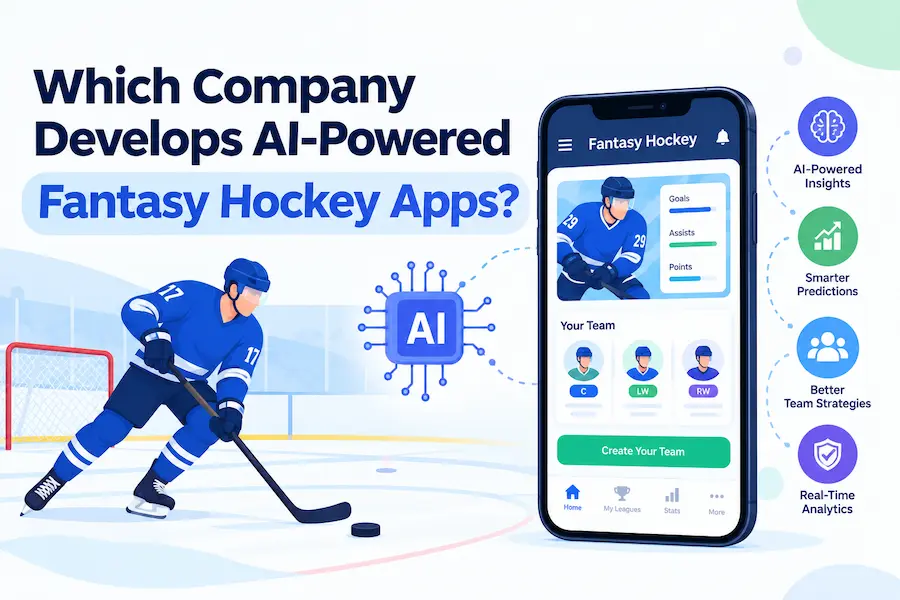
Fantasy hockey is becoming more focused on data because fans want more than just basic player stats and league standings. Today, users expect real-time scores, player insights, lineup suggestions, personalized notifications, and tools to help them make better fantasy choices.
This change has created a great opportunity for businesses that want to create their own fantasy hockey platforms. However, making an AI-powered fantasy hockey app requires more than just regular mobile app development. The platform needs accurate hockey data, an efficient scoring system, AI models, safe user management, scalable infrastructure, and a smooth mobile experience.
Therefore, businesses looking to develop a fantasy hockey app should collaborate with a development team that understands both fantasy sports and artificial intelligence.
Grand View Research reports that the global fantasy sports market was worth $27.8 billion in 2025 and is expected to reach $31.4 billion in 2026. By 2033, the market is predicted to grow to $75.1 billion, with a yearly growth rate of 13.3% from 2026 to 2033. In 2025, application-based platforms made up 78.1% of the market, highlighting the importance of mobile apps in this field.
At the same time, the AI in sports market is growing quickly. Grand View Research estimates this market will grow from $12.7 billion in 2026 to $49.9 billion by 2033, with a yearly growth rate of 21.6%.
Together, these trends make AI-powered fantasy hockey an appealing business opportunity for companies aiming at hockey fans.
Why Build an AI-Powered Fantasy Hockey App?
Fantasy hockey allows users to make virtual teams with real hockey players and score points based on how those players perform in actual games. Users can choose players, manage their teams, watch games, compare stats, and compete with others.
AI can improve this experience by making it more helpful and tailored to individual users.
Instead of having users look through hundreds of player stats, an AI-based platform can handle a lot of data and provide valuable insights. The system can assess recent player performance, past statistics, strength of opponents, ice time, power-play usage, injuries, team performance, and other important information.
Current fantasy hockey platforms demonstrate how much data can be involved. NHL.com's fantasy coverage includes player rankings, projections, daily picks, EDGE statistics, waiver suggestions, and separate rankings for forwards, defensemen, and goalies.
An AI-powered application can enhance this by customizing the information for each user.
For example, instead of providing the same player recommendation to everyone, the application can look at the user's league settings, roster, upcoming opponents, and scoring system before giving a suggestion.
This makes users more likely to return to the application during the hockey season.
Also Read: - How to Develop a Fantasy Sports App Like AFL Fantasy?
Essential Features of an AI Fantasy Hockey App
A successful application needs a strong base before adding advanced AI features.
The first layer should have user registration, profile management, player databases, team creation, league management, drafts, scoring, leaderboards, notifications, and live game updates.
Users should be able to look at available players and see details like their position, team, recent performance, season stats, injury status, upcoming games, and fantasy value.
The team-building part should be easy to use. Users should be able to pick players, manage their roster, make substitutions, and check projected performance without dealing with complicated screens.
The platform should also support different league types. Businesses might want to provide season-long leagues, head-to-head competitions, daily contests, private leagues, public leagues, salary-cap formats, or customized scoring systems.
Real-time scoring is an important feature. When a player scores a goal, gets an assist, takes a shot, makes a save, or records any other important statistic, the system should quickly update the user’s fantasy score.
NHL fantasy scoring uses different statistics for skaters and goalies. For example, skaters are ranked based on goals, assists, power-play points, shots on goal, hits, and blocked shots. Goalies are valued based on wins, goals-against average, save percentage, and shutouts.
Your application can use a similar scoring system or create its own rules based on the target market.
AI Features That Can Improve Fantasy Hockey Apps
AI is most helpful when it addresses a real problem for users. One strong use of AI is in player recommendations. The system can look at player performance, the next opponents, recent form, team strategy, injuries, line combinations, and other information to suggest players that match a user's fantasy strategy.
Another helpful feature is predictive analytics. AI can analyze past and present data to estimate how players might perform. These estimates should be seen as insights or projections, not guarantees.
AI can also assist with lineup suggestions. A user can ask the application to recommend the best lineup for an upcoming game. The system takes into account the user’s roster, scoring rules, player availability, and expected performance.
A conversational AI assistant can make the application easier to use. Users can ask questions about their team, compare players, get trade suggestions, or find out why one player might be a better choice for a certain game.
For example, a user might ask, "Should I start Player A or Player B this week?" The AI can look at the relevant data and explain its suggestions.
Many modern fantasy hockey applications are using this approach. Citrus Fantasy Sports, for instance, has an AI assistant that can answer questions about rosters, trades, waivers, and lineups based on the user's league settings and team details.
AI can also provide personalized notifications. Instead of sending the same alert to everyone, the system can send updates based on the teams and players each user follows. This makes notifications more relevant and can help keep users engaged.
Real-Time Hockey Data Integration
AI cannot give helpful fantasy insights without reliable data. It needs a trustworthy sports data provider that can give information about schedules, teams, players, game events, statistics, lineups, and other important details.
The backend gets data from the sports API and works on it before sharing the information with users.
For instance, when a goal happens, the system can recognize the event, identify the players involved, calculate the fantasy points, update the teams affected, and send the new scores to users. This needs a well-designed scoring engine.
The application should also include a way to make corrections. Sports data can change after an event is first recorded. The system should update fantasy scores when the statistics are fixed.
Real-time data is very important for modern fantasy hockey platforms. The NHL's official fantasy experience features real-time gameplay, while other fantasy hockey apps offer live scoring, live statistics, and real-time league updates.
Because of this, developers of fantasy sports apps need to have strong skills in API integration, event processing, databases, caching, and real-time communication.
Also Read: - How to Build a Scalable Fantasy Sports Platform Like DraftKings
Technology Stack for Fantasy Hockey App Development
The technology stack is based on how big the application is and what the business needs. For mobile development, businesses can select either native Android and iOS development or cross-platform tools like Flutter or React Native. Using cross-platform development can save time when the application needs to work on different mobile platforms.
For the backend, technologies like Node.js, Python, Java, or other similar frameworks can be used for managing APIs, handling user authentication, managing scores, contests, and processing data.
Python is especially helpful for AI and machine learning because it has many libraries for data science and machine learning.
A cloud platform like AWS, Microsoft Azure, or Google Cloud can provide the necessary infrastructure to manage changing traffic levels. The system can adjust resources when more users join during important games.
The database design should handle many updates quickly. Caching can lessen unnecessary database requests, and message queues can efficiently manage many events.
For AI features, the development team can create recommendation models, prediction systems, natural-language interfaces, and personalization tools based on what the product needs.
The architecture should be flexible so that businesses can add new features without having to rebuild the whole application.
How AI Can Personalize the Fantasy Hockey Experience
Personalization can make a fantasy hockey app more relevant for each user. Every user has different preferences. For example, one user might care more about goals and assists, while another might focus on defensive statistics. Some users may like aggressive player choices, while others may prefer consistent ones. AI can learn from user behavior and change the information shown to each individual.
For instance, the system can notice which players a user follows often and give them updates about those players. It can also look at the user’s past roster choices and suggest information that fits their interests. An AI recommendation engine can rank players based on various factors instead of just providing one general ranking.
The application can customize the home dashboard. When a user opens the application, they might see upcoming games with their fantasy players, alerts about injuries, expected scores, roster suggestions, and league standings.
This method saves users time when looking for information. AI can also create summaries. Instead of checking many statistics pages, users can get a brief summary that explains changes in a player's fantasy value.
The aim is not to overload users with AI-generated data. The goal is to make large amounts of sports information clear and useful.
AI-Based Analytics and Player Prediction
Player predictions are very important for AI-powered fantasy hockey apps. A prediction model can analyze past statistics, current player performance, team strength, the skill of opponents, player injuries, and how tough the schedule is. This helps the system estimate how well a player might perform.
Instead of giving just one number as a definite answer, the app could show a range of expected performance and explain the main factors that affect the prediction. This is crucial because the outcomes of sports events are unpredictable. AI should help with decision-making rather than guarantee specific results.
Fantasy hockey analysis currently uses various data points to make player projections. NHL.com's projections for the 2026-27 season look at factors like past performance, expected line combinations, power-play time, injury history, age, and potential for improvement.
An AI-powered platform can enhance this analysis by processing more data and tailoring the results for each user's league. This can provide users with more detailed insights.
Security and Responsible Platform Management
Security should remain a priority throughout fantasy hockey app development. The app may hold user accounts, personal information, transaction details, league data, and other sensitive records. Developers should use secure login methods, encrypted communication, controlled access, secure APIs, database protection, and regular security tests.
The admin dashboard also needs strong security because administrators may manage users, leagues, scoring rules, content, notifications, and financial information.
AI can help improve security by spotting unusual activity patterns. It can identify suspicious login attempts, strange account activity, repeated transactions, or odd behavior in contests for closer examination.
Businesses must also know the laws and regulations relevant to their target market. Fantasy sports, paid contests, gaming, payments, advertising, data privacy, and age restrictions can be regulated differently in various countries and regions.
A careful development process should review these requirements before launching the app. A good fantasy hockey app development company should discuss compliance and security during the planning phase, not just after the app is launched.
Monetization Models for an AI Fantasy Hockey App
An AI fantasy hockey platform can make money in different ways. One way is through a subscription model, which allows users to pay for access to advanced player projections, AI recommendations, detailed analytics, premium alerts, and other features.
Another option is a freemium model, where users can access basic fantasy features for free but need to pay for advanced analytics. The platform can also earn money from advertisements aimed at users who use the free version. Potential advertisers include sports brands, hockey equipment companies, media companies, and other businesses related to the target market.
Businesses can offer high-quality league management tools for users who want more customization. Another option is sponsored content. For example, a hockey brand could sponsor a specific analytics section, player feature, competition, or community campaign.
The way to make money from this should fit the audience and local rules. A business should not add too many paid features that make the app hard to use.
Must Read: - Top 10 Fantasy App Development Companies in India for 2026
Cost of Developing an AI-Powered Fantasy Hockey App
The cost of developing an application depends on how complex it is.
A simple fantasy hockey MVP may cost between $15,000 and $25,000. This includes features like user registration, player data, team creation, basic leagues, scoring, notifications, and an admin panel.
A medium-level platform that offers real-time scoring, different league formats, advanced statistics, payment options, analytics, and personalized features may cost around $25,000 to $50,000.
An advanced platform with AI capabilities can cost $50,000 to $100,000 or more. The price varies based on the AI models used, data infrastructure, the number of platforms supported, real-time requirements, design complexity, and how well it can scale.
These are general budget estimates, not exact quotes. The total budget can also be influenced by sports data licensing. Some providers charge additional fees for API access, historical data, advanced statistics, commercial use, or larger request volumes.
AI development can increase costs because businesses might need data pipelines, model development, testing, cloud computing, monitoring, and ongoing improvements for their models.
The best strategy is to begin with a clear minimum viable product (MVP) and then add advanced AI features later based on what users want.
How to Choose a Fantasy Hockey App Creation Company
Choosing the right technology partner is very important for the project. A good company for creating a fantasy hockey app should know how to work with fantasy sports apps, real-time data, mobile development, cloud services, AI, and systems that can grow with demand.
Ask the development team how they will manage live hockey data and calculate fantasy points. Inquire about how they will fix data errors, handle traffic spikes, deal with API failures, and support many users at the same time. You should also look at the company’s past work. Focus on apps that have strong user interface and user experience, reliable real-time features, and effective fantasy sports processes.
The development team should create a clear plan that includes steps for planning, design, development, API integration, AI use, testing, deployment, and maintenance. It is also important to explain who owns the source code and the data structure. Businesses should understand what they will receive after development and what support the company will offer afterward.
A good technical partner should not just create screens based on a list of features. They should help the business make sensible technology choices.
Why Choose Fantasy App Development for an AI Fantasy Hockey App?
Fantasy App Development is a top choice for businesses looking to create custom fantasy sports apps using AI technology.
The company specializes in building fantasy hockey platforms that include features like player selection, team creation, leagues, real-time scoring, player statistics, notifications, analytics, and AI-based recommendations.
For businesses wanting to develop a fantasy hockey app, the platform can be tailored to fit the specific audience and market, rather than using a generic approach.
AI can be included in the application with features like personalized player suggestions, predicting trends, chat assistants, automatic alerts, grouping users, and insights based on data.
The development process can also allow for future growth. A business could begin with hockey and later add basketball, football, cricket, baseball, or other sports using a flexible design. It is crucial to build the foundation correctly from the start.
Final Thoughts
AI is changing how people use fantasy sports apps. Modern platforms can analyze data and give personalized information, helping users manage their fantasy teams better, instead of just showing statistics.
This change is supported by the overall growth of fantasy sports and AI in sports. The global fantasy sports market is expected to reach $75.1 billion by 2033, and the AI in sports market is expected to reach $49.9 billion during the same time.
For businesses entering this market, success will require more than just adding an AI chatbot or prediction feature. The application must have reliable hockey data, accurate fantasy scoring, a strong backend, an easy-to-use interface, secure systems, and helpful AI features.
The right company for developing a fantasy hockey app can combine all the necessary elements to create a platform that can grow as more users join.
Whether you want a fantasy hockey platform for the whole season, a daily fantasy game, an AI-focused analytics tool, or a multi-sport platform, businesses should begin with clear needs and a strong technical base.
With skilled developers in fantasy sports apps, AI can enhance the fantasy hockey experience instead of just being an extra feature.