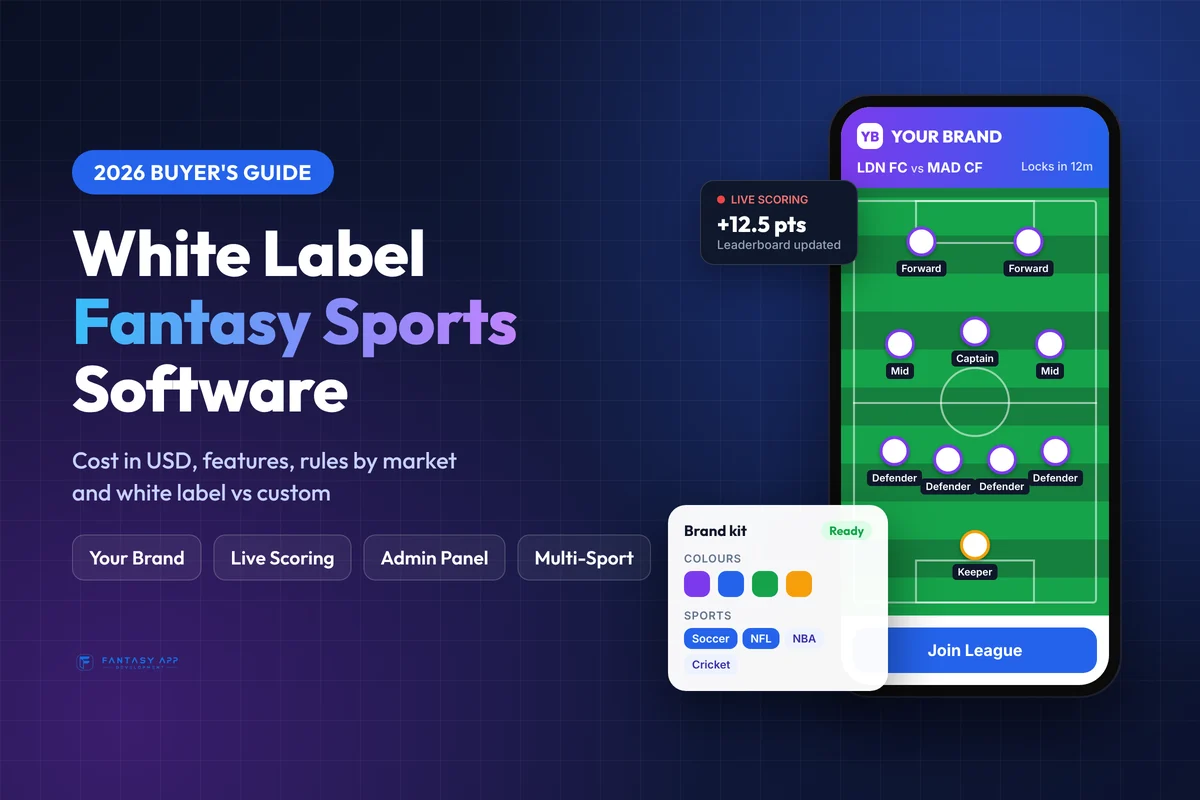
Quick answer: White label fantasy sports software is a ready-made fantasy platform (apps, website, admin panel, scoring engine and data feeds) that a provider rebrands with your name, logo and colours so you can launch in weeks instead of months. It usually costs less up front than a custom build, but you trade away some control over features, data and the product roadmap. This guide explains how white label works, what it costs in USD, which features to check, the rules in the US, UK, Europe and other markets, and when a custom or hybrid build is the better choice.
Key takeaways
- White label = a tested platform you rebrand. Custom = a platform built around your own product idea. Hybrid = a ready core plus custom features.
- Vendor quotes for white label fantasy software commonly start around $15,000 to $25,000, while custom builds run from about $50,000 to $100,000+ (BR Softech, 2026).
- Sports data feeds are a separate monthly cost, often $1,000 to $10,000+ per month depending on sports and speed (UINNO, 2026).
- The market is large: estimates put the global fantasy sports market at $34 to $39 billion in 2025 (TBRC via SiGMA, Global Market Insights).
- Software is the easy part. Licensing decides where you can run paid contests, so check the rules for every market before you pick a model.
What is white label fantasy sports software?
White label fantasy sports software is a pre-built fantasy sports platform that a provider licenses or sells to you and rebrands as your own product. Your users see your brand. The provider supplies the core technology, and usually hosting, updates and support.
A typical white label package includes:
- Android and iOS apps plus a web version
- A contest or league engine (season-long, daily, pick'em or free-to-play)
- A live scoring engine connected to a sports data provider
- User accounts, wallet or reward points, referrals and notifications
- An admin panel to create contests, manage users, set prizes and see reports
Three related terms are often mixed up:
- White label: the same tested product, rebranded for you. Fastest and cheapest, least flexible.
- Turnkey (or clone script): you buy the source code of a ready platform and can change it, often with the vendor's help.
- Custom: the platform is designed and built for your idea from the start. Slowest and most expensive, full control.
How does a white label fantasy platform work?
Behind your brand, the provider runs the same building blocks every fantasy app needs:
- Data feed: fixtures, line-ups, player stats and live events come from a sports data provider through an API.
- Scoring engine: converts those stats into fantasy points using your scoring rules, and updates leaderboards in near real time.
- Contest engine: handles leagues, drafts, salary caps, entry limits, lock times and prize distribution.
- User layer: sign-up, profiles, teams, chat, notifications and (where legal) payments and KYC.
- Admin panel: your team runs contests, offers, content and reports without writing code.
You control the brand, contest settings, prizes, marketing and customer relationship. The provider controls the code and, in many deals, the hosting.
White label vs custom vs hybrid: which should you choose?
| Factor | White label | Hybrid (ready core + custom features) | Custom build |
|---|---|---|---|
| Typical launch time | 2 to 6 weeks | 1 to 3 months | 3 to 6+ months |
| Up-front cost (USD) | Lowest, often $15k to $25k | Mid, about $20k to $50k | Highest, $50k to $100k+ |
| Pricing model | One-time fee, monthly licence or revenue share | Project fee plus maintenance | Project fee plus maintenance |
| Feature flexibility | Limited to the vendor's roadmap | Good for your key differentiators | Unlimited |
| Source code ownership | Usually no | Often yes (check the contract) | Yes |
| User data ownership | Must be written into the contract | Yes | Yes |
| Best for | Testing a market, media brands, sponsors, seasonal contests | Startups that need speed and a unique feature | Funded operators building a long-term brand |
The cost ranges above combine public vendor estimates (BR Softech, Algoscale, UINNO) and vary a lot by scope, sports and team location. Treat them as a starting point and ask for itemised quotes.
Choose white label if you need to launch before a season starts, your features are standard, and you want to test demand with a small budget. Choose custom if your product idea is different from what is already on the market, you plan to raise funding, or you need full control of data and code. Many operators start with white label or hybrid and move to custom once they know what their players want.
How much does white label fantasy sports software cost?
Your total cost has four parts. Many quotes show only the first one.
| Cost item | What it covers | Typical range (USD) |
|---|---|---|
| Set-up or licence fee | Branding, app store builds, configuration, admin training | About $15,000 to $25,000 one-time, or a monthly licence |
| Sports data feed | Fixtures, line-ups, live stats per sport and league | About $1,000 to $10,000+ per month |
| Hosting and maintenance | Servers, updates, bug fixes, support, app store updates | Commonly estimated at 15% to 25% of the build cost per year, or a monthly fee |
| Revenue share (if any) | Some providers take a share of contest fees or revenue | Varies by contract |
| Compliance | Licences, legal opinions, KYC/age checks, geolocation, payment gateway | Depends on market; can exceed the software cost |
For a custom or hybrid build, our usual bands are about $10,000 to $20,000 for a one-sport MVP, $20,000 to $30,000 for a mid-level app, $30,000 to $50,000 for an advanced app and $50,000+ for an enterprise platform. See our detailed fantasy football app cost guide for a feature-by-feature breakdown.
Which features should good white label fantasy software include?
Player-facing features
- Fast sign-up (email, Google, Apple) and a team builder that works in under two minutes
- Multiple formats: season-long leagues, daily contests, pick'em and free-to-play
- Live scoring and leaderboards that update within seconds of the real event
- Private leagues, invite links, league chat and push notifications
- Player stats, injury news and lineup alerts before lock
- Multi-language and multi-currency support for international users
Operator and admin features
- Contest builder with entry limits, prize tables and lock times
- Promotions, referral codes, bonus points and sponsor placements
- Reports on users, retention, contest fill rate and revenue
- Fraud controls: multi-account detection, device checks, bot detection
- Responsible gaming tools: deposit limits, self-exclusion, age checks (where paid play is allowed)
- Geolocation and geo-blocking by country or state
Technical must-haves
- Proven load handling on peak days (NFL Sundays, Premier League weekends, IPL finals)
- Choice of data provider, or at least a clear list of covered sports and leagues
- Data export, so you can take your user data with you if you change provider
- App store compliance for Apple and Google rules on contests and prizes
Which sports can you launch with white label software?
Most providers cover the sports with reliable data feeds. Match the sport to your market:
| Market | Sports with strong fantasy demand |
|---|---|
| United States and Canada | NFL, NBA, MLB, NHL, golf, college football |
| United Kingdom and Europe | Football (soccer), cricket, rugby, F1 |
| Middle East (UAE, Saudi Arabia) | Football, cricket |
| Australia | AFL, NRL, cricket |
| Africa | Football (Premier League and local leagues) |
| South Asia | Cricket, kabaddi, football |
For sport-specific builds, see our services for fantasy football, fantasy basketball, fantasy baseball, fantasy hockey, fantasy cricket and fantasy kabaddi app development.
Is white label fantasy sports legal? Rules by market
The software itself is legal everywhere. What is regulated is running contests with entry fees and cash prizes. Your business model, not your software, decides which licence you need. This is a summary, not legal advice.
| Market | Paid contests | What to know |
|---|---|---|
| United States | State by state | Daily fantasy is licensed or allowed in many states and banned or unclear in some, such as Idaho and Hawaii. Pick'em contests face growing action from regulators in states like Arizona and Michigan (Legal Sports Report). Geolocation by state is a must. |
| United Kingdom | Licence needed | The Gambling Commission has warned that fantasy contests where prizes depend on the number of paying entrants may need a pool betting licence (UK Gambling Commission). |
| European Union | Country by country | There is no single EU licence. Each country sets its own gambling rules, so many brands launch free-to-play first. |
| Middle East | Mostly free-to-play | Cash gambling is restricted in most Gulf states, so sponsor-funded, free-to-play contests are the usual route. |
| India | Banned | The Promotion and Regulation of Online Gaming Act, 2025 bans real-money online games, so fantasy apps there run free-to-play models. |
Before you sign with a provider, ask whether the platform supports state or country geo-blocking, age and identity checks, responsible gaming limits and a switch between paid and free-to-play modes. These features cost far less to have from day one than to add later.
How do you choose a white label fantasy sports provider?
Use this checklist when you compare providers:
- Ask for a live demo on real data, not screenshots. Join a contest and watch the scoring during a live game.
- Check who owns what. Get source code, user data and app store accounts in writing. Your apps should be published under your developer accounts.
- Get an itemised quote: set-up, licence, data feed, hosting, support, revenue share and the cost of each custom change.
- Ask about peak load: how many concurrent users the platform has handled on a match day.
- Review compliance features for your target markets (geolocation, KYC, age checks, limits).
- Read the exit terms: notice period, data export format and help with migration.
- Check the roadmap and support hours, especially if your users are in a different time zone from the provider.
How long does it take to launch a white label fantasy app?
A rebranded white label app can go live in about 2 to 6 weeks. Most of that time goes on branding, contest setup, payment or reward setup and app store review. A hybrid build with a few custom features takes about 1 to 3 months. At Fantasy App Development, we build on a ready, tested core and typically deliver a branded fantasy app in about 30 days, then add custom features in later phases.
Want to compare models in more depth? Read our guides on building a platform like DraftKings, FanDuel-style app development, building an app like Underdog Fantasy and building a fantasy app users love.
Final word
White label fantasy sports software is the fastest, lowest-risk way to test a fantasy idea in a new market. It works best when your features are standard and speed matters more than control. If your idea is different, or you plan to grow a long-term brand, a hybrid or custom build gives you ownership of the code, the data and the roadmap. Either way, decide your target market and legal model first, then choose the software.
Planning a fantasy sports app for the US, UK, Europe, the Middle East or another market? Contact our team for a free consultation and an itemised quote.