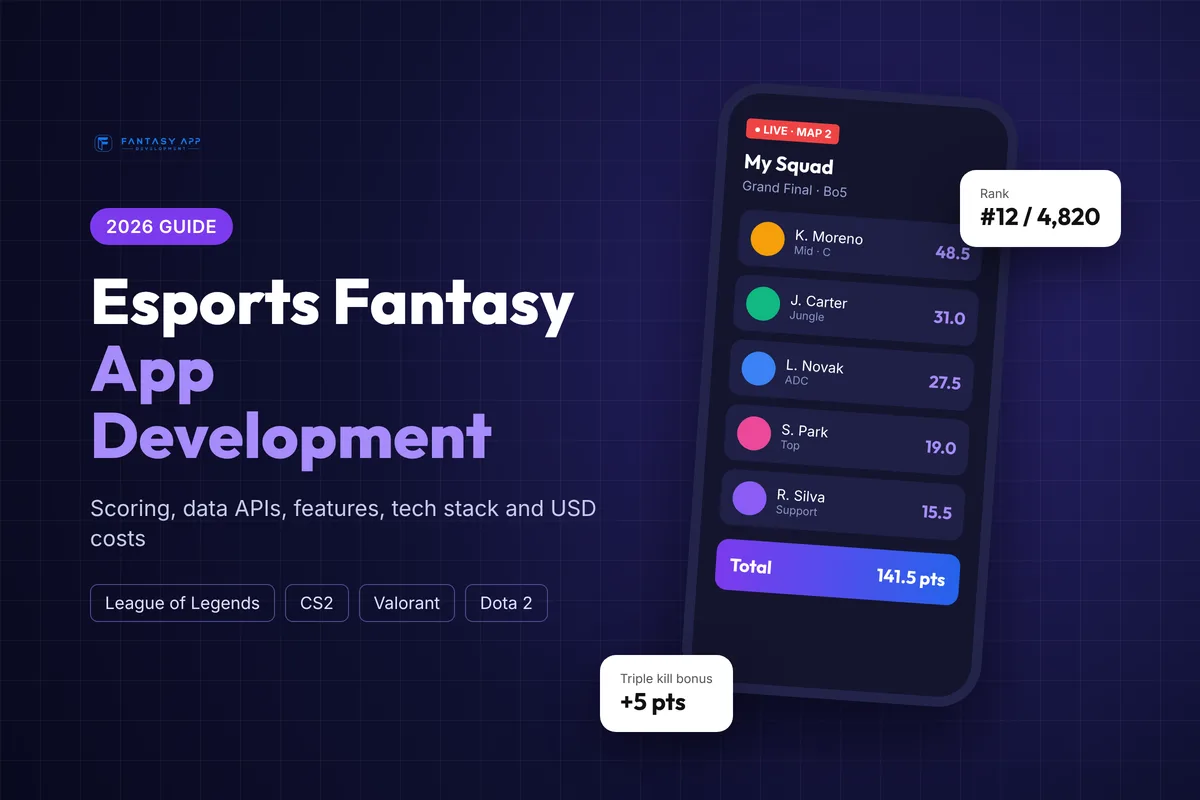
Quick answer: Esports fantasy app development means building a platform where fans pick real pro players from games such as League of Legends, Counter-Strike 2, Valorant and Dota 2, then score points from their kills, assists, objectives and match results. To build one you need per-game scoring rules, a licensed esports data API for live stats, contest or league tools, wallets or virtual coins, and location checks for paid play. An MVP for one or two titles typically costs about $15,000 to $25,000, and a multi-title platform with daily contests, leagues and live scoring runs $35,000 to $60,000 or more. This guide covers games, scoring, data feeds, features, tech stack, USD costs, rules in the US, UK, Europe and Asia, and a launch plan.
Key takeaways
- The audience is large and young: the global esports audience was about 640.8 million in 2025, per Newzoo figures (Game-Wisdom, citing Newzoo).
- Asia-Pacific holds more than half of esports viewers, so plan for Asian time zones and languages, not just the US and Europe (Outlook Respawn).
- Data is ready to license: PandaScore's API offers historical and real-time stats for 13 esports titles, including League of Legends, Counter-Strike, Dota 2 and Valorant (PandaScore docs).
- Big DFS brands already run esports contests: DraftKings has offered daily fantasy for League of Legends, CS, Dota 2, Rocket League and Valorant (Esports.net).
- Each game needs its own scoring model. A MOBA and a tactical shooter cannot share one points table.
What is an esports fantasy app?
An esports fantasy app works like fantasy football or fantasy cricket, but the "athletes" are professional gamers. Users draft or pick a roster of pro players (and sometimes a team), and they earn points based on how those players perform in real tournament matches, such as LoL's LCK or LEC, CS2 Majors, the Valorant Champions Tour or Dota 2's major events.
Esports fits fantasy very well. Matches are frequent, every action is already recorded by the game, and fans are digital-first and comfortable with apps, chat and in-app purchases. The main difference from traditional sports is that the "rules of the sport" change with every game patch, so your scoring engine has to be easy to update.
Which esports games should your fantasy app support?
Start with one or two titles that your target market watches most, then add more. This table compares the most common choices:
| Game | Genre | Roster idea | Strong markets |
|---|---|---|---|
| League of Legends | MOBA (5v5) | Top, Jungle, Mid, ADC, Support + 1 team | Korea, China, Europe, North America, Vietnam |
| Counter-Strike 2 | Tactical shooter (5v5) | 5 players, captain gets 1.5x | Europe, CIS, Brazil, North America |
| Valorant | Tactical shooter (5v5) | Duelist, Initiator, Controller, Sentinel + flex | North America, Japan, Southeast Asia, Europe, Turkey |
| Dota 2 | MOBA (5v5) | Carry, Mid, Offlane, 2 Supports | Europe, CIS, Southeast Asia, Peru |
| Mobile Legends / mobile titles | Mobile MOBA / battle royale | 5 players or squad-based | Indonesia, Philippines, Malaysia, India, Brazil |
| Rocket League | Sports-action (3v3) | 3 players + team | North America, Europe, Oceania |
How does esports fantasy scoring work?
Each game needs its own points table. Keep it simple enough for a new user to understand in one screen, and store it as configuration (not code) so you can tune it after every patch or tournament.
| Stat | LoL / Dota 2 example | CS2 / Valorant example |
|---|---|---|
| Kill | +3 | +1 per kill |
| Death | -1 | -0.5 per death |
| Assist | +2 | +0.5 |
| Creep score / farm | +0.02 per CS | Not used |
| Objectives | Towers, dragons, Baron / Roshan for team picks | Plants, defuses, first kills |
| Multi-kill bonus | +2 to +10 (triple to penta) | +2 for 4K, +5 for ace |
| Map / game win | +2 for team | +1 per round won for team |
Two esports-specific rules matter a lot. First, series length varies (best-of-1, best-of-3 or best-of-5), so decide whether you score per map or average per map, or a player in a five-map series gets a huge edge. Second, handle substitutions and roster changes clearly, because teams swap players more often than in traditional sports.
What features does an esports fantasy app need?
Core features for players
- Sign-up and profile with email, Google, Apple, Discord or Steam login. Discord login is a big win for this audience.
- Match and tournament schedule by game, league and region, with time-zone-aware start times.
- Team builder with a salary cap or credits, role slots and captain / vice-captain picks.
- Contests and leagues: public contests, private leagues with invite codes, head-to-head and season-long tournament leagues.
- Live scoring and leaderboards that update during each map.
- Player stats and form (KDA, average fantasy points, recent results, patch notes) to help users pick.
- Wallet or virtual coins depending on whether the market allows paid contests.
- Notifications for line-up locks, roster changes and results.
- Stream links or embeds so users can watch the match on Twitch or YouTube while tracking points.
Admin panel features
- Game, tournament and match management, with auto-import from the data feed.
- Per-game scoring configuration and player credit (salary) settings.
- Contest templates, prize tables and rake settings.
- KYC, withdrawals, geo-blocking and responsible-play limits for paid markets.
- Reports on users, revenue and contest fill rates.
If you want a deeper feature checklist that applies to any sport, see our guide on how to build a fantasy app that users love.
Where do esports fantasy apps get their data?
You need a licensed esports data provider for schedules, rosters, live match events and final stats. Common options:
- PandaScore (Paris): REST and live APIs for 13 titles, with a product aimed at fantasy operators (PandaScore Fantasy).
- GRID: official data partner for several publishers and tournament organisers, strong for CS2, Dota 2 and others.
- Bayes Esports and Abios: live data and odds feeds used by betting and media companies.
- Official publisher APIs (for example Riot's developer APIs) are useful for player profiles, but check their terms: they are often not licensed for paid contests on pro matches.
Plan for data to be one of your biggest running costs. Pricing is usually per game and per tier (historical versus live), so licensing four titles live can cost far more than one. Ask for a trial and test latency during a real tournament before you sign.
What tech stack works for an esports fantasy app?
| Layer | Common choice | Why |
|---|---|---|
| Mobile apps | Flutter or React Native | One codebase for iOS and Android |
| Web app | Next.js | Fast, SEO-friendly pages for tournaments and players |
| Backend | Node.js (NestJS) or Go | Handles many live connections well |
| Database | PostgreSQL or MongoDB + Redis | Contests and wallets in a database; Redis for live leaderboards |
| Real-time | WebSockets / Socket.IO | Push points during each map |
| Queue | Kafka, RabbitMQ or SQS | Process feed events and settle contests safely |
| Cloud | AWS or Google Cloud with auto-scaling | Traffic spikes at Majors and Worlds finals |
For a full breakdown of each layer, read our fantasy sports app tech stack guide.
How much does it cost to build an esports fantasy app?
| Scope | What you get | Typical cost (USD) | Timeline |
|---|---|---|---|
| MVP | 1 to 2 games, daily contests, live scoring, basic admin, free-to-play coins | $15,000 to $25,000 | 30 to 45 days |
| Mid-level | 3 to 4 games, private leagues, wallet, KYC, referral system, Discord login | $25,000 to $40,000 | 2 to 3 months |
| Advanced | Multi-title, season-long tournament leagues, streams, AI player insights, multi-language | $40,000 to $60,000+ | 3 to 5 months |
| White label | Ready platform with your brand, then add games | From about $8,000 setup | 2 to 4 weeks |
Running costs are extra: data feeds (often the largest line), cloud hosting, payment fees, KYC checks, app store fees and marketing. Compare these models in our white label fantasy sports software guide, or see season-long vs daily fantasy to decide which contest model to launch first.
How do esports fantasy apps make money?
- Contest entry fees (rake) in markets where paid fantasy is allowed.
- Virtual coin packs and battle-pass style seasons for free-to-play markets.
- Premium subscriptions for advanced stats, AI picks and ad-free play.
- Sponsorships from peripheral, energy drink and gaming brands, plus team and tournament partnerships.
- Advertising and affiliate deals with streaming platforms and game stores.
Is esports fantasy legal?
Free-to-play esports fantasy is legal in most countries. Paid contests follow the same rules as other fantasy sports in each market, and some regulators look more closely at esports because many players are young.
| Market | What to know |
|---|---|
| United States | Paid daily fantasy is regulated state by state; esports contests generally follow the same DFS rules (Legal Sports Report). Age is 18+ in most states and 21+ in some. |
| United Kingdom | Paid fantasy with cash prizes usually needs a Gambling Commission licence. Free-to-play with prizes is a common route. |
| Europe | Rules differ by country; several markets treat paid fantasy as gambling. Start free-to-play, then add paid play country by country. |
| Southeast Asia and Brazil | Huge mobile esports audiences; free-to-play and sponsorship-led models are the safest start. Brazil now regulates betting nationally, so get local advice for paid contests. |
| India | The Online Gaming Act 2025 bans real-money online games, so only free-to-play esports fantasy is possible. |
This is general information, not legal advice. Always check with a local gaming lawyer before you launch paid contests.
How do you build an esports fantasy app step by step?
- Pick your market and first titles. Match games to where your audience lives, for example Valorant and CS2 for North America and Europe, or Mobile Legends for Southeast Asia.
- Choose the contest model: daily contests, season-long tournament leagues or both.
- Write scoring rules per game and test them on past tournaments so top players score fairly.
- License a data feed and test live latency during a real event.
- Design the UX around fast team building, dark mode, and Discord sharing.
- Build the MVP (about 30 to 45 days), including the admin panel and anti-fraud checks.
- Run a beta during a mid-size tournament before a big event.
- Launch before a major event such as LoL Worlds, a CS2 Major or Valorant Champions, when interest peaks.
- Grow with creators and communities: streamer leagues, team partnerships and referral rewards.
What makes an esports fantasy app different from a sports fantasy app?
- Patches change the meta. Scoring and player credits need regular updates.
- Global, round-the-clock schedule. Leagues run in Korea, China, Europe and the Americas, so you need time-zone handling everywhere.
- Younger audience. Strong age checks and responsible-play tools matter more.
- Community-first. Discord, Twitch and creator leagues drive growth more than TV ads.
Why build your esports fantasy app with Fantasy App Development?
Fantasy App Development is a Jaipur-based team of 35 that has built fantasy platforms for 400+ clients worldwide, across cricket, football, basketball, baseball, hockey and more. We can launch an esports fantasy MVP in about 30 days, set up per-game scoring and data feeds, and build for free-to-play or paid markets. See our portfolio or contact us for a free estimate in USD.