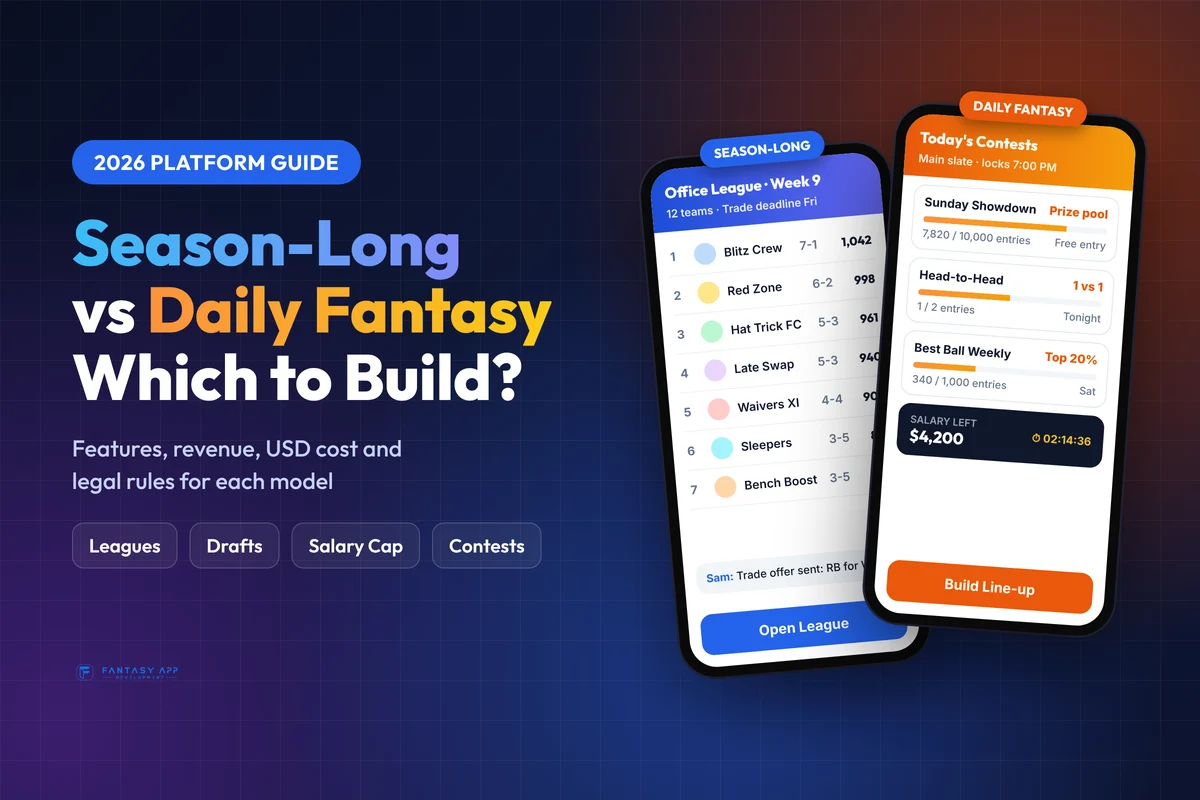
Quick answer: Season-long vs daily fantasy sports comes down to one choice: do you want a social app where friends play together all season, or a contest app where players enter new games every day? Season-long fantasy (like Sleeper, ESPN and Yahoo) is cheaper to launch, works free-to-play in almost every country and builds loyal leagues. Daily fantasy (like DraftKings and FanDuel) earns more per active user but needs a heavier contest engine, licences in most markets and more marketing. For most new brands, the best path is to launch season-long or free-to-play first, then add daily contests where they are legal.
Key takeaways
- Season-long fantasy means you draft a team once and manage it for the whole season against the same league.
- Daily fantasy sports (DFS) means you pick a new salary-cap team for a single day, round or slate, and results are final within hours.
- Season-long is the bigger habit: in an Ipsos study for the fantasy trade association, 82% of fantasy players played in a season-long league (Legal Sports Report, 2016 data).
- Paid DFS is regulated state by state in the US; most guides list Hawaii, Idaho, Montana, Nevada and Washington as states where the major DFS apps are not available (Football365, 2026).
- A season-long MVP usually costs less than a DFS MVP, because DFS needs salaries, contest lobbies, payouts and compliance from day one.
What is season-long fantasy sports?
Season-long fantasy sports is the original fantasy format: a group of players (usually 8 to 14) drafts real athletes before the season, then sets line-ups, makes trades and adds free agents every week until a league champion is crowned.
Popular examples include Sleeper, ESPN Fantasy, Yahoo Fantasy, NFL Fantasy and the Premier League's official Fantasy Premier League. The format is built on friendships, rivalries and long-term strategy. See our guides to building a fantasy football app like Sleeper and building an FPL-style app for two very different season-long models.
What is daily fantasy sports (DFS)?
Daily fantasy sports (DFS) is a contest format where players build a new team for one game, one day or one weekend slate, usually under a salary cap, and compete against other entrants for prizes. Results are known the same day or weekend.
DraftKings and FanDuel made DFS mainstream in the US. Variants include showdown (single game), best ball tournaments and pick'em contests, where players pick over or under on player stats. Read our guides to building a DraftKings-style platform, FanDuel-style app development and building an Underdog-style pick'em app.
Season-long vs daily fantasy: what are the key differences?
| Factor | Season-long fantasy | Daily fantasy (DFS) |
|---|---|---|
| Commitment | Whole season, weekly decisions | One day or slate at a time |
| Who you play against | Same friends or league all season | Large public contests and strangers |
| Team building | Snake or auction draft, then trades and waivers | Salary cap line-up for each contest |
| Engagement pattern | Steady weekly visits, peaks on game days | Bursts before every lock time |
| Social features | Very important: chat, trades, rivalries | Less important: leaderboards matter more |
| Main revenue | Ads, sponsors, premium tools, league fees where legal | Entry fees with a platform commission (rake) |
| Regulation | Free-to-play leagues are widely legal | Paid contests licensed or restricted in many markets |
| Hardest tech | Live draft room, waivers, trades, chat | Contest engine, salaries, payouts, fraud checks |
| Marketing cost | Lower: leagues invite their friends | Higher: you must keep filling public contests |
Which model makes more money?
DFS can earn more per active player because each contest carries an entry fee and the platform keeps a share. But DFS also costs more to run: you need licences, payment processing, identity and age checks, geolocation, responsible gaming tools and constant marketing to fill contests.
Season-long apps earn less per user but keep users for longer. Leagues renew every year with the same friends, so retention is naturally high, and growth is viral because every commissioner invites 8 to 14 people. Money comes from sponsorship, advertising, premium features (projections, trade analysers, AI tips) and, where legal, a fee on paid leagues.
| Revenue stream | Season-long | DFS |
|---|---|---|
| Entry fee commission | Optional (paid leagues) | Core |
| Premium subscription | Strong | Possible |
| Advertising and sponsors | Strong | Moderate |
| B2B / white label for media brands | Strong | Moderate |
| Virtual items and cosmetics | Moderate | Low |
How much does each model cost to build?
| Scope | Season-long app (USD) | DFS app (USD) |
|---|---|---|
| MVP, one sport | $10,000 to $20,000 | $20,000 to $30,000 |
| Full product, one sport | $20,000 to $30,000 | $30,000 to $50,000 |
| Multi-sport, high scale | $30,000 to $50,000+ | $50,000+ |
| Typical MVP timeline | 1 to 2 months | 2 to 3 months |
These ranges follow our usual cost bands. DFS starts higher because the contest engine, wallet, payouts and compliance tools are needed from day one, not added later. Both models also pay for sports data, hosting and maintenance. See our fantasy app cost guide for a full breakdown, or a white label platform if you need to launch in weeks.
Which features does each model need?
Season-long must-haves
- League creation with custom scoring and roster rules
- Live draft room (snake and auction) with timers and auto-pick
- Weekly line-ups, head-to-head matchups and playoffs
- Trades, waivers (rolling or FAAB) and free agents
- League chat, notifications and commissioner tools
- Keeper and dynasty options for returning leagues
DFS must-haves
- Contest lobby with entry fees, sizes and prize tables
- Player salaries that update for each slate
- Salary-cap line-up builder and late swap
- Live scoring and leaderboards for thousands of entries
- Wallet, deposits, withdrawals and automated payouts
- KYC, age checks, geolocation, limits and fraud detection
Is season-long or daily fantasy easier to launch legally?
Season-long is usually easier. Free-to-play leagues are legal almost everywhere, and many apps never take money for contests. DFS with cash prizes is a regulated product in most markets. This is a summary, not legal advice.
| Market | Season-long (free) | DFS (paid) |
|---|---|---|
| United States | Widely legal | State by state; not available on major apps in a handful of states, and pick'em faces extra scrutiny (Legal Sports Report) |
| Canada | Widely legal | Province by province; Ontario regulates through iGaming Ontario |
| United Kingdom | Legal | May need a Gambling Commission pool betting licence (UK Gambling Commission) |
| European Union | Legal | Country by country gambling rules |
| Australia | Legal | State and territory wagering rules apply |
| Middle East | Legal with sponsor prizes | Generally not allowed |
| India | Legal (free-to-play) | Banned under the Online Gaming Act, 2025 |
How do you choose the right model? A 5-step framework
- Start with your market: if paid contests are restricted where your users live, start season-long or free-to-play.
- Look at your audience: friend groups, offices and fan clubs suit season-long; experienced, competitive players suit DFS.
- Check your budget and runway: DFS needs more money for build, licences and user acquisition.
- Pick one sport with a clear season: NFL, Premier League, NBA, IPL or golf majors, and time your launch before it starts.
- Plan the hybrid path: build the data feed, scoring engine and accounts so daily contests can be added later without a rebuild.
Which well-known apps use each model around the world?
Looking at successful apps in each region shows how the market, the sport and the law shape the model:
| Region | Season-long examples | Daily or contest-style examples | What it tells you |
|---|---|---|---|
| United States | ESPN Fantasy, Yahoo Fantasy, Sleeper | DraftKings, FanDuel, Underdog, PrizePicks | Both models are big; DFS needs state-by-state compliance |
| United Kingdom and Europe | Fantasy Premier League and other official league games | Sorare (collectible card based) | Free, official season-long games dominate |
| Australia | AFL Fantasy, SuperCoach | Smaller DFS market | Season-long games tied to local leagues lead |
| India | Few | Dream11 and others, now free-to-play | Match-by-match contests are the habit, but cash play is banned since 2025 |
The pattern is clear: where paid contests are restricted, free season-long games tied to a popular league win. Where paid fantasy is regulated and allowed, both models can grow side by side. Our guide on how to build an app like AFL Fantasy covers the Australian season-long model in more detail.
Can one app offer both season-long and daily fantasy?
Yes. Many leading apps now mix formats: season-long apps add daily or best ball contests, and DFS apps add season-long style leagues. A shared core (sports data, scoring engine, user accounts, notifications) supports both. The smart approach is to launch one format well, learn what your players want, and then add the second.
Final word
Choose season-long if you want a lower-cost, legally simpler, community-driven app with loyal leagues. Choose daily fantasy if you have the budget, licences and marketing to run contests at scale. If you are unsure, start season-long or free-to-play and design the platform so daily contests can be switched on later.
Fantasy App Development builds both season-long and daily fantasy apps for clients worldwide and can deliver a branded app in about 30 days. Explore our fantasy football, basketball and cricket app services, or contact us for a free consultation on the right model for your market.