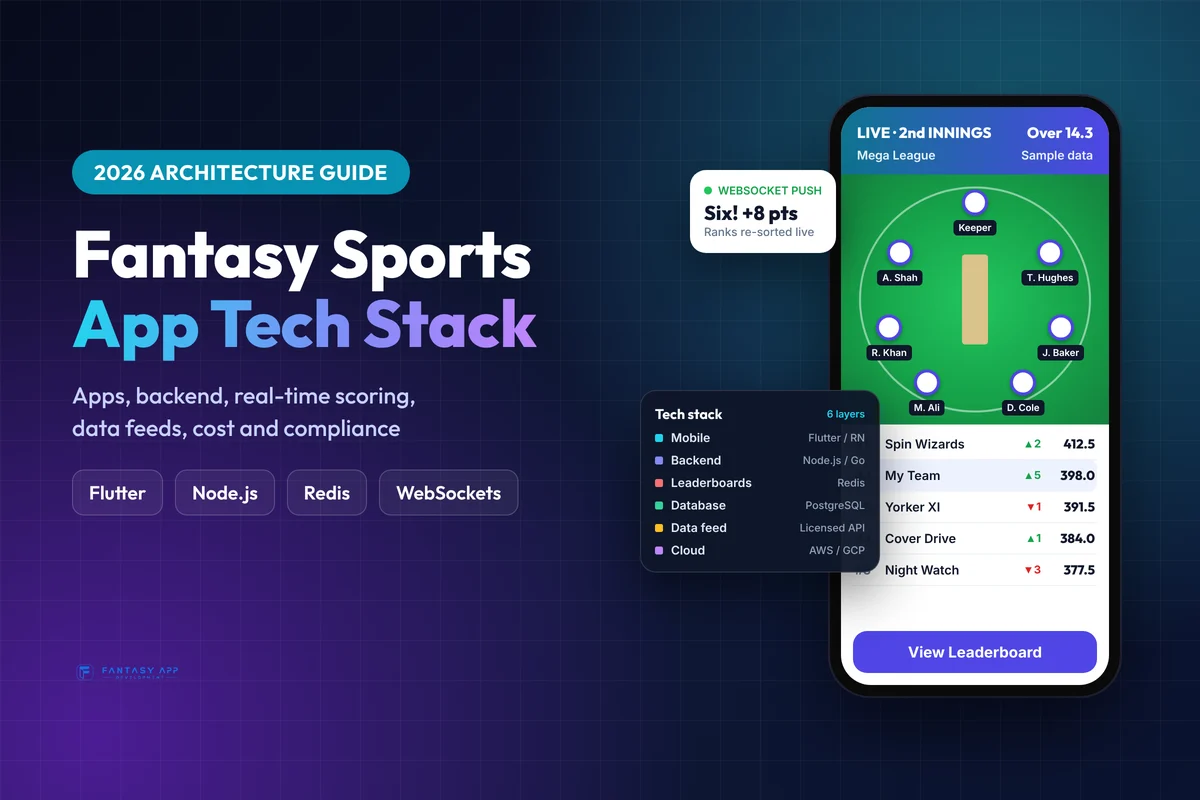
Quick answer: A modern fantasy sports app tech stack has six layers: mobile apps (Flutter or React Native), a web app and admin panel (React or Next.js), a backend API (Node.js, Go or Java), a real-time layer (WebSockets with Redis pub/sub), a database plus cache (PostgreSQL or MongoDB with Redis sorted sets for leaderboards), and a licensed sports data feed such as Sportradar, Stats Perform or SportsDataIO. Paid contests add a payments, KYC and geolocation layer. The right choices depend less on fashion and more on three things: your peak traffic before lock time, how fast scores must update, and which markets you launch in.
Key takeaways
- The sports data feed is the first and most important technical decision; the scoring engine depends on it (RaftLabs).
- Redis sorted sets are the standard tool for live leaderboards; MyTeam11 used Redis Cloud for real-time leaderboards and sessions for 15 million users (Redis).
- At very large scale, teams change tools: Dream11 has spoken about moving real-time workloads to Aerospike (Aerospike).
- Traffic is spiky: most users arrive in the hour before lock time and during live games, so design for peaks, not averages.
- A cross-platform app (Flutter or React Native) plus one backend is the most cost-effective stack for most startups.
What does a fantasy sports app architecture look like?
A fantasy sports app architecture is the set of services that turn real-world sports data into contests, live points and leaderboards. Every fantasy app, from a small free-to-play league to a large daily fantasy platform, follows the same flow:
- Data ingestion: fixtures, line-ups and live stats arrive from a sports data provider through an API or push feed.
- Scoring engine: converts each stat event into fantasy points using your rules.
- Contest and league engine: manages teams, drafts, salary caps, entries, lock times and prizes.
- Leaderboard service: ranks every team in every contest in near real time.
- Real-time delivery: pushes new points and ranks to the app through WebSockets and push notifications.
- User, wallet and compliance services: accounts, payments, KYC, age and location checks where paid play is allowed.
- Admin panel and analytics: tools for your team to run contests, fix stats and measure growth.
Which technologies should you use for each layer?
| Layer | Recommended options | Why |
|---|---|---|
| Mobile apps | Flutter or React Native; native Swift/Kotlin for very large apps | One codebase for iOS and Android cuts cost and time |
| Web app and admin | React or Next.js | Fast, SEO-friendly pages and rich admin dashboards |
| Backend API | Node.js (NestJS/Express), Go or Java (Spring Boot) | Good concurrency for many short requests at lock time |
| Real-time | WebSockets (Socket.IO or native), Redis pub/sub | Live points and ranks without constant polling |
| Primary database | PostgreSQL or MongoDB | Reliable storage for users, teams, contests and transactions |
| Cache and leaderboards | Redis (sorted sets); Aerospike at very large scale | Ranking millions of entries in milliseconds |
| Job queues | BullMQ, RabbitMQ or Kafka | Scoring, settlements, notifications and payouts in the background |
| Sports data | Sportradar, Stats Perform (Opta), SportsDataIO, Sportmonks, sport-specific feeds | Licensed, accurate and fast stats with corrections |
| Payments (paid contests) | Stripe, Adyen, PayPal or local gateways | Deposits and payouts in each market |
| Compliance | KYC/identity checks, geolocation services, age verification | Required for paid contests in regulated markets |
| Notifications | Firebase Cloud Messaging, Apple Push Notification service | Lineup alerts, score updates, promotions |
| Cloud and DevOps | AWS, Google Cloud or Azure; Docker, Kubernetes, CI/CD | Auto-scaling for match-day peaks |
| Analytics | Mixpanel, Amplitude, GA4, BigQuery | Retention, funnels and contest performance |
Flutter or React Native for a fantasy sports app?
Both are proven choices. Flutter gives smooth, consistent UI across iOS and Android and is a strong fit for animated team builders and live scorecards. React Native shares a language (JavaScript or TypeScript) with a React web app and a Node.js backend, which helps small teams move faster. Go fully native only when you have the budget for two mobile teams and need the last bit of performance or platform-specific features.
How does the scoring engine work?
The scoring engine listens for stat events from the data feed (a goal, a touchdown, a wicket, a birdie) and updates fantasy points for every affected player and team. A reliable engine:
- Stores scoring rules as configuration, so you can change points per sport, league or contest without new code.
- Processes events in order and is idempotent, so a repeated event never counts twice.
- Handles stat corrections after the game and recalculates points and ranks.
- Covers edge cases: substitutions, postponed games, abandoned matches, ties and missed cuts.
- Can replay a full past season to test new rules before launch.
How do real-time leaderboards scale?
Leaderboards are where most fantasy apps hit their first scaling wall. When a star player scores, thousands of teams change points at once, and every contest must re-rank. The common pattern is:
- Keep each contest's leaderboard in a Redis sorted set, keyed by contest, with team points as the score.
- When points change, update only the affected teams with atomic increments.
- Read the top of the board and each user's own rank directly from Redis.
- Publish changes through Redis pub/sub to WebSocket servers, which push them to connected apps.
- Write final standings to the primary database when the contest settles.
For very large platforms with tens of millions of entries, teams shard leaderboards across clusters or move to stores like Aerospike, as Dream11 has described.
Which sports data provider should you choose?
| Provider | Strengths | Pricing signals |
|---|---|---|
| Sportradar | Very wide coverage, official data deals with many leagues | Custom enterprise quotes |
| Stats Perform (Opta) | Deep football and multi-sport data | Custom quotes |
| SportsDataIO | US sports, fantasy projections and DFS salaries | Median buyer about $16,500 per year (Vendr) |
| Sportmonks | Football and cricket, developer-friendly | Plans from €29 per month (Sportmonks) |
Test latency during a live match, check how corrections are delivered, and confirm your licence covers fantasy use in every country you plan to launch in. Read more in our guides on NFL data for a Sleeper-style app, football data for an FPL-style app and golf data feeds.
How do you handle traffic spikes on match day?
- Auto-scaling: scale API and WebSocket servers ahead of known lock times, not after load arrives.
- Caching: serve player lists, fixtures and contest lobbies from Redis or a CDN.
- Queues: accept team saves quickly and process heavy work (scoring, settlement, emails) in the background.
- Rate limits and backoff: protect the API from refresh storms and reconnect loops.
- Load testing: simulate peak lock-time traffic and a full live game before every season.
- Observability: dashboards and alerts on latency, errors and queue length during live events.
What does the tech stack cost?
| Scope | Typical build cost (USD) | Main stack differences |
|---|---|---|
| MVP, one sport | $10,000 to $20,000 | Cross-platform app, single backend, managed database and Redis |
| Mid-level | $20,000 to $30,000 | Admin panel, chat, job queues, push campaigns |
| Advanced, multi-sport | $30,000 to $50,000 | Multiple feeds, AI features, analytics, multi-language |
| Enterprise or paid DFS | $50,000+ | Wallet, KYC, geolocation, sharded leaderboards, high availability |
Monthly running costs include cloud hosting, the data feed, third-party services (KYC, geolocation, messaging) and maintenance. Paid daily fantasy platforms usually cost more because compliance and payout systems are required from day one; see our season-long vs daily fantasy comparison and our fantasy app cost guide.
Which compliance features does the stack need in each market?
| Market | Technical requirements for paid contests |
|---|---|
| United States | State-level geolocation, age and identity checks, responsible gaming limits; rules differ by state (Legal Sports Report) |
| United Kingdom | Licensing may apply to paid fantasy (UK Gambling Commission); age checks, safer gambling tools and audit logs |
| European Union | GDPR-compliant data storage and consent, plus country-level gambling rules |
| Middle East and India | Free-to-play only in practice; India bans real-money online games under the 2025 Online Gaming Act |
Build a switch between free-to-play and paid modes into the platform so you can launch in restricted markets first and turn on paid contests only where you are licensed.
Final word
The best fantasy sports tech stack is boring in the right places: a proven cross-platform app, a clean backend, PostgreSQL or MongoDB, Redis for leaderboards, WebSockets for live updates and a licensed data feed you have tested on a real match day. Spend your engineering time on the scoring engine, peak-time performance and the features that make your app different.
Fantasy App Development builds fantasy sports apps on this stack for clients worldwide and can deliver a branded app in about 30 days. See our cricket, football and basketball app services, or contact us to plan your architecture.