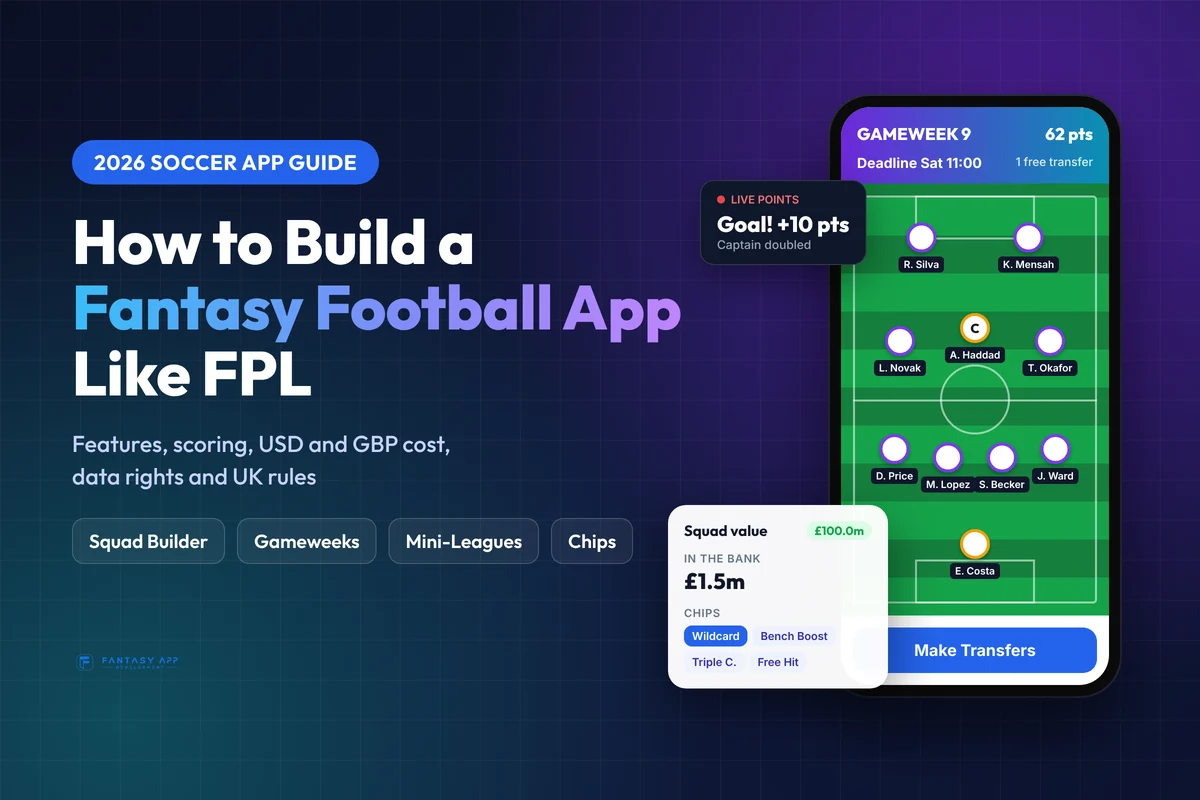
Quick answer: To build a fantasy football app like Fantasy Premier League (FPL), you need a budget-based squad builder, gameweek deadlines, transfers and chips, live points from a licensed football data feed, and private and public mini-leagues. A one-league MVP typically costs about $10,000 to $20,000, and a multi-league platform with live bonus points, cups, chat and sponsor prizes runs $30,000 to $50,000 or more. The bigger decisions are which leagues you cover, how you license data and images, and whether you stay free-to-play. This guide covers features, costs in USD and GBP, tech stack, UK and international rules, and a launch plan.
Key takeaways
- FPL is the world's biggest fantasy football game: more than 11.5 million people played in 2024/25, a record (Wikipedia, citing the Premier League).
- Over 9.1 million managers had signed up before the first 2025/26 deadline, also a record (Sportscasting).
- FPL is free-to-play and earns from sponsors and attention, not entry fees. That model works almost everywhere without a gambling licence.
- Football data is affordable to start: Sportmonks lists plans from €29 per month (Sportmonks). Official images and club logos need separate licences.
- Win by owning a niche FPL does not cover: another league, a local market, a new format or a community.
What is Fantasy Premier League and how does it work?
Fantasy Premier League (FPL) is the official, free fantasy game of the English Premier League. Each manager picks a 15-player squad within a £100 million virtual budget, starts 11 players each gameweek, and scores points based on what those players do in real matches.
The core rules that keep millions of people playing all season:
- Budget and squad limits: 2 goalkeepers, 5 defenders, 5 midfielders and 3 forwards, with at most 3 players from one club.
- Gameweek deadlines: teams lock before the first match of each round.
- Captain and vice-captain: the captain's points are doubled.
- Transfers: one free transfer per gameweek (unused ones can be saved up to a limit); extra transfers cost points.
- Chips: one-off boosts such as Wildcard, Bench Boost, Triple Captain and Free Hit.
- Player prices: values rise and fall with demand during the season.
- Mini-leagues: friends, workplaces, fan communities and creators run their own leagues and cups.
Why build a fantasy football app like FPL?
Football (soccer) is the world's most-watched sport, and fantasy football is a habit for fans in the UK, Europe, Africa, the Middle East and Asia. Yet the big official games cover only a few leagues, and most local leagues have no good fantasy product at all. That leaves room for:
- League-specific games: Saudi Pro League, MLS, Eredivisie, Ligue 1, African or Asian leagues, women's football.
- Tournament games: World Cup, Euros, AFCON, Champions League.
- Brand and media games: a broadcaster, betting-free sponsor or club running its own fantasy league to grow its audience.
- New formats: daily or single-match fantasy, draft leagues, head-to-head cups, AI-assisted squad picks.
Which features does an FPL-style app need?
| Feature | What it does | Phase |
|---|---|---|
| Sign-up and profiles | Email, Google or Apple login, favourite club, country | MVP |
| Squad builder | Budget, position limits, club limits, player search and filters | MVP |
| Gameweek engine | Deadlines, auto-subs, captain and vice-captain logic | MVP |
| Transfers and prices | Free transfers, point hits, dynamic player prices | MVP |
| Live points | Points update from goals, assists, clean sheets, saves, cards and bonus | MVP |
| Mini-leagues | Classic and head-to-head leagues, invite codes, league tables | MVP |
| Chips | Wildcard, Bench Boost, Triple Captain, Free Hit or your own boosts | Phase 2 |
| Cups and prizes | Knockout cups, monthly prizes, sponsor rewards | Phase 2 |
| Stats and insights | Fixture difficulty, ownership %, form, AI squad tips | Phase 2-3 |
| Social | League chat, share cards, creator leagues | Phase 2 |
| Multi-league and multi-language | Several competitions, languages and time zones | Phase 3 |
The admin panel should let your team set scoring rules, edit player prices and positions, fix stat corrections, run promotions, moderate chat and see reports on active managers and retention.
How does FPL-style scoring work?
A clear, public scoring table builds trust. Here is an example outfield scoring model, close to what many football fantasy games use, that you can adapt:
| Action | Defender | Midfielder | Forward |
|---|---|---|---|
| Playing 60+ minutes | 2 | 2 | 2 |
| Goal scored | 6 | 5 | 4 |
| Assist | 3 | 3 | 3 |
| Clean sheet | 4 | 1 | 0 |
| Yellow / red card | -1 / -3 | -1 / -3 | -1 / -3 |
Your scoring engine must also handle late stat corrections, postponed matches, double and blank gameweeks, and auto-substitutions. These edge cases are where most fantasy apps lose user trust, so test them with replays of last season's data before launch.
What tech stack and data do you need?
| Layer | Common choices |
|---|---|
| Mobile apps | Flutter or React Native, or native Swift and Kotlin |
| Web and admin | React or Next.js |
| Backend | Node.js, Go or Java with a job queue for gameweek processing |
| Real-time | WebSockets and Redis for live points and league tables |
| Database | PostgreSQL or MongoDB, Redis for caching ranks |
| Football data | Sportmonks, Stats Perform (Opta), Sportradar, API-Football and others |
| Cloud | AWS, Google Cloud or Azure with auto-scaling for deadline spikes |
Two traffic peaks matter most: the hour before each deadline, when millions of transfers can arrive at once, and Saturday afternoons, when everyone checks live points. Ranking millions of managers after each gameweek is a batch job you should design for from day one.
Data and rights: stats come from a licensed data provider. Official player photos, club badges and league logos are separate intellectual property. In England, Football DataCo manages data rights for the Premier League and EFL and protects official player action images (Football DataCo). Many independent games use player names and stats from a licensed feed with generic kits and no official badges. Take legal advice before using any league or club branding.
How much does it cost to build a fantasy football app like FPL?
| Version | Scope | Cost (USD) | Approx. GBP | Timeline |
|---|---|---|---|---|
| MVP | One league, squad builder, gameweeks, live points, mini-leagues | $10,000 to $20,000 | £8,000 to £16,000 | 1 to 2 months |
| Mid-level | MVP plus chips, cups, head-to-head, admin panel, push alerts | $20,000 to $30,000 | £16,000 to £24,000 | 2 to 3 months |
| Advanced | Multiple leagues, stats hub, AI tips, chat, multi-language | $30,000 to $50,000 | £24,000 to £40,000 | 3 to 5 months |
| Enterprise | Millions of users, sponsor tools, paid modes where licensed | $50,000+ | £40,000+ | 5+ months |
GBP figures are rounded conversions. Running costs come on top: football data (from about €29 per month for a few leagues on entry plans, much more for live, deep stats), hosting that scales on deadline days, and maintenance before each new season. See our fantasy football app cost guide for a detailed breakdown, or consider a white label fantasy sports platform if you must launch before the next season.
How can an FPL-style app make money?
- Sponsorship: title sponsors, sponsored mini-leagues and branded prizes. This is how most free official games are funded.
- Advertising: display and video ads around team pages and live points.
- Premium membership: advanced stats, AI transfer planner, ad-free mode.
- Brand and B2B licensing: run white-label versions for clubs, broadcasters or media brands.
- Paid contests: only where you hold the right licence; see the rules below.
Is a fantasy football app legal in the UK and other markets?
Free-to-play fantasy football like FPL is legal in nearly every country. Rules apply when players pay to enter for cash prizes. This is a summary, not legal advice.
| Market | What to know |
|---|---|
| United Kingdom | The Gambling Commission has warned that fantasy leagues run as a business, where prizes depend on paying entrants, may need a pool betting licence (UK Gambling Commission). Free entry with sponsor prizes is the usual route. |
| European Union | Each country has its own gambling regulator, so paid contests need local approval. Free-to-play works across the EU, with GDPR for user data. |
| Middle East | Gambling is restricted in most Gulf states, so free-to-play with sponsor prizes is the standard model. |
| Africa | Paid games fall under national or state betting regulators; free-to-play with airtime or sponsor rewards is common. |
| United States | Paid fantasy is regulated state by state (see our Sleeper-style app guide). |
| India | The Online Gaming Act, 2025 bans real-money online games, so football fantasy there must be free-to-play. |
How do you build an FPL-style app, step by step?
- Choose your niche: a league, a region, a tournament or a community FPL does not serve well.
- Pick your model: season-long gameweeks, daily contests, draft leagues or a mix, and decide free-to-play vs paid.
- License data: compare coverage, live speed, stat depth (bonus-style stats need detailed data) and price.
- Write the rules: budget, squad limits, scoring, transfers, chips and tie-breaks, all public.
- Design and prototype: squad builder and live points first; test with 15 to 20 real fans.
- Build and load-test: simulate deadline spikes and replay a full past season through the scoring engine.
- Launch 4 to 6 weeks before the season: most managers pick their squads in pre-season.
- Grow: add cups, chat, creator leagues and more competitions based on what players ask for.
Final word
FPL shows that a free, well-run fantasy football game can build a huge, loyal audience. You do not need to beat FPL at its own game. Pick a league, market or format it does not serve, get the scoring and deadlines right, and launch before the season starts.
Fantasy App Development builds fantasy football apps for clients worldwide and can deliver a branded app in about 30 days. Explore our fantasy football app development service, read how to build a fantasy app users love or how AI agents improve engagement, and contact us for a free consultation.