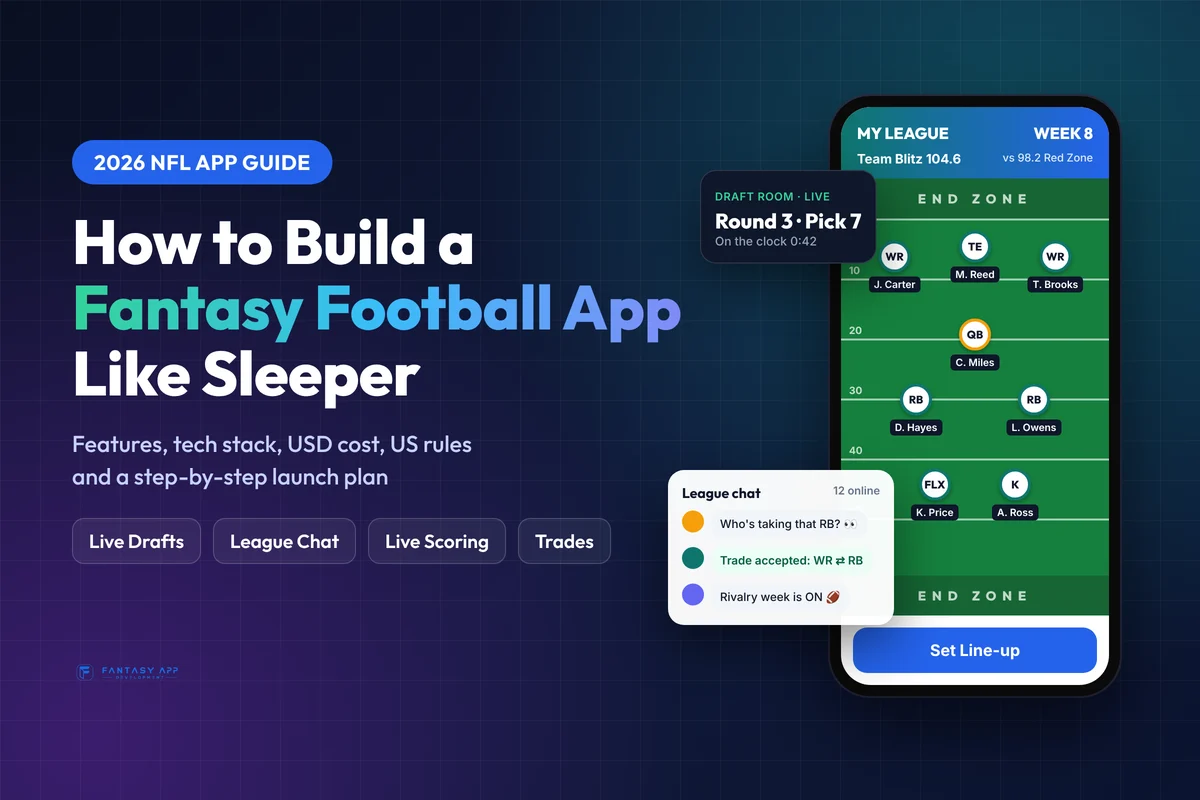
Quick answer: To build a fantasy football app like Sleeper, you need five core pieces: season-long leagues with snake, linear and auction drafts; live NFL scoring from a licensed data feed; built-in league chat; trades, waivers and a weekly matchup engine; and a mobile-first design that feels fast on game day. A one-sport MVP typically costs about $20,000 to $30,000, and a full Sleeper-style platform with chat, multiple sports and a payments wallet runs $50,000 or more, plus sports data fees. This guide covers the features, tech stack, costs in USD, US and international rules, and a step-by-step launch plan.
Key takeaways
- Sleeper grew by making fantasy football social: chat sits next to every league, draft and trade.
- Sleeper raised a $40 million Series C in 2021 at a valuation of about $400 million (Front Office Sports).
- The audience is big: about 84 million adults in the US and Canada played fantasy sports or bet on sports in the past year, per 2025 FSGA research (FSGA).
- Live NFL data is a separate cost. One marketplace reports a median SportsDataIO contract of about $16,500 per year (Vendr).
- Start free-to-play, then add paid leagues only in states and countries where you hold the right approvals.
What is Sleeper and why do fantasy players love it?
Sleeper is a US fantasy sports app best known for season-long fantasy football leagues with built-in chat. It started in fantasy football and added other sports, esports and newer products over time. In February 2026 it launched prediction markets powered by Kalshi for what it described as its 10 million users (GamesBeat).
Players pick Sleeper over older apps for a few clear reasons:
- Chat everywhere. Every league has its own group chat, and trades, waivers and big scores show up inside it.
- Modern, fast design. The app feels like a social app, not a stats spreadsheet.
- Flexible leagues. Snake, linear and auction drafts, dynasty and keeper leagues, custom scoring and best-ball formats.
- Free to start. Anyone can create a league for free; money features are optional.
What are the must-have features of a fantasy football app like Sleeper?
Player app features
| Feature | What it does | Phase |
|---|---|---|
| Sign-up and profiles | Email, Google or Apple login, avatar, favourite team | MVP |
| League creation | Public or private leagues, invite links, custom scoring and roster settings | MVP |
| Draft room | Live snake, linear and auction drafts with timers, queue and auto-pick | MVP |
| Mock drafts | Practice drafts against bots or other users | Phase 2 |
| Roster management | Set line-ups, bench, injured reserve, lock at kick-off | MVP |
| Waivers and free agents | FAAB bidding or rolling waivers, processed on a schedule | MVP |
| Trades | Propose, counter, accept, veto and trade review | MVP |
| Live scoring | Points update during NFL games, weekly head-to-head matchups | MVP |
| League chat | Group chat, GIFs, reactions, polls, automatic trade and score posts | MVP |
| Dynasty and keeper leagues | Rosters carry over, rookie drafts, future draft picks | Phase 2 |
| Best ball and playoffs | Auto-optimised line-ups, playoff brackets, trophies | Phase 2 |
| Player news and projections | Injury updates, depth charts, AI start/sit tips | Phase 2-3 |
| Wallet and paid leagues | League dues and payouts where legal, with KYC and geolocation | Phase 3 |
Admin panel features
- User, league and content management
- Scoring rules, season and week settings, stat corrections
- Chat moderation, reports and bans
- Push notification campaigns and promotions
- Analytics: daily active users, leagues created, draft completion, retention
- Payment, KYC and geolocation reports (if you run paid leagues)
Season-long vs daily fantasy: which model should a Sleeper-style app use?
Sleeper is built around season-long fantasy: you draft once and manage the team all season. Daily fantasy (DFS), made popular by DraftKings and FanDuel, uses a new salary-cap team for each slate of games. The two need different engines.
| Factor | Season-long (Sleeper, ESPN, Yahoo) | Daily fantasy (DraftKings, FanDuel) |
|---|---|---|
| Core loop | Draft, weekly matchups, trades, waivers | Pick a salary-cap line-up for each slate |
| Social depth | High: same friends all season | Lower: large public contests |
| Hardest tech | Live draft room, chat, waiver processing | Contest engine, salaries, payouts at scale |
| Revenue | Premium features, ads, league dues fees | Entry fee rake |
| Legal complexity | Lower when free-to-play | Higher: licensed state by state |
Many apps now mix both. If you want the daily model, read our guides to building a platform like DraftKings and FanDuel-style app development.
What tech stack does a fantasy football app need?
| Layer | Common choices |
|---|---|
| Mobile apps | React Native or Flutter (one codebase for iOS and Android), or native Swift and Kotlin |
| Web app and admin | React or Next.js |
| Backend | Node.js, Go or Elixir for real-time features |
| Real-time (drafts, chat, scores) | WebSockets, Redis pub/sub |
| Database | PostgreSQL or MongoDB, plus Redis for leaderboards and caches |
| NFL data feed | Licensed providers such as Sportradar or SportsDataIO |
| Push notifications | Firebase Cloud Messaging and Apple Push Notification service |
| Cloud | AWS, Google Cloud or Azure with auto-scaling |
Plan for peaks. Sunday afternoons in the NFL season bring most of your weekly traffic into a few hours, and draft nights in late August can spike even higher. Load-test drafts and live scoring before the season starts, not during week 1.
How much does it cost to build a fantasy football app like Sleeper?
| Version | What you get | Typical cost (USD) | Timeline |
|---|---|---|---|
| MVP | One sport (NFL), leagues, snake draft, live scoring, basic chat | $10,000 to $20,000 | 1 to 2 months |
| Mid-level | MVP plus auction drafts, trades, waivers, full chat, admin panel | $20,000 to $30,000 | 2 to 3 months |
| Advanced | Dynasty, best ball, mock drafts, AI tips, multiple sports | $30,000 to $50,000 | 3 to 5 months |
| Enterprise | Wallet and paid leagues, KYC, geolocation, high-scale infrastructure | $50,000+ | 5+ months |
These are development costs with an offshore team. US and Western European agencies usually charge several times more for the same scope. Ongoing costs come on top:
- NFL data feed: often thousands to tens of thousands of dollars per year. A median SportsDataIO buyer pays about $16,500 per year, according to Vendr; Sportradar quotes are custom.
- Hosting: scales with users and season peaks.
- Maintenance and updates: new NFL season rules, iOS and Android updates, bug fixes.
- Compliance: legal reviews, KYC and geolocation services if you add paid leagues.
For a feature-by-feature breakdown, see our fantasy football app cost guide. If you need to launch before the next NFL season, a white label fantasy sports platform can cut the timeline.
How do Sleeper-style apps make money?
- League dues and payouts: a fee on money leagues where they are legal. Sleeper earns from its wallet, which handles paid league entries.
- Premium subscriptions: advanced stats, trade analysers, projections and ad-free use.
- Advertising and sponsors: branded leagues, sponsored contests and in-app placements.
- Daily contests and pick'em: extra game modes where licensed.
- Virtual items: custom avatars, league trophies and themes.
Is it legal to launch a fantasy football app in the US, UK and other markets?
Free-to-play fantasy football is legal in almost every market. Paid contests are where the rules start. This is a summary, not legal advice.
| Market | What to know |
|---|---|
| United States | The federal UIGEA (2006) exempts fantasy contests that meet its skill tests, but each state decides on paid fantasy. Several states license daily fantasy, some ban it, and regulators in states like Arizona and Michigan have acted against pick'em contests (Legal Sports Report). Use state-level geolocation. |
| Canada | Rules vary by province; Ontario regulates online gaming through iGaming Ontario. |
| United Kingdom | Paid fantasy where prizes depend on the number of entrants may need a Gambling Commission pool betting licence (UK Gambling Commission). |
| Europe, Middle East, Australia | Country-by-country rules. Many brands launch free-to-play with sponsor prizes first. |
| India | The Promotion and Regulation of Online Gaming Act, 2025 bans real-money online games, so only free-to-play works. |
How do you build a fantasy football app like Sleeper, step by step?
- Pick your audience and angle. Sleeper already owns "social fantasy football". Find a gap: a sport (golf, soccer, college football), a region (UK, Australia, Middle East), a format (dynasty, best ball) or a community (creators, workplaces).
- Choose your model and legal path. Season-long, daily or both, and free-to-play or paid.
- License a data feed. Compare coverage, latency, stat corrections and price before you design scoring.
- Design the core loop. League setup, draft, weekly line-ups, chat. Test clickable prototypes with 15 to 20 real players.
- Build the MVP. Draft room, live scoring and chat first. These decide whether people stay.
- Load-test and beta. Run mock drafts with hundreds of users and replay last season's games through your scoring engine.
- Launch before the draft season. For the NFL, aim to be live by early August, when most leagues draft.
- Grow with features users ask for. Dynasty, best ball, AI tips, more sports and, where legal, paid leagues.
Final word
Sleeper proved that fantasy football is a social product first and a stats product second. To compete, you do not need every Sleeper feature on day one. You need a fast draft room, accurate live scoring, great chat and a clear reason why your audience should switch. Start lean, launch before the season and grow with your users.
Fantasy App Development builds custom fantasy apps for clients worldwide and can deliver a branded app in about 30 days. See our fantasy football app development service, explore basketball, baseball and hockey builds, or read how to build a fantasy app users love. Ready to plan yours? Get a free consultation.