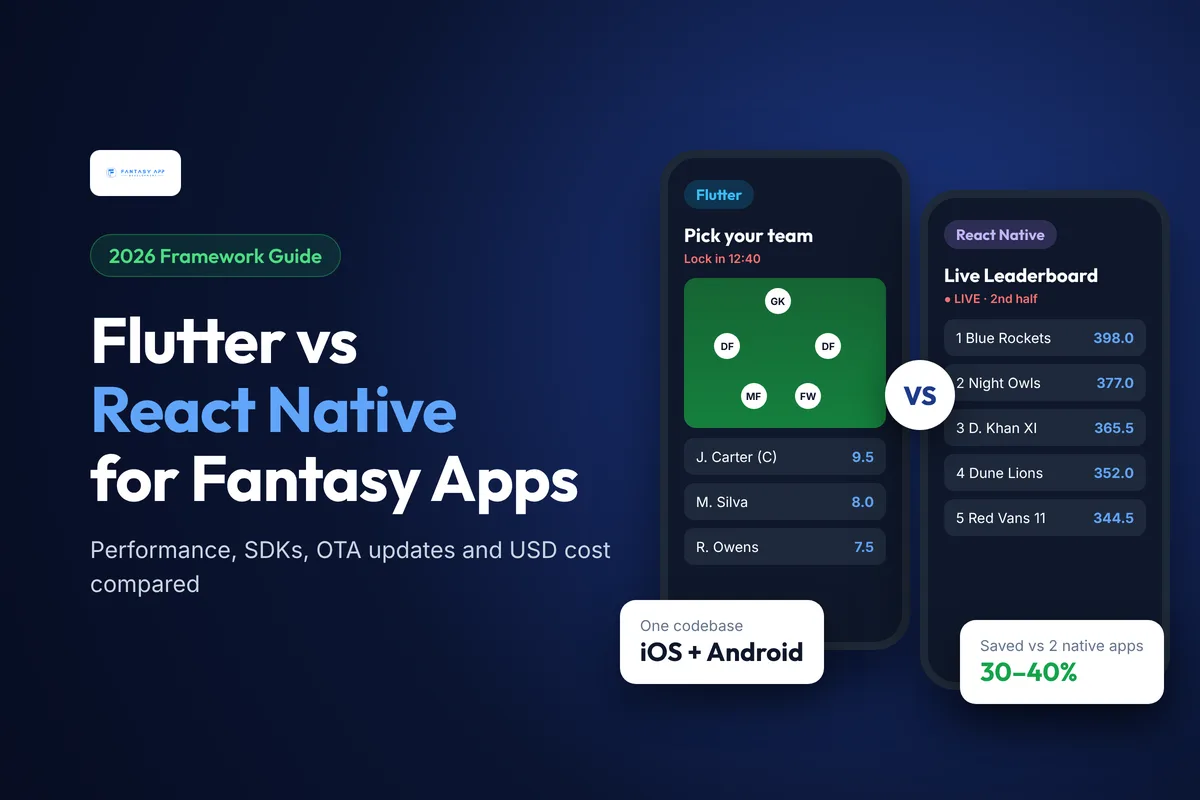
Quick answer: Should you build a fantasy sports app in Flutter or React Native? Both are good choices in 2026, and both can power a fantasy app with millions of users. Pick Flutter if your app is design-heavy (animated team builder, live point counters, custom leaderboards) and you want the same look and smooth performance on cheap Android phones and iPhones. Pick React Native if your team already writes JavaScript or TypeScript, your website and admin panel are built in React or Next.js, or you depend on many third-party SDKs for payments, KYC and geolocation. For most fantasy startups the deciding factor is your team and your web plan, not raw speed. Either way, one cross-platform codebase usually costs 30% to 40% less than building separate native iOS and Android apps.
Key takeaways
- The performance gap has narrowed. React Native's New Architecture became the default in version 0.76 (October 2024), and Flutter's Impeller renderer is now the default on iOS and modern Android.
- Flutter draws every pixel itself, so a complex team builder or animated leaderboard looks identical on every device. It is the safer pick for heavy custom UI.
- React Native uses JavaScript/TypeScript and React. JavaScript is used by about two-thirds of developers in Stack Overflow's 2025 survey, so hiring is easier, and code and skills can be shared with a React or Next.js web app.
- Over-the-air (OTA) fixes matter on match day. React Native has Expo EAS Update; Flutter has Shorebird. Microsoft's CodePush service (App Center) was retired in March 2025.
- The hard parts of a fantasy app (real-time scoring, leaderboards, wallet, data feeds) live on the backend, so your framework choice affects cost far less than your backend design.
- Typical cross-platform build cost in USD: MVP $10,000 to $20,000, mid-level $20,000 to $30,000, advanced $30,000 to $50,000, enterprise $50,000+.
Last updated: November 8, 2026. Framework details reflect Flutter 3.x and React Native 0.8x releases. Costs are typical ranges for a full fantasy app (mobile apps, backend and admin panel) and depend on features and markets.
Flutter vs React Native: what is the difference?
Flutter is Google's open-source UI toolkit. You write the app in the Dart language, and Flutter compiles it to native machine code. It does not use the phone's own buttons and lists; it draws the whole interface with its own rendering engine (Impeller). That is why a Flutter app looks the same everywhere.
React Native is Meta's open-source framework. You write the app in JavaScript or TypeScript with React, and it renders real native iOS and Android components. Since the New Architecture (JSI, Fabric and TurboModules), JavaScript talks to native code directly instead of through the old "bridge", which removed most of the lag that older React Native apps were known for.
Both let one team ship an iPhone app and an Android app from one codebase. If you are still choosing the rest of your stack, see our full fantasy sports app tech stack guide.
Flutter vs React Native comparison table for fantasy apps
| Factor | Flutter | React Native | Better for fantasy apps |
|---|---|---|---|
| Language | Dart | JavaScript / TypeScript (React) | React Native, if your team knows JS |
| UI rendering | Own engine (Impeller), pixel-identical on all devices | Real native components | Flutter, for custom animated screens |
| Animations (point counters, confetti, drag-and-drop) | Very smooth out of the box | Smooth with Reanimated and Skia libraries | Flutter, slightly |
| Long live lists (leaderboards, player pools) | ListView.builder handles large lists well | FlashList handles large lists well | Tie |
| Low-end Android phones | Consistent frame rates | Good on New Architecture with Hermes | Flutter, slightly |
| Third-party SDKs (payments, KYC, geolocation, analytics) | Most have plugins; some need a custom wrapper | Largest library ecosystem (npm) | React Native |
| Web app and admin sharing | Flutter Web works, but it is canvas-based and weak for SEO | Shares logic and skills with React / Next.js websites | React Native |
| Over-the-air updates | Shorebird (paid tiers) | Expo EAS Update (free tier available) | React Native, slightly |
| Hiring pool | Growing, smaller | Very large | React Native |
| Build cost | Similar | Similar | Tie |
Which is faster for live scores and leaderboards?
For a fantasy app, "performance" means three things: the team builder must not stutter, live points must tick up smoothly, and a leaderboard with thousands of rows must scroll without blank gaps.
- Rendering: Flutter has a small edge on animation-heavy screens because it controls every frame. Since Impeller compiles shaders ahead of time, the old "first-run jank" on iOS is largely gone.
- React Native in 2026: with the New Architecture and the Hermes engine, typical screens start and scroll about as fast as Flutter. Heavy animations should run on the UI thread with Reanimated.
- Live data: both handle WebSockets, server-sent events and push notifications (Firebase Cloud Messaging and APNs) equally well. Speed of score updates depends on your backend, not on the app framework.
The real bottleneck on match day is usually the server, not the phone. Thousands of users open the app in the minutes before a team lock, and the backend has to answer them. Our guide on how to scale a fantasy sports app covers that part.
Which is better for payments, KYC and geolocation?
Paid-contest apps in markets such as the US (state-by-state rules) or the UK need extra services: payment gateways, identity checks (KYC), age checks and, in the US, precise geolocation to block users in states where paid contests are not allowed. Free-to-play apps need far fewer of these.
Most of these vendors ship native iOS and Android SDKs. React Native has the larger ecosystem of ready wrappers, so integration is often faster. Flutter can use the same native SDKs through platform channels, but a developer may need to write and maintain the wrapper. Before you choose, list every SDK you need and check that each has an official or well-maintained package for your framework.
| Need | What to check | Typical situation |
|---|---|---|
| Payments and wallet | Official SDK for Stripe, Adyen, PayPal or your local gateway | Both frameworks well covered |
| KYC and age checks | Vendor plugin, or native SDK you can wrap | React Native often has more ready packages |
| Geolocation compliance (US paid contests) | Vendor support for your framework | Confirm with the vendor before you build |
| Sports data feed | Handled by your backend API | Framework does not matter |
| Push notifications and analytics | Firebase, OneSignal, Amplitude, Mixpanel | Both frameworks well covered |
Do you need a web app too?
Many fantasy platforms also need a website (for SEO and sign-ups), a web version of the game, and an admin panel to manage matches, contests and payouts.
- With React Native: your web app and admin panel can be built in React or Next.js, and your team can share types, validation and API code across all three. One hiring profile covers everything.
- With Flutter: Flutter Web can reuse the game screens, which is handy for a logged-in web version. But it renders to a canvas, so it is not a good fit for public, SEO-focused pages. Most Flutter teams still build the marketing site and admin panel in a separate web framework.
How do over-the-air updates help on match day?
If a scoring display bug appears during a big match, waiting one to two days for App Store review is painful. Over-the-air (OTA) updates let you push fixes to the app's code without a full store release, as long as the change follows Apple and Google rules (no change to the app's core purpose).
- React Native: Expo EAS Update is the main option now. Microsoft retired App Center, including CodePush, on March 31, 2025, so older apps should migrate.
- Flutter: Shorebird offers code push for Flutter apps on iOS and Android.
Whichever you choose, keep critical rules (lock times, scoring, prize logic) on the server. Then many "bugs" can be fixed without any app update at all.
How much does a fantasy app cost in Flutter vs React Native?
The framework itself barely changes the price. What changes the price is the scope: number of sports, contest types, paid vs free-to-play, markets and integrations. Here are typical USD ranges for a full fantasy platform built with either framework (iOS and Android apps, backend and admin panel).
| Build level | What you get | Typical cost (USD) | Timeline |
|---|---|---|---|
| MVP | One sport, free-to-play or basic contests, team builder, live scores, leaderboard, admin panel | $10,000 to $20,000 | 4 to 8 weeks |
| Mid-level | Private leagues, referrals, wallet, push notifications, analytics | $20,000 to $30,000 | 8 to 12 weeks |
| Advanced | Multi-sport, paid contests, KYC, geolocation, AI player insights | $30,000 to $50,000 | 3 to 5 months |
| Enterprise | Multi-market, high-scale infrastructure, custom integrations | $50,000+ | 5 months+ |
Building two separate native apps (Swift for iOS and Kotlin for Android) usually adds 30% to 40% to the mobile part of the budget, plus higher long-term maintenance. For a deeper breakdown, read our fantasy football app cost guide. If you want to launch faster, a white label fantasy sports platform can cut the timeline further.
When should you choose Flutter?
- Your design is custom and animation-heavy: drag-and-drop team builder, animated pitch or field view, ticking point counters, celebration effects.
- Many of your users have budget Android phones (common in South Asia, Africa and parts of Latin America) and you want consistent frame rates.
- You want the app to look exactly the same on iOS and Android, matching a strict brand guide.
- Your team is new to mobile and does not have a strong JavaScript background.
When should you choose React Native?
- Your team, or your agency, already works in JavaScript, TypeScript and React.
- Your website, web game or admin panel is built in React or Next.js, and you want to share code and people across them.
- You need many third-party SDKs for payments, KYC, geolocation and marketing attribution, which is common for US and UK paid-contest apps.
- You want a mature OTA update workflow with Expo for fast match-day fixes.
Our recommendation
We build fantasy apps for clients in the US, UK, Europe, the Middle East, Australia and India, and we use both frameworks. Our rule of thumb is simple:
- Start with your team and your web plan. If your team or web stack is React, choose React Native. If neither applies and your UI is highly custom, choose Flutter.
- List your SDKs early. Check payments, KYC and geolocation support before writing any code.
- Put the effort into the backend. Scoring, lock times, leaderboards and the wallet decide whether your app survives match day.
- Plan OTA updates from day one, so a display bug never ruins a big game week.
Not sure which fits your idea? Tell us your sport, market and features on our contact page, and we will suggest the right stack and a fixed USD estimate. You can also see what we build for fantasy football and fantasy cricket.
Sources: React Native 0.76 release notes, Flutter Impeller docs, Stack Overflow Developer Survey 2025, Microsoft App Center retirement, Expo EAS Update, Shorebird.