
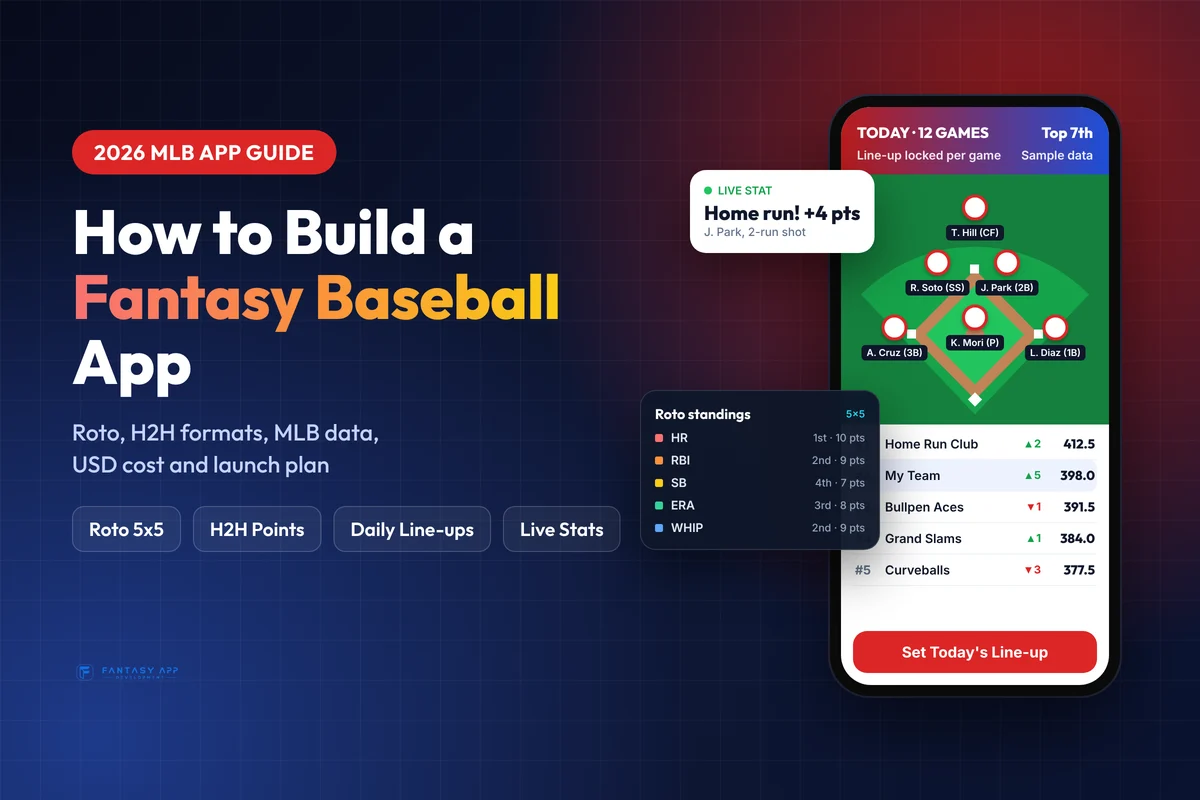
Quick answer: To build a fantasy baseball app, you need season-long leagues in the three main formats (rotisserie, head-to-head points and head-to-head categories), a daily line-up manager for a 162-game season, live scoring from a licensed MLB data feed, and solid league tools such as drafts, trades and waivers. A one-format MVP typically costs about $10,000 to $20,000, and a full platform with all formats, daily contests and chat runs $30,000 to $50,000 or more. This guide covers formats, features, data, tech stack, costs in USD, rules in the US, Canada, Japan and other markets, and a launch plan built around Opening Day.
Key takeaways
- Baseball's audience is growing: MLB's 2025 attendance reached 71.4 million, the third straight year of growth (MLB).
- Interest is global: the 2025 Tokyo Series averaged more than 24 million viewers in Japan, the most-watched MLB series ever there (MLB).
- Rotisserie ("roto") is described by ESPN as the most common way to play fantasy baseball (ESPN).
- Yahoo's default league uses 5 batting categories (R, HR, RBI, SB, AVG) and 5 pitching categories (W, SV, K, ERA, WHIP) (Yahoo via AOL).
- Baseball is a daily sport, so your app must make daily line-up changes fast and reliable.
What is a fantasy baseball app?
A fantasy baseball app lets fans draft real MLB players (or players from other leagues such as Japan's NPB or Korea's KBO) and earn points or category wins based on their real statistics. Most fantasy baseball is season-long: a league drafts in March, manages rosters through about six months of games, and crowns a champion in September.
Because MLB teams play almost every day, fantasy baseball is the most "daily" of the season-long fantasy sports. Players check line-ups, starting pitchers and injuries every day, which makes it a high-engagement product if the app is fast and helpful.
Which fantasy baseball formats should your app support?
| Format | How it works | Best for |
|---|---|---|
| Rotisserie (roto) | Teams are ranked in each stat category across the whole season; points by rank | Experienced, stat-loving players |
| Head-to-head categories | Weekly matchup; win, lose or tie each category (e.g. 6-3-1 in a 10-category league) | Players who want weekly rivalries |
| Head-to-head points | Every stat has a point value; the team with more points wins the week | Beginners and fantasy football fans |
| Best ball | Draft only; the app picks your best line-up automatically | Casual players with little time |
| Dynasty and keeper | Keep some or all players for future seasons; prospects matter | Long-running, committed leagues |
| Daily fantasy (DFS) | Salary-cap team for one day's games | Players who want quick contests, where licensed |
Most new apps launch with head-to-head points (easiest to learn) and roto or categories (what experienced players expect), then add best ball and dynasty. Our season-long vs daily fantasy guide explains how to choose between league and contest models.
How does fantasy baseball scoring work?
Category scoring (roto and head-to-head categories)
The classic 5x5 setup tracks five hitting stats (runs, home runs, RBI, stolen bases, batting average) and five pitching stats (wins, saves, strikeouts, ERA, WHIP). Many leagues swap in on-base percentage, quality starts or holds. Your app should let commissioners choose categories freely.
Points scoring (head-to-head points)
| Stat | Example points |
|---|---|
| Single / double / triple / home run | 1 / 2 / 3 / 4 (total bases) |
| Run, RBI, walk | 1 each |
| Stolen base | 1 to 2 |
| Batter strikeout | -1 |
| Inning pitched | 3 |
| Pitcher strikeout | 1 |
| Win / save | 2 to 5 |
| Earned run allowed | -2 |
These are example values; publish your own rules clearly and let commissioners customise them.
What features does a fantasy baseball app need?
Player features
- Sign-up with email, Google or Apple and a quick league join flow
- Live drafts (snake and auction) with timers, queues and auto-pick, plus mock drafts
- Daily line-up manager with "start active players" and lock-per-game options
- Probable starting pitchers, two-start pitchers, weather and postponement alerts
- Live scoring and category standings that update during games
- Trades, waivers (rolling or FAAB), free agents and injured list slots
- Player pages with stats, splits, news and projections
- League chat, push alerts and weekly recaps
Admin and commissioner features
- Custom categories or point values, roster positions and limits
- Stat corrections and postponed or suspended game handling
- Playoff settings, keeper and dynasty rules
- Promotions, sponsor leagues and reporting dashboards
Where do you get MLB data for a fantasy app?
You need schedules, probable pitchers, confirmed line-ups, live play-by-play stats, injuries and stat corrections. Licensed providers such as Sportradar and SportsDataIO sell MLB feeds for fantasy use; SportsDataIO's buyers report a median contract of about $16,500 per year across its products (Vendr). For NPB or KBO leagues, check coverage carefully, because fewer providers offer live data.
Baseball has more postponements and stat corrections than most sports, so test how your provider handles rain delays, suspended games and scoring changes before you launch.
What tech stack does a fantasy baseball app need?
| Layer | Common choices |
|---|---|
| Mobile apps | Flutter or React Native |
| Web and admin | React or Next.js |
| Backend | Node.js, Go or Java with job queues for daily lock processing |
| Real-time | WebSockets and Redis for live scores and standings |
| Database | PostgreSQL or MongoDB plus Redis caches |
| Cloud | AWS, Google Cloud or Azure with auto-scaling for evening game windows |
With up to 15 MLB games a day across several time zones, your scoring engine runs almost continuously from spring training to October. Plan background jobs for nightly category recalculation and daily roster locks.
How much does it cost to build a fantasy baseball app?
| Version | Scope | Cost (USD) | Timeline |
|---|---|---|---|
| MVP | One format (H2H points), snake draft, daily line-ups, live scoring, private leagues | $10,000 to $20,000 | 1 to 2 months |
| Mid-level | Roto and categories, auction drafts, trades, waivers, chat, admin panel | $20,000 to $30,000 | 2 to 3 months |
| Advanced | Best ball, dynasty, projections, AI line-up tips, NPB/KBO support | $30,000 to $50,000 | 3 to 5 months |
| Enterprise | Paid leagues or DFS with KYC, geolocation and high-scale infrastructure | $50,000+ | 5+ months |
Add data, hosting and maintenance on top. See our fantasy app cost guide for cost drivers, or a white label platform if you must launch before Opening Day.
Is fantasy baseball legal in the US, Canada, Japan and other markets?
Free fantasy baseball leagues are legal almost everywhere. Paid contests are regulated. This is a summary, not legal advice.
| Market | What to know |
|---|---|
| United States | Paid fantasy is regulated state by state; a few states block the major DFS apps (Legal Sports Report). |
| Canada | Province by province; Ontario regulates online gaming through iGaming Ontario. |
| Japan and South Korea | Strict gambling laws; free-to-play leagues with sponsor prizes are the realistic model. |
| Latin America | Country-specific rules; free-to-play is the safest way to start. |
| UK and Europe | Paid contests may need a gambling licence; free leagues are fine. |
How do you build a fantasy baseball app, step by step?
- Pick your audience: US and Canadian MLB fans, Japanese or Korean fans, Latin American markets, or a niche such as dynasty players.
- Choose formats: start with head-to-head points plus one category format.
- License data: test live speed, probable pitchers and stat corrections.
- Design the daily loop: make setting a line-up take seconds, not minutes.
- Build the MVP: draft room, daily line-ups, live scoring and private leagues first.
- Replay a past season: test scoring, categories and postponements with real historical data.
- Launch before draft season: most leagues draft in March, before Opening Day.
- Grow: add best ball, dynasty, prospects, AI tips and, where licensed, paid contests.
Final word
Fantasy baseball rewards apps that respect how much its players care about stats and daily decisions. Get the formats right, make daily line-ups effortless, keep scoring accurate through rain delays and corrections, and launch before draft season.
Fantasy App Development builds fantasy sports apps for clients worldwide and can deliver a branded app in about 30 days. See our fantasy baseball app development service, read how to build a Sleeper-style league app, or contact us for a free consultation.