
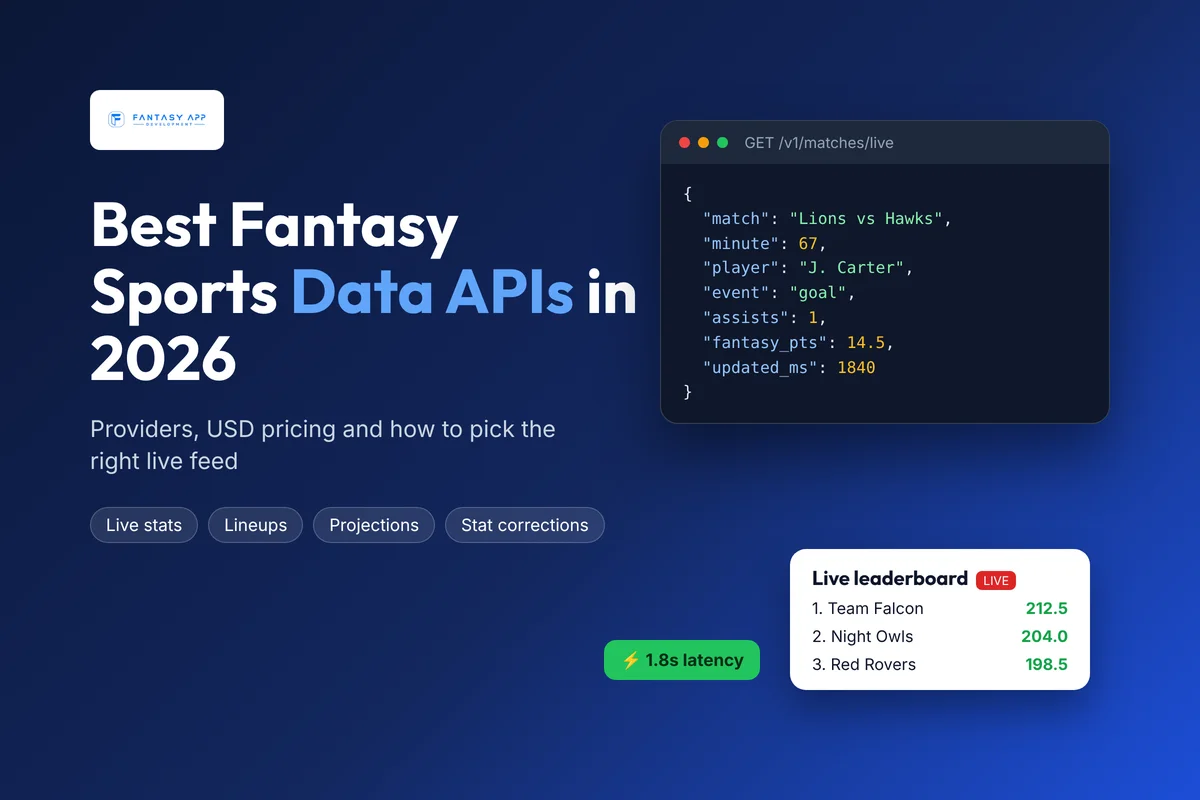
Quick answer: The best fantasy sports data API depends on your sports, budget and how live your contests are. Sportradar and Stats Perform (Opta) are the enterprise choices with official league feeds and the widest coverage. SportsDataIO is the most fantasy-focused US provider, with projections and DFS salaries for the NFL, NBA, MLB and NHL. Sportmonks and API-Football are low-cost picks for soccer, and Roanuz, Entity Sport and CricketData are common for cricket. Most new fantasy apps start on a mid-priced feed ($100 to $2,000 per month per sport), then move to an official enterprise feed when they need sub-second live scoring or real-money contests in regulated markets. Below is a comparison table, a checklist for choosing, real cost ranges in USD and how to integrate the feed into your app.
Key takeaways
- Your data feed is the heart of a fantasy app: player lists, fixtures, lineups, live stats and final scores all come from it.
- Enterprise feeds (Sportradar, Stats Perform, Genius Sports) are priced by quote and usually start in the thousands of dollars per month.
- Developer APIs (SportsDataIO entry tiers, Sportmonks, API-Football) publish plans from about $19 to $150 per month, but often with delays, rate limits or fewer stats.
- For live contests, latency matters more than price: a 60-second delay is fine for season-long leagues but not for daily fantasy with live leaderboards.
- Always build a data layer between the API and your app, so you can switch or add providers without rewriting the scoring engine.
Last updated: November 11, 2026. Author: Denwek.
What is a fantasy sports data API?
A fantasy sports data API is a web service that sends your app structured sports data: teams, players, fixtures, confirmed lineups, injuries, live play-by-play stats and final box scores. Your app turns those stats into fantasy points using its own scoring rules. Some providers also sell fantasy-specific extras such as player projections, ownership percentages, DFS salaries and pre-calculated fantasy points.
Data is usually delivered in one of three ways:
- REST pull: your server requests data on a schedule (for example every 10 to 30 seconds during a match). Simple, and the most common option.
- Push feeds and webhooks: the provider sends updates as they happen. Faster, and used by enterprise feeds.
- WebSocket or streaming: a constant live stream of events, needed for second-by-second scoring and in-play features.
Best fantasy sports data APIs compared (2026)
| Provider | Best for | Sports coverage | Fantasy extras | Pricing model |
|---|---|---|---|---|
| Sportradar | Large, regulated real-money platforms | 80+ sports, official NFL, NBA, NHL, MLB and many soccer leagues | Deep live stats, push feeds, odds; fantasy points built by you | Custom annual contract; commonly reported from about $5,000+ per month |
| Stats Perform (Opta) | Soccer-first products in the UK and Europe | Soccer, cricket, tennis, rugby, US sports | Opta event data, advanced metrics, predictions | Custom quote, sized to the client |
| Genius Sports | Official league data and fan engagement | NFL (official), Premier League, many federations | Official live data, fan engagement tools | Custom quote |
| SportsDataIO | US fantasy and DFS apps | NFL, NBA, MLB, NHL, college, soccer, golf, MMA, NASCAR and more | Projections, DFS salaries, injuries, depth charts, fantasy points | Low-cost tiers with delayed data; real-time by quote |
| Sportmonks | Soccer and cricket on a budget | 2,000+ soccer leagues, cricket | Lineups, live events, predictions add-on | Public plans from about €29 per month |
| API-Football (API-Sports) | MVPs and side projects | 1,000+ soccer leagues; sister APIs for other sports | Lineups, player stats, predictions | Free tier (100 requests/day), paid from about $19 per month |
| Roanuz / Entity Sport / CricketData | Fantasy cricket | International, IPL, BBL, PSL, The Hundred and domestic cricket | Ball-by-ball data, fantasy points, player credits | Monthly plans or per-tournament packs |
| MySportsFeeds / balldontlie | Prototypes and hobby leagues | NFL, NBA, MLB, NHL | Box scores and basic stats | Free or low-cost personal plans |
Prices change often and most enterprise vendors only quote after a sales call, so treat these ranges as a starting point for budgeting, not a price list.
How to choose a sports data API for your fantasy app
Use this checklist before you sign a contract:
- Coverage: does it cover every league you want at launch and in the next year? Check lower leagues and women's competitions too.
- Latency: how many seconds from a real event to your API? Daily fantasy and live leaderboards need a few seconds; season-long leagues can live with minutes.
- Stat depth: your scoring rules need every stat they use. A fantasy football app that rewards tackles, key passes or clean sheets needs those exact fields.
- Lineups and injuries: confirmed lineups (usually 60 minutes before kick-off in soccer, at the toss in cricket) drive player selection. Late lineups mean angry users.
- Stat corrections: leagues change stats after games. Ask how corrections are sent and how long after the match.
- Licensing: some leagues require official data for real-money or betting-like products. Check the license allows commercial fantasy use in your target countries.
- Uptime and support: look for a 99.9% SLA, a status page and support during match hours in your users' time zones.
- Total cost: include per-sport fees, overage charges, extra leagues and the cost of a backup provider.
Which data API is best for each sport?
| Sport | Budget option | Mid-market option | Enterprise option |
|---|---|---|---|
| American football (NFL) | MySportsFeeds | SportsDataIO | Sportradar, Genius Sports |
| Soccer (Premier League, LaLiga, MLS) | API-Football | Sportmonks | Stats Perform (Opta), Sportradar |
| Cricket (IPL, BBL, internationals) | CricketData | Roanuz, Entity Sport | Sportradar, Stats Perform |
| Basketball (NBA, EuroLeague) | balldontlie | SportsDataIO | Sportradar |
| Baseball (MLB) | MLB Stats API (personal use) | SportsDataIO | Sportradar |
| Ice hockey (NHL) | MySportsFeeds | SportsDataIO | Sportradar |
| Esports, MMA, golf | PandaScore free tier (esports) | SportsDataIO (MMA, golf), PandaScore | Sportradar, GRID (esports) |
Building for one sport only? See our sport-specific guides for the fantasy cricket app, fantasy football app and fantasy basketball app services.
How much does a sports data feed cost?
The data feed is often the biggest running cost of a fantasy app after the team. Typical monthly costs in USD look like this:
| Stage | Typical feed | Monthly cost (USD) | Good for |
|---|---|---|---|
| Prototype / MVP test | Free tier or developer plan | $0 to $150 | Demos, closed beta, free-to-play leagues |
| Launch (1 to 2 sports) | Mid-market real-time feed | $500 to $3,000 | Season-long and free-to-play daily contests |
| Growth (3+ sports, live DFS) | Mid-market plus a backup feed | $3,000 to $10,000 | Live leaderboards, many leagues |
| Enterprise / regulated real money | Official league data | $10,000+ | US state-licensed DFS, UK and EU operators |
Data is a running cost on top of the build. For the full picture, read our guide on how much it costs to develop a fantasy football app and how fantasy sports apps make money to plan the revenue that pays for it.
How to integrate a sports data API into a fantasy app
A reliable setup has five parts:
- Ingestion service: pulls or receives data from the provider, checks it and stores raw events. Never let the mobile app call the provider directly; it exposes your API key and burns your rate limit.
- Normalisation layer: maps the provider's player, team and match IDs to your own IDs. This is what lets you add or swap providers later.
- Scoring engine: turns stats into fantasy points using your rules, and recalculates when a stat correction arrives.
- Cache and real-time push: Redis for hot data and WebSockets or Firebase to push live points to thousands of users at once.
- Monitoring and fallback: alerts when the feed goes silent mid-match, plus a second provider or manual scoring tool for emergencies.
We cover the full architecture in our fantasy sports app tech stack guide, and how to handle match-day traffic spikes in how to scale a fantasy sports app.
Common mistakes when picking a data provider
- Choosing on price alone: a cheap feed that misses a lineup or lags by two minutes during a big match can cost more in refunds and lost users than a year of the better feed.
- Ignoring licensing: using a personal or non-commercial API in a paid product can get your access cut off on match day. Check legal rules too in our is fantasy sports legal country guide.
- Hard-coding one provider: without a normalisation layer, switching providers means rewriting scoring and player screens.
- No test with live matches: always run a paid trial through at least one full match day before launch, and compare final points with official stats.
Need help choosing and integrating a data feed?
Fantasy App Development has built fantasy platforms for 400+ clients worldwide since 2024 and has integrated feeds for cricket, soccer, American football, basketball, baseball, hockey and esports. We help you pick a provider that fits your sports, markets and budget, then build the ingestion, scoring and live leaderboard layer around it. See our portfolio or contact us for a free consultation and a USD cost estimate.