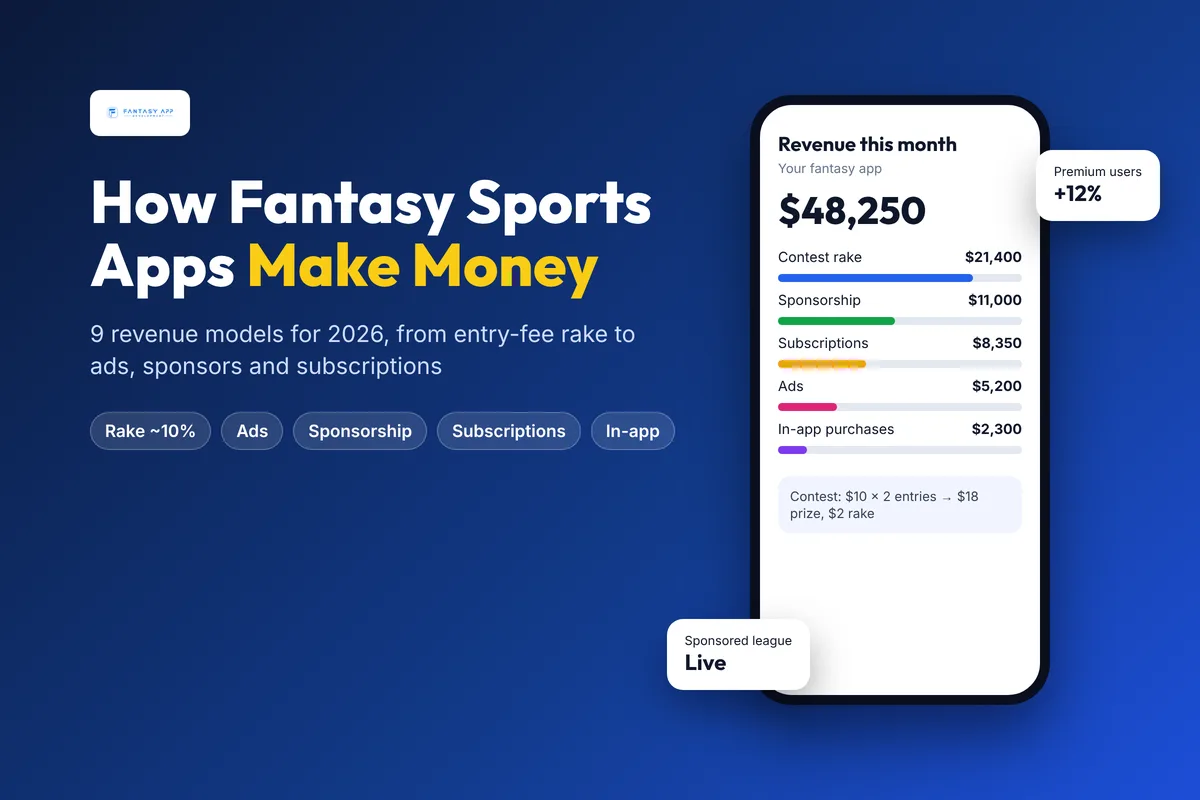
Quick answer: Fantasy sports apps make money in two main ways. Paid-contest apps such as DraftKings and FanDuel keep a share of every entry fee, called the rake, which is usually around 10% (for example, two players pay $10 each and the winner gets $18). Free-to-play apps such as Fantasy Premier League, Yahoo, ESPN and Sleeper earn from advertising, sponsorship, premium subscriptions, in-app purchases and data or traffic they send to partners. Most successful apps combine three or four of these revenue streams. Below are the 9 fantasy sports revenue models used in 2026, how much each can earn, where each is legal, and which one fits the app you want to build.
Key takeaways
- Entry-fee rake (about 10%) is the biggest money maker for paid daily fantasy, but it is only legal in some markets.
- Free-to-play is now the most common global model. It earns from ads, sponsors, subscriptions and in-app purchases.
- India's 2025 Online Gaming Act banned real-money fantasy, so Dream11 moved to free-to-play with ads and sponsorships.
- Brands pay for fantasy games because players come back every week. Coca-Cola, for example, ran a fantasy-style campaign with the Premier League in 2025/26.
- Pick your revenue model before you build. It decides your features, payment stack, licensing and launch markets.
Last updated: November 4, 2026. This guide is general information, not legal advice. Check local law before you launch paid contests.
What are the main ways fantasy sports apps make money?
There are 9 common revenue models. The table shows each one, who uses it and where it works.
| # | Revenue model | How it earns | Example apps | Works in |
|---|---|---|---|---|
| 1 | Entry-fee rake (paid contests) | Keeps ~10% of contest entry fees | DraftKings, FanDuel, Underdog | Most US states, some other licensed markets |
| 2 | Advertising | Display, video and rewarded ads (CPM/CPC) | Yahoo, ESPN, Dream11 (since 2025) | Everywhere |
| 3 | Sponsorship and branded games | Brands pay to sponsor leagues, prizes or the whole game | Fantasy Premier League partners, media fantasy games | Everywhere |
| 4 | Premium subscription | Monthly or season pass for advanced tools | Yahoo Fantasy Plus, Sleeper premium features | Everywhere |
| 5 | In-app purchases | Boosters, extra transfers, custom avatars, league themes | Freemium fantasy games | Everywhere (check loot-box rules) |
| 6 | Private league fees (commissioner tools) | Small fee to run a private paid or premium league | Season-long league platforms | Most markets |
| 7 | Affiliate and partner traffic | Referral fees for sending users to partners (tickets, merch, licensed sportsbooks) | Media and sports-news fantasy apps | Where the partner product is legal |
| 8 | B2B, white label and licensing | Selling the fantasy platform to clubs, leagues, media and brands | Genius Sports, white-label providers | Everywhere |
| 9 | Data and insights | Paid stats, projections or anonymised fan insights for partners | Research tools, team and league partners | Everywhere (follow GDPR/CCPA) |
1. How does entry-fee rake work?
In a paid contest, every player pays an entry fee. The platform keeps a percentage, and the rest goes into the prize pool. FanDuel has said it keeps about 10% of entry fees, and a $10 head-to-head contest on DraftKings or FanDuel pays the winner $18, so the platform keeps $2 of the $20 collected (Legal Sports Report). Rake can be higher on small contests and lower on big tournaments with guaranteed prizes.
| Contest | Entries x fee | Total collected | Prize pool (90%) | Platform revenue (10%) |
|---|---|---|---|---|
| Head-to-head | 2 x $10 | $20 | $18 | $2 |
| 50/50 league | 100 x $5 | $500 | $450 | $50 |
| Guaranteed tournament | 10,000 x $20 | $200,000 | $180,000 | $20,000 |
Watch out for overlay. If a guaranteed tournament does not fill, the platform still pays the full prize and loses money on that contest. Good contest management, dynamic contest sizes and real-time fill tracking stop this.
Where it is legal: paid daily fantasy is available in roughly 43 to 45 US states, with operator licences in states such as New York. India banned real-money fantasy in August 2025, and many countries treat paid fantasy as gambling. See our fantasy sports statistics 2026 for the state list and market data.
2. How do free fantasy apps make money from ads?
Free-to-play apps sell ad space. Advertisers pay per 1,000 impressions (CPM) or per click (CPC). Fantasy players open the app several times a week to check scores and change lineups, so they see many ad impressions. The best ad formats for fantasy apps are:
- Rewarded video: users watch an ad to get an extra transfer, a booster or a hint. This earns the most and feels fair to users.
- Native ads in the scores feed and player news.
- Banner ads on low-attention screens, never on the team builder.
Dream11 is the biggest recent example. After India's real-money ban, it relaunched as a free-to-play game funded by ads and sponsorships, with brands such as Swiggy, Astrotalk and Tata Neu (exchange4media).
3. Why do brands sponsor fantasy sports games?
Fantasy games keep fans active for a whole season, which is worth more to a brand than a single TV ad. Sponsors pay for naming rights, branded prizes, sponsored leagues and in-game challenges. Coca-Cola's 2025/26 "Beat the Icon" campaign used a Premier League fantasy format to reach Gen Z fans and almost doubled its engagement targets (SportBusiness). Media brands also run their own fantasy games to grow registrations and subscriptions, for example The Telegraph's fantasy football with Genius Sports (Genius Sports).
This model works especially well in the UK, Europe, the Middle East and Australia, where free-to-play is the normal format. Read our guides on building an app like FPL and fantasy apps for the UAE and Saudi Arabia.
4. Do premium subscriptions work for fantasy apps?
Yes. Season-long players happily pay for tools that help them win. Yahoo sells Fantasy Plus with premium draft, trade and research tools while the core game stays free (Yahoo), and Sleeper keeps its main app free and ad-light, earning from optional premium features. Popular paid features include:
- AI lineup and trade suggestions, projections and start/sit advice
- Advanced stats, injury alerts and live win probability
- Ad-free experience
- Custom league settings, keeper and dynasty tools
Subscriptions give predictable monthly revenue, and they are legal almost everywhere because users pay for software, not for a chance to win money. Our AI in fantasy apps guide covers the AI features users pay for.
5. What can fantasy apps sell as in-app purchases?
In-app purchases are one-time buys inside a free game: extra transfers, chips such as triple captain or bench boost, custom kits and avatars, league trophies and themes. Keep anything that changes results cheap or earnable for free, so the game still feels fair. Avoid random paid rewards (loot boxes), which some European countries regulate.
6 to 9. What other revenue streams can a fantasy app add?
- Private league fees: charge commissioners a small fee per league for premium settings, live drafts and payout tracking.
- Affiliate traffic: earn referral fees for sending fans to tickets, merchandise, streaming services or, where legal and licensed, sportsbooks.
- B2B and white label: license your platform to sports clubs, leagues, media companies and brands that want their own fantasy game. See white label fantasy sports software.
- Data and insights: sell projections and stats tools, or share anonymised fan insights with partners, following GDPR and CCPA.
Which revenue model should you choose?
Choose by market first, then by audience. This table gives a simple starting point.
| Your situation | Best main model | Add later |
|---|---|---|
| US startup with a DFS licence | Entry-fee rake | Subscriptions, ads on free contests |
| UK / Europe startup | Free-to-play + sponsorship | Subscriptions, in-app purchases |
| India (after the 2025 ban) | Free-to-play + ads | Sponsored contests, in-app purchases |
| Middle East (UAE, Saudi Arabia) | Free-to-play + brand sponsorship | Premium features |
| Australia tipping / pick'em | Free-to-play + sponsors | Private league fees |
| Sports club, league or media brand | Sponsorship + first-party data | Subscriptions, merch affiliate |
Not sure between paid daily contests and a free season-long game? Read season-long vs daily fantasy, and see how to build a footy tipping app for the Australian model.
How much revenue can a fantasy sports app make?
It depends on your users and model. A simple way to estimate:
- Paid contests: monthly revenue = total entry fees x rake. For example, $500,000 in monthly entries x 10% = $50,000.
- Ads: monthly revenue = monthly impressions / 1,000 x CPM. Rates vary a lot by country, so test in your market.
- Subscriptions: monthly revenue = active users x conversion rate x price. If 5% of 50,000 users pay $5 a month, that is $12,500.
These are illustrative numbers only. Your real results depend on retention, marketing and local rules.
Which features do you need for each revenue model?
| Model | Must-have features |
|---|---|
| Paid contests | Wallet, payment gateway, KYC and age checks, geolocation, contest engine, payouts, responsible gaming tools |
| Ads | Ad SDK and mediation, rewarded video, consent banner (GDPR/CCPA) |
| Sponsorship | Branded leagues, custom prizes, sponsor banners, campaign reports |
| Subscriptions and in-app purchases | App Store and Google Play billing, paywall, feature flags |
| B2B / white label | Multi-tenant admin, custom branding, API, analytics per client |
Planning the build? See our fantasy sports app tech stack and fantasy app cost guide. A fantasy sports app MVP usually costs about $15,000 to $30,000, and a full multi-sport platform with payments and analytics costs $50,000 to $100,000 or more.
Build a fantasy app with the right revenue model
Fantasy App Development has built fantasy apps for 400+ clients worldwide, with free-to-play, paid contest and sponsor-led models, and can launch an app in about 30 days. Explore our fantasy football and fantasy cricket app development services, see our portfolio, or contact us for a free revenue model and cost plan.