
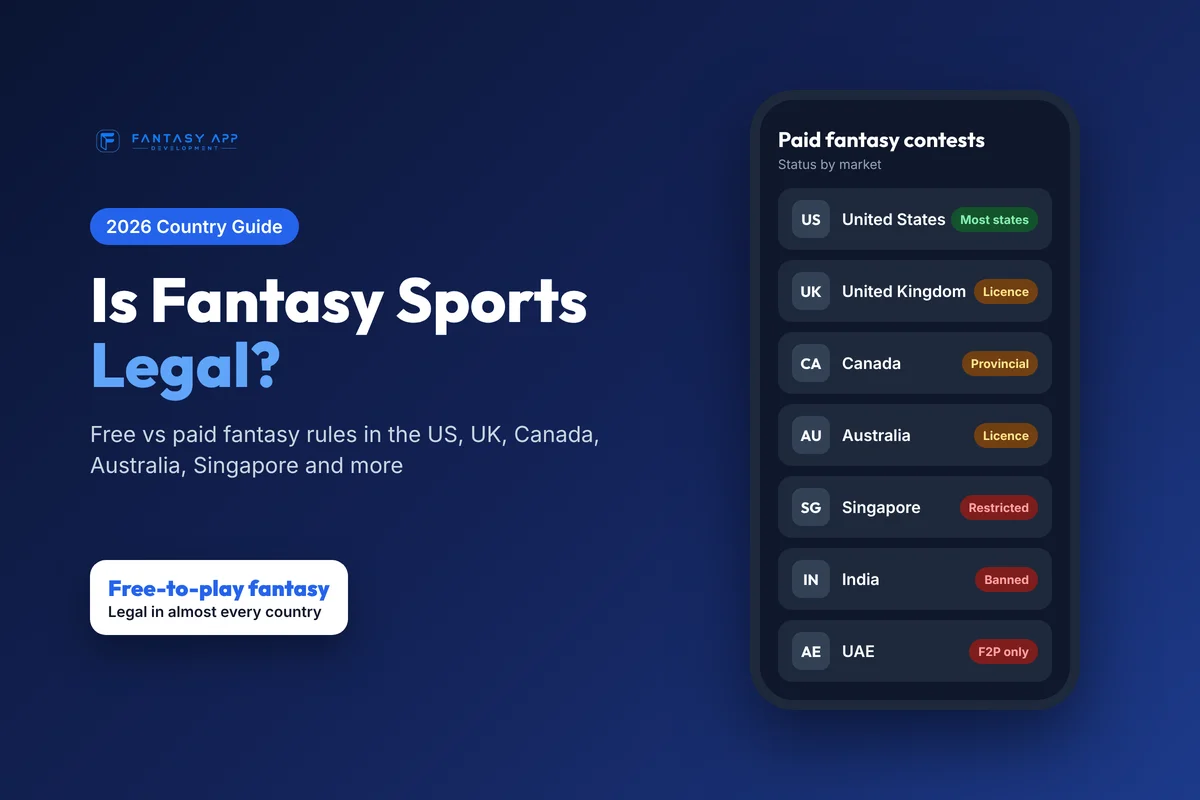
Quick answer: Is fantasy sports legal? Free-to-play fantasy sports (no entry fee) is legal in almost every country. Paid fantasy contests with cash prizes are where the rules change: they are legal and regulated in most US states, need a gambling licence in the UK, are treated as wagering that needs a licence in Australia, are run province by province in Canada, are effectively off-limits without a licence in Singapore, and are banned in India since the Online Gaming Act 2025. In the UAE and Saudi Arabia, only free-to-play models are safe. This guide gives a country-by-country table, explains what makes paid fantasy "gambling" or "skill", and shows how app founders can launch legally in 2026.
Key takeaways
- Free-to-play fantasy sports with sponsor prizes is the one model you can launch almost anywhere.
- US: paid daily fantasy sports (DFS) is allowed in most states, but a handful of states ban or restrict it, and California's Attorney General called DFS illegal in 2025.
- UK: paid fantasy leagues can need a Gambling Commission pool betting licence, even when run by a small organiser.
- Canada: Ontario's regulated market has had no paid DFS since 2022; a November 2025 court opinion and Alberta's 2026 market launch may change that.
- Australia: paid fantasy is wagering and needs a state or territory licence (most operators use the Northern Territory).
- Singapore: paid fantasy is treated as gambling under the Gambling Control Act 2022 and needs a licence that is rarely available to private operators.
Last updated: November 6, 2026. This guide is general information, not legal advice. Laws change often, so speak to a gaming lawyer in each market before you take entry fees.
Is fantasy sports gambling or a game of skill?
Every country answers this question in its own way, and the answer decides whether you need a licence. Three things usually matter:
- Consideration: does the player pay to enter (cash, credits bought with cash, or an NFT)?
- Prize: can the player win money or something of money's worth?
- Chance vs skill: is the result mainly decided by skill (research, team selection) or by chance?
If a game has no entry fee, most laws do not treat it as gambling, even if there are prizes. That is why free-to-play games like Fantasy Premier League, AFL Fantasy and ESPN Fantasy run worldwide. Once you add a paid entry and a cash prize, many countries call it betting, pool betting or wagering, whatever the skill element. Some places, like most US states, accept that fantasy is mainly skill and regulate it as its own category.
Is fantasy sports legal? Country-by-country table (2026)
| Country | Free-to-play fantasy | Paid fantasy (cash prizes) | Main law or regulator |
|---|---|---|---|
| United States | Legal | Legal in most states, often with state registration; banned or restricted in a few (e.g. Hawaii, Idaho, Montana, Nevada, Washington) | UIGEA 2006 fantasy carve-out plus state law |
| United Kingdom | Legal | Needs a Gambling Commission licence (pool betting) in most cases | Gambling Act 2005, Gambling Commission |
| Canada | Legal | Provincial; paid DFS not in Ontario's regulated market since 2022; status changing in 2026 | Criminal Code, provincial regulators (AGCO, iGaming Ontario) |
| Australia | Legal | Treated as wagering; needs a state or territory licence | Interactive Gambling Act 2001, state/territory regulators (e.g. NT) |
| Singapore | Legal, within class licence conditions | Treated as gambling; needs a licence, rarely available | Gambling Control Act 2022, Gambling Regulatory Authority |
| India | Legal | Banned since 2025 (online money games) | Promotion and Regulation of Online Gaming Act 2025 |
| UAE | Legal (sponsor prizes) | Not allowed outside the licensed commercial gaming regime | Federal penal code, GCGRA |
| Saudi Arabia | Legal (sponsor prizes) | Not allowed (all gambling banned) | Islamic law and national regulations |
Is fantasy sports legal in the US?
Yes, in most of the country. The federal Unlawful Internet Gambling Enforcement Act (UIGEA) of 2006 includes a carve-out for fantasy contests that meet certain rules (outcomes based on the skill of participants and the stats of multiple real athletes, prizes set before the contest). But UIGEA is only a federal safe harbour. Each state decides whether paid fantasy is legal under its own gambling law.
- Legal and regulated: around 40 states allow paid DFS, and many (such as New York, Virginia, Massachusetts, Tennessee and Colorado) require operators to register, pay fees and follow consumer-protection rules. Illinois brings in its first fantasy sports framework in 2026.
- Banned or restricted: Hawaii, Idaho, Montana, Nevada and Washington are usually listed as states where major DFS operators do not offer paid contests. Nevada treats DFS as gambling that needs a gaming licence.
- California: in July 2025 the state Attorney General issued an opinion that DFS is illegal sports betting under state law. It is an opinion, not a statute, and operators were still active, so watch this market closely.
- Pick'em games: "player props" style fantasy (more/less picks) faces extra limits in several states, even where classic salary-cap DFS is fine.
Season-long, free-to-play fantasy (like ESPN, Yahoo or Sleeper's free leagues) is legal in every state. If you are planning a US product, read our guide to season-long vs daily fantasy sports before you choose a model.
Is fantasy sports legal in the UK?
Free fantasy games are legal and very popular in the UK (Fantasy Premier League alone has more than 10 million players). Paid fantasy is different. The UK Gambling Commission has warned that paid-entry fantasy leagues may need a pool betting licence, because the prize pot depends on how many people pay to enter. Key points:
- Leagues run privately between friends, with no profit for the organiser, are generally outside the rules.
- Paid leagues that are open to the public, promoted on social media or run as a business can need an operating licence, even if they are small.
- The Commission has taken action against platforms it believed offered gambling without a licence (for example, its 2024 case against the fantasy platform Sorare, which disputes the claim).
- Licensed operators and B2B suppliers do offer paid fantasy in the UK, but they follow full gambling rules: age and identity checks, safer-gambling tools and advertising codes.
For most UK founders, the smart path is free-to-play with sponsor prizes first, then a paid product through a licensed partner. Our FPL-style fantasy football guide shows how to build that free model.
Is fantasy sports legal in Canada?
Yes for free-to-play, and it is complicated for paid DFS. Under the Criminal Code, provinces run or license gaming. When Ontario opened its regulated iGaming market in April 2022, it required players to compete only against other Ontario players, so the big DFS operators pulled paid contests from the province.
- November 2025: the Court of Appeal for Ontario gave an opinion that letting Ontario players compete with players in other jurisdictions (shared liquidity) would be legal for peer-to-peer games such as poker and DFS. An appeal to the Supreme Court of Canada is possible, and rules still need to be written.
- Alberta: Alberta's regulated online gaming market launches in July 2026. Reports suggest paid DFS may face the same problems as in Ontario, so check the final rules.
- Other provinces: most still rely on their lottery corporation (for example PlayNow or Loto-Québec), and offshore paid fantasy operates in a grey area.
Free-to-play NHL, NFL and CFL fantasy is fully legal across Canada. See our fantasy hockey app guide for a Canada-friendly product.
Is fantasy sports legal in Australia?
Free fantasy games such as AFL Fantasy, NRL Fantasy and SuperCoach are legal and very popular. Paid fantasy sports in Australia is treated as wagering. Under the Interactive Gambling Act 2001, only licensed Australian operators can offer it, and they must hold a state or territory wagering licence. Most paid fantasy brands (for example Draftstars) operate under a Northern Territory licence, and some states such as South Australia add their own rules.
A licensed paid fantasy app in Australia also has to follow national consumer protection rules, including BetStop (the national self-exclusion register) and identity checks. Tipping and pick'em games run as free competitions are much simpler. Read our footy tipping app guide for that model.
Is fantasy sports legal in Singapore?
Singapore is one of the strictest markets. The Gambling Control Act 2022, overseen by the Gambling Regulatory Authority (GRA), covers online gambling. Legal guides say paid fantasy sports for money or money's worth is treated as a game of chance or a lottery, so it is prohibited without a licence, and licences for online sports betting go only to Singapore Pools. Penalties for running unlawful gambling include large fines and prison terms.
Free-to-play games can operate under a class licence, as long as they meet its conditions (for example, no paid entry and no banned mechanics). So the realistic model for Singapore is a free fantasy or prediction game, funded by sponsors, ads or a brand partnership.
What about India, the UAE and Saudi Arabia?
- India: the Promotion and Regulation of Online Gaming Act 2025 banned online money games, including paid fantasy. Dream11 and other big apps switched to free-to-play. Free fantasy and esports are allowed.
- UAE and Saudi Arabia: traditional gambling is not allowed, so fantasy apps in the Gulf run as free-to-play with sponsor prizes. Read our UAE and Saudi fantasy app guide for examples.
How to launch a legal fantasy sports app in 2026
| Step | What to do | Why it matters |
|---|---|---|
| 1. Pick your markets | Choose countries (and US states or Canadian provinces) before you design the product | The legal model drives features, payments and cost |
| 2. Choose the model | Free-to-play, freemium (subscriptions), or paid entry | Free-to-play can launch globally; paid entry needs licences |
| 3. Get legal advice | Hire a gaming lawyer in each paid market | Rules change every year and fines are high |
| 4. Build compliance in | Geo-fencing, age and KYC checks, self-exclusion, deposit limits, audit logs | Needed for any paid market and expected by app stores |
| 5. Follow app store rules | Apple and Google allow real-money gaming only in permitted regions with proper licences | Apps that skip this get rejected or removed |
| 6. Plan revenue | Sponsorship, ads, subscriptions or B2B licensing for free markets | Gives income where paid contests are not allowed |
Not sure which revenue model fits each market? Our guide on how fantasy sports apps make money compares nine models with examples.
How much does legal compliance add to the cost of a fantasy app?
A free-to-play fantasy app MVP usually costs about $10,000 to $20,000, because it needs no payments, KYC or geo-fencing. A paid-contest app for licensed markets needs extra modules: geolocation checks, identity and age verification, wallet and payment gateway, responsible gaming tools and reporting. These typically add $10,000 to $30,000 to the build, plus third-party fees (KYC and geolocation services) and licence and legal costs, which vary a lot by market. A white-label fantasy sports platform can cut time to market if you start with a free model.
Build a compliant fantasy sports app with us
Fantasy App Development has built fantasy sports apps for 400+ clients worldwide and can launch an app in about 30 days. We build free-to-play, freemium and paid-contest fantasy apps with geo-fencing, KYC hooks and market-specific settings, so you can start free and switch on paid features only where they are allowed. Explore our fantasy football and fantasy cricket app development services, see our portfolio, or contact us for a free plan and quote for your market.