
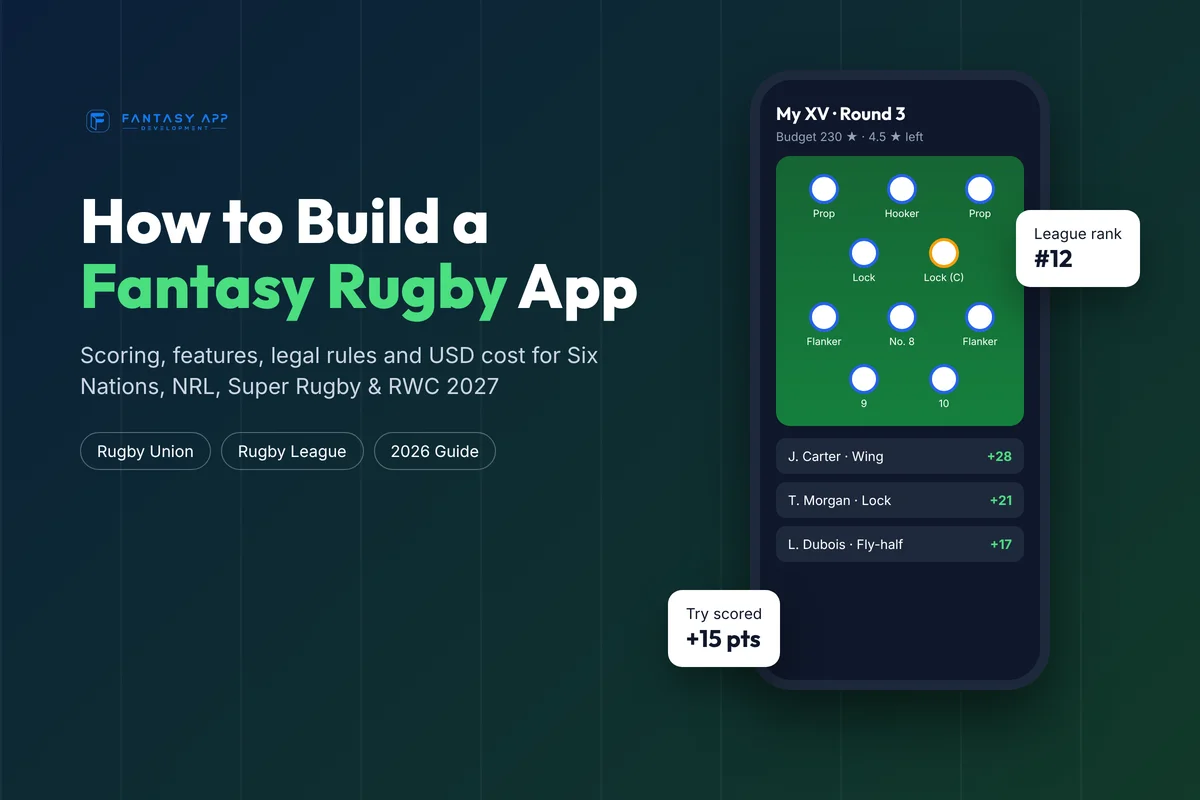
Quick answer: To build a fantasy rugby app, choose your code (rugby union, rugby league or both) and competitions (Six Nations, NRL, Super Rugby Pacific, Premiership, Top 14, URC or the 2027 Rugby World Cup), pick a game format (salary-cap season-long, weekly contests or tipping), design a position-based scoring system, connect a live rugby data feed, then build the team builder, private leagues, live leaderboards and admin panel. A fantasy rugby app MVP usually costs about $15,000 to $30,000 and can launch in around 30 days on a ready fantasy base. A full multi-competition platform costs about $50,000 to $100,000 or more. Below is the full step-by-step guide, with a sample scoring table, feature list, legal rules by market and a cost breakdown.
Key takeaways
- Fantasy rugby is a low-competition niche compared with fantasy football, cricket or NFL, so a well-built app can win a loyal audience fast.
- Rugby union and rugby league need different scoring rules. Most apps start with one code and add the other later.
- The 2027 Rugby World Cup in Australia (24 teams, October to November 2027) is the biggest launch window in the next two years.
- Free-to-play with sponsorship and private leagues is the safest global model. Paid contests need a licence in the UK and Australia and differ by state in the US.
- Budget roughly $15k to $30k for an MVP and $50k to $100k+ for a full platform, plus a yearly rugby data feed.
Last updated: November 5, 2026. This guide is general information, not legal advice.
What is a fantasy rugby app?
A fantasy rugby app lets fans pick a squad of real rugby players within a budget or draft. Those players then score fantasy points based on what they do in real matches: tries, tackles, metres carried, kicks and more. Fans compete in public leagues or private leagues with friends, and the highest points total wins.
Popular examples include the official Six Nations Fantasy Rugby game, which gives players a budget of stars (230 in recent seasons) to pick a starting XV plus replacements, Superbru fantasy and predictor games, and in rugby league, NRL Fantasy and NRL SuperCoach in Australia.
Why build a fantasy rugby app in 2026?
- Low competition: there are far fewer fantasy rugby products than fantasy football or NFL products, so it is easier to rank, get press and attract sponsors.
- Passionate global fan base: rugby has strong audiences in the UK, Ireland, France, Italy, South Africa, New Zealand, Australia, Argentina, Japan, Fiji and a growing market in the US (Major League Rugby).
- Big events every year: the Six Nations (February to March), Rugby Championship (August to October), club seasons from autumn to spring, and the NRL season from March to October.
- Rugby World Cup 2027: Australia hosts the first 24-team men's Rugby World Cup in late 2027. World Cups bring a spike of casual fans looking for a fantasy game.
- Sponsor appeal: rugby audiences are attractive to banks, beer brands, telecoms and car makers, which makes free-to-play with sponsorship a strong revenue model.
Which fantasy rugby format should you choose?
| Format | How it works | Best for | Build effort |
|---|---|---|---|
| Salary-cap season-long | Pick a squad within a budget, make transfers each round, score all season | Six Nations, Premiership, Top 14, URC, NRL | Medium |
| Draft league | Friends draft players so each player belongs to one team only | Private leagues, office groups | Medium to high |
| Weekly / daily contests | New team every round or match, with a fresh leaderboard | Short tournaments, paid contests where legal | Medium |
| Tipping / predictor | Predict winners and margins instead of picking players | Casual fans, quick MVP, media brands | Low |
| Single-tournament game | One game for the Six Nations or the Rugby World Cup only | Sponsors, federations, broadcasters | Low to medium |
If you want the fastest launch, a predictor game is the simplest option. See our guide on how to build a footy tipping app, which works the same way for rugby. For the difference between formats, read season-long vs daily fantasy sports apps.
How does fantasy rugby scoring work?
Rugby has many more measurable actions than most sports, so scoring is where your app can stand out. Here is a sample rugby union scoring table you can adapt. Values are examples, not taken from any official game.
| Action | Sample points | Notes |
|---|---|---|
| Try (back) | +10 | Many games give forwards more for a try (for example +15) to balance positions |
| Try (forward) | +15 | Rewards props, hookers and locks |
| Try assist | +4 | Last pass or kick before the try |
| Conversion | +2 | Kicker |
| Penalty goal / drop goal | +3 | Kicker |
| Every 10 metres carried | +1 | Rewards ball carriers |
| Clean break / defender beaten | +1 to +2 | Outside backs score well here |
| Tackle made | +1 | Keeps forwards valuable |
| Turnover won / lineout steal | +3 to +4 | Breakdown specialists |
| Missed tackle | -1 | |
| Penalty conceded | -1 | |
| Yellow card / red card | -3 / -6 | |
| Player of the match | +10 to +15 | Bonus |
| Team win | +2 to +4 | Optional team points for starters |
For rugby league (NRL, Super League), use different stats: run metres, tackle busts, line breaks, line-break assists, offloads, tackles, missed tackles, errors, forced drop-outs, 40/20 kicks and field goals. Keep both rule sets in a configurable scoring engine so you can change values from the admin panel without a new app release.
Rugby positions in your team builder
A rugby union squad usually needs props, hooker, locks, back row, scrum-half, fly-half, centres, wings and full-back, plus replacements. Rugby league uses fullback, wingers, centres, five-eighth, halfback, props, hooker, second rows and lock. Enforce position limits and a max-players-per-team rule so squads stay fair.
What features does a fantasy rugby app need?
| Area | Must-have features |
|---|---|
| Player app | Sign-up and social login, team builder with budget and positions, captain and vice-captain, transfers and chips, fixtures, player stats and form, push notifications |
| Leagues | Public leagues, private leagues with invite codes, head-to-head leagues, club and fan-group leagues |
| Live match | Live points, live leaderboard, team lineups and late changes, injury and substitution updates |
| Engagement | Weekly prizes, badges, chat or banter, share cards for social media, predictor side-game |
| Admin panel | Competition and fixture setup, player prices, scoring rules, contests, sponsor banners, user management, reports |
| Paid contests (where legal) | Wallet, payments, KYC and age checks, geolocation, payouts, responsible gaming tools |
Where do you get live rugby data?
Your scoring engine needs a reliable live feed with lineups, match events and player stats. Global sports data providers such as Opta (Stats Perform), Sportradar and Genius Sports cover major rugby union and rugby league competitions. Coverage depth differs by league, so check that your chosen provider gives player-level stats (tackles, metres, turnovers) for every competition you plan to run, not just scores. Data is usually a yearly licence and is often the biggest running cost after hosting.
How to build a fantasy rugby app: step by step
- Pick your market and competitions. For example, Six Nations plus Premiership for the UK and Ireland, or NRL for Australia.
- Choose the format and revenue model. Free-to-play with sponsors, subscriptions or licensed paid contests. See how fantasy sports apps make money.
- Design scoring and pricing. Write the scoring table, player price rules and transfer rules.
- Select the data provider. Confirm live player stats for every competition.
- Design the UX. Keep the team builder fast on mobile. Most fans pick teams on their phone just before kick-off.
- Build the app and admin. A common stack is Flutter or React Native for mobile, Node.js for the API, MongoDB or PostgreSQL, Redis for live leaderboards and WebSockets for live points. See our fantasy sports app tech stack guide.
- Test with real match data. Replay past matches to check scoring and leaderboard load.
- Launch before the season. Go live 3 to 4 weeks before round one so fans can build teams and invite friends.
Is fantasy rugby legal in the UK, Ireland, Australia and the US?
| Market | Free-to-play | Paid contests with cash prizes |
|---|---|---|
| UK | Legal | Usually needs a Gambling Commission licence when prizes are funded by entry fees |
| Ireland | Legal | Regulated under the new gambling regulator (GRAI); get local advice |
| France | Legal | Paid games are tightly regulated by the ANJ |
| Australia / New Zealand | Legal | Treated like wagering; needs a licence (state licence in Australia) |
| South Africa | Legal | Provincial gambling rules apply |
| United States | Legal | Allowed in many states under DFS laws, banned or limited in others |
| India | Legal | Real-money games banned under the 2025 Online Gaming Act |
Because of these rules, most new fantasy rugby apps launch as free-to-play with sponsor prizes, then add paid contests only in licensed markets. This is general information, not legal advice.
How much does it cost to build a fantasy rugby app?
| Option | What you get | Typical cost (USD) | Timeline |
|---|---|---|---|
| Predictor / tipping MVP | Match predictions, leagues, leaderboard, admin | $8,000 to $15,000 | 3 to 5 weeks |
| Fantasy rugby MVP | One competition, salary-cap team builder, live points, private leagues, admin | $15,000 to $30,000 | About 30 days on a ready base |
| Full platform | Union and league, multiple competitions, draft and weekly formats, sponsor tools, analytics | $50,000 to $100,000+ | 3 to 5 months |
| Paid contest add-on | Wallet, payments, KYC, geolocation, responsible gaming | $10,000 to $25,000+ | 4 to 8 weeks |
Running costs include the rugby data feed, cloud hosting, app store fees and support. A white-label fantasy sports platform is the fastest and lowest-cost way to launch before a big tournament such as the Six Nations or the 2027 Rugby World Cup.
How can a fantasy rugby app make money?
- Sponsorship: a title sponsor for the game, branded leagues and prizes.
- Advertising: display and rewarded video ads on fixtures and leaderboards.
- Premium subscription: advanced stats, player projections and extra chips.
- B2B licensing: run the game for a club, union, broadcaster or newspaper.
- Paid contests: entry-fee rake, only in licensed markets.
Build your fantasy rugby app with us
Fantasy App Development has built fantasy sports apps for 400+ clients worldwide and can launch an app in about 30 days. We can build a fantasy rugby union, rugby league or predictor app for your market, with live scoring, private leagues and sponsor tools. Explore our fantasy football and fantasy cricket app development services, see our portfolio, or contact us for a free fantasy rugby app plan and quote.