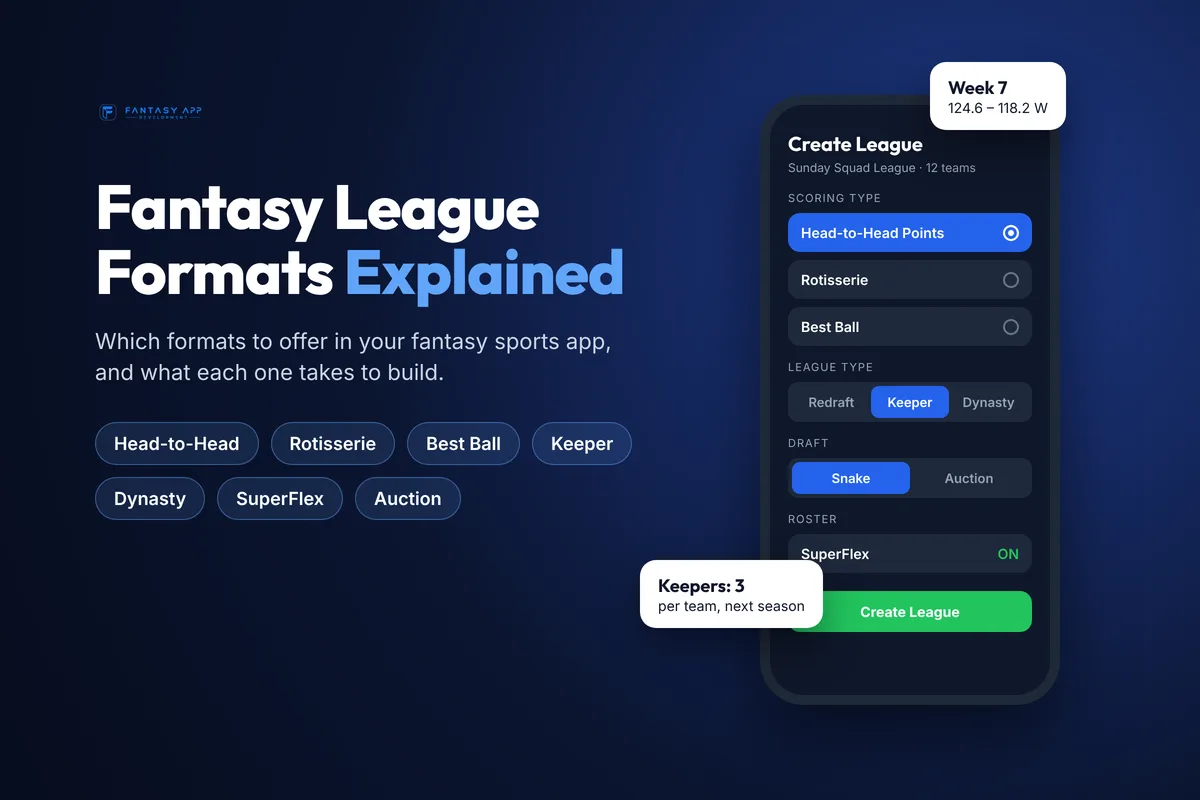
Quick answer: The main fantasy league formats are head-to-head (H2H) points or categories, where you face one opponent each week; rotisserie (roto), where teams are ranked across stat categories over the whole season; total points; best ball, where you only draft and the app sets your best lineup automatically; redraft, keeper and dynasty, which decide how many players you keep from year to year; and twists such as salary cap/auction, SuperFlex, guillotine and survivor. For a fantasy app business, the right mix is usually H2H plus redraft at launch, then best ball, keeper and dynasty once users stay for a second season. Below is a comparison table, how each format works, and what each one means for your app's features and build cost in USD.
Key takeaways
- A league format has three layers: how you win (H2H, roto, total points), how you manage (managed vs best ball) and how long rosters last (redraft, keeper, dynasty).
- Head-to-head points is the most common format in fantasy football; rotisserie is the classic for fantasy baseball and high-stakes leagues.
- Best ball has become one of the fastest-growing formats: the 2026 flagship NFL best ball contests on DraftKings and Underdog together offered close to $50 million in prizes.
- Dynasty and keeper leagues keep users active all year (rookie drafts, trades), which helps retention and subscription revenue.
- Each extra format adds engine work: roto needs category ranking, best ball needs an auto-lineup optimizer, dynasty needs multi-season rosters and rookie drafts.
Last updated: November 10, 2026. Author: Omkar.
What is a fantasy league format?
A fantasy league format is the set of rules that decides how teams are built, how they score and how a winner is picked. Two leagues can use the same sport and the same scoring system but feel completely different because of their format. A 10-team head-to-head redraft league with weekly lineups plays nothing like a 12-team dynasty best ball league where nobody touches their roster after the draft.
It helps to think of every format as a mix of three choices:
- Competition type: head-to-head, rotisserie, total points, survivor or guillotine.
- Management style: managed (you set lineups, make trades and waiver claims) or best ball (draft only).
- Roster lifespan: redraft (new draft every season), keeper (keep a few players) or dynasty (keep everyone).
Draft type (snake, auction/salary cap) and roster settings (SuperFlex, 2QB, IDP) sit on top of these choices.
Fantasy league formats compared
| Format | How it works | Popular in | Time needed from users | App build effort |
|---|---|---|---|---|
| Head-to-head (H2H) points | Play one opponent per week; higher total points wins; best records make playoffs | Fantasy football (NFL), soccer leagues, basketball | Medium (weekly lineups) | Low (core format) |
| H2H categories | Win or lose each stat category against your weekly opponent | Fantasy basketball, baseball, hockey | Medium to high | Medium |
| Rotisserie (roto) | Teams ranked 1 to N in each category over the season; ranks are added up | Fantasy baseball, high-stakes leagues | High (daily moves) | Medium |
| Total points | Season-long points table, no weekly matchups | FPL-style soccer games, cricket, mass public leagues | Low to medium | Low |
| Best ball | Draft only; the app picks your highest-scoring lineup after each week | NFL tournaments (DraftKings, Underdog), MLB, NBA | Very low after the draft | Medium (auto-lineup optimizer) |
| Redraft | Fresh draft every season; nothing carries over | Most casual leagues worldwide | Low | Low |
| Keeper | Keep a few players (often 1 to 5) for next season, sometimes at a draft-pick cost | Long-running friend and office leagues | Medium | Medium |
| Dynasty | Keep the whole roster year after year; yearly rookie draft; trade future picks | Hardcore NFL, NBA and MLB players | High, all year | High |
| Salary cap / auction | Bid on players with a fixed budget instead of a snake draft | Daily fantasy, auction leagues, FPL-style games | Medium | Medium (live auction room) |
| Guillotine | Lowest-scoring team each week is eliminated; its players go to waivers | Novelty NFL leagues | Medium | Low to medium |
| Survivor / pick'em | Pick one team or result per round; lose and you are out | NFL survivor pools, Australia footy tipping | Very low | Low |
Head-to-head vs rotisserie vs total points: how do you win?
Head-to-head (H2H) points
Each week, your team plays one other team in the league. Whoever scores more fantasy points wins the week. Wins and losses build a standings table, and the top teams make the playoffs at the end of the season. H2H points is the default in most fantasy football apps because it is simple and creates a weekly rivalry. Its weakness is luck: you can post the second-highest score of the week and still lose. Some apps fix this with an extra "vs median" win, where every team above the week's median score also gets a win.
H2H categories
Instead of total points, you compete in stat categories such as points, rebounds, assists and steals in basketball, or home runs, RBIs and ERA in baseball. Winning 6 of 9 categories gives you a 6-3 week. This format is common in fantasy basketball and hockey, where category balance matters.
Rotisserie (roto)
Rotisserie ignores weekly matchups. Over the whole season, every team is ranked in each category. In a 12-team league, the best team in home runs gets 12 points, the worst gets 1, and so on for every category. The highest combined total wins. Roto rewards depth and season-long management, so it is the classic format for fantasy baseball and many high-stakes leagues, because one bad week rarely decides the title.
Total points
Every point counts toward one season table, like the global leaderboard in fantasy Premier League-style games. It scales to millions of users, which is why most public soccer and cricket fantasy games use it, often with private mini-leagues on top. Read more in our guide to building a fantasy football app like FPL.
Redraft vs keeper vs dynasty: how long do rosters last?
| Redraft | Keeper | Dynasty | |
|---|---|---|---|
| Players kept next season | None | A few (often 1 to 5) | Whole roster |
| Draft each year | Full draft | Full draft minus keepers | Rookie draft only |
| Off-season activity | None | Choose keepers | Trades, rookie scouting, future picks |
| Best for | New and casual players | Friend leagues that run for years | Committed, year-round players |
| Retention value for your app | Seasonal | Good | Very high |
Redraft is the easiest way in, and most new users start here. Keeper leagues add a reason to come back next year, usually with a cost such as giving up the round where a keeper was drafted. Dynasty leagues treat each team like a real franchise: young players gain value, rookies are drafted every year and future draft picks can be traded. Platforms such as Sleeper built much of their early following on dynasty features. If you are planning a similar product, see how to build a fantasy football app like Sleeper.
What is best ball and why is it growing?
In best ball, you draft a team and then you are done. No waiver claims, no trades and no weekly lineup decisions. After each week's games, the app automatically counts the highest-scoring legal lineup from your roster. Most best ball contests use total points; some add playoff rounds.
Best ball is popular because it fits busy players and works for large paid tournaments. For the 2026 NFL season, the flagship best ball contests on DraftKings and Underdog together offered close to $50 million in prizes, with each allowing hundreds of thousands of $25 entries. Rosters are larger than in managed leagues (18 picks on Underdog, 20 on DraftKings) because there are no waiver pickups to cover injuries.
For an app, the key technical piece is the optimal lineup calculator: after every scoring period it must pick the best combination that fits the roster rules (for example, 1 QB, 2 RB, 3 WR, 1 TE and 1 FLEX) for every team, which is a heavier job when you have hundreds of thousands of entries.
What are SuperFlex, 2QB, auction and IDP?
These are roster and draft settings that work inside any format above:
- SuperFlex: one flex spot can be used on a quarterback as well as a running back, wide receiver or tight end. Because quarterbacks score the most points, it makes them much more valuable in drafts. 2QB leagues go further and require two starting quarterbacks.
- Auction / salary cap: every manager gets the same budget (for example $200) and bids on players instead of taking turns in a snake draft. In daily fantasy, a salary cap is used to pick a lineup for one slate.
- IDP (individual defensive players): you roster real defenders such as linebackers and cornerbacks instead of one team defense.
- PPR / half-PPR: a scoring setting that awards points per reception in American football.
Fun formats: guillotine, survivor, chopped and vampire leagues
- Guillotine: the lowest-scoring team is eliminated every week and its players go to waivers, so the remaining managers bid for them. The last team standing wins.
- Survivor / pick'em: pick one winning team each week without reusing a team; one wrong pick and you are out. Australian footy tipping is a close cousin. See our footy tipping app guide.
- Vampire: one manager has no draft and "steals" players from opponents they beat.
- Daily fantasy (DFS): one-day or one-week contests with a salary cap, separate from season-long leagues. See season-long vs daily fantasy sports apps.
Which fantasy league formats should your app support?
You do not need every format on day one. A phased plan keeps cost down and gets you to market fast:
| Phase | Formats | Why | Typical added cost (USD) |
|---|---|---|---|
| MVP (launch) | H2H points + total points, redraft, snake draft, private leagues | Covers most casual players in football, soccer and cricket | Included in a $15k to $30k MVP |
| Phase 2 | Best ball, salary cap/auction draft, survivor/pick'em | Low-effort formats that bring in new and busy users | About $5k to $15k |
| Phase 3 | Keeper and dynasty, rookie drafts, pick trading, SuperFlex | Year-round engagement and higher retention | About $10k to $25k |
| Phase 4 | H2H categories, rotisserie, IDP, guillotine, custom scoring | Power users and sport-specific leagues (baseball, basketball, hockey) | About $8k to $20k |
Costs are typical ranges for adding the feature to an existing fantasy platform and depend on sports, data feeds and design. A full multi-format platform built from scratch usually costs $50,000 to $120,000 or more. See our fantasy sports app tech stack guide and fantasy football app cost guide for details.
How are league formats built in a fantasy app?
The cleanest way is a rules engine: store each league's settings as data (competition type, roster slots, scoring rules, keeper count, draft type) instead of hard-coding formats. Then one engine can run many formats. Core pieces:
- League settings schema: format, team count, roster slots, scoring table, playoff weeks, tie-breakers, trade and waiver rules.
- Draft room: live snake and auction drafts over WebSockets, with auto-pick and timers.
- Scoring service: converts live stats from a data feed into points or category totals.
- Standings engine: H2H records, roto rank tables, median wins, eliminations.
- Best ball optimizer: computes the best legal lineup per team each period.
- Multi-season storage: carries rosters, keepers, rookie picks and league history into the next season.
As your league count grows, these jobs need queues and caching. Our guide on how to scale a fantasy sports app covers that.
Do league formats change the legal picture?
Usually not by themselves. What matters is whether users pay to enter and win cash prizes. Free-to-play leagues of any format are allowed in most countries. Paid best ball tournaments, daily fantasy and paid season-long leagues are regulated differently in each US state, often need a Gambling Commission licence in the UK, and real-money games are banned in India. Read our country-by-country guide: is fantasy sports legal? This is general information, not legal advice.
Build a multi-format fantasy app with us
Fantasy App Development has built fantasy sports apps for 400+ clients worldwide and can launch an app in about 30 days. We build H2H, rotisserie, best ball, keeper, dynasty, salary cap and pick'em formats on one configurable rules engine, for football, soccer, cricket, basketball, baseball and more. Explore our fantasy football app development and fantasy basketball app development services, see our portfolio, or contact us for a free plan and quote.