
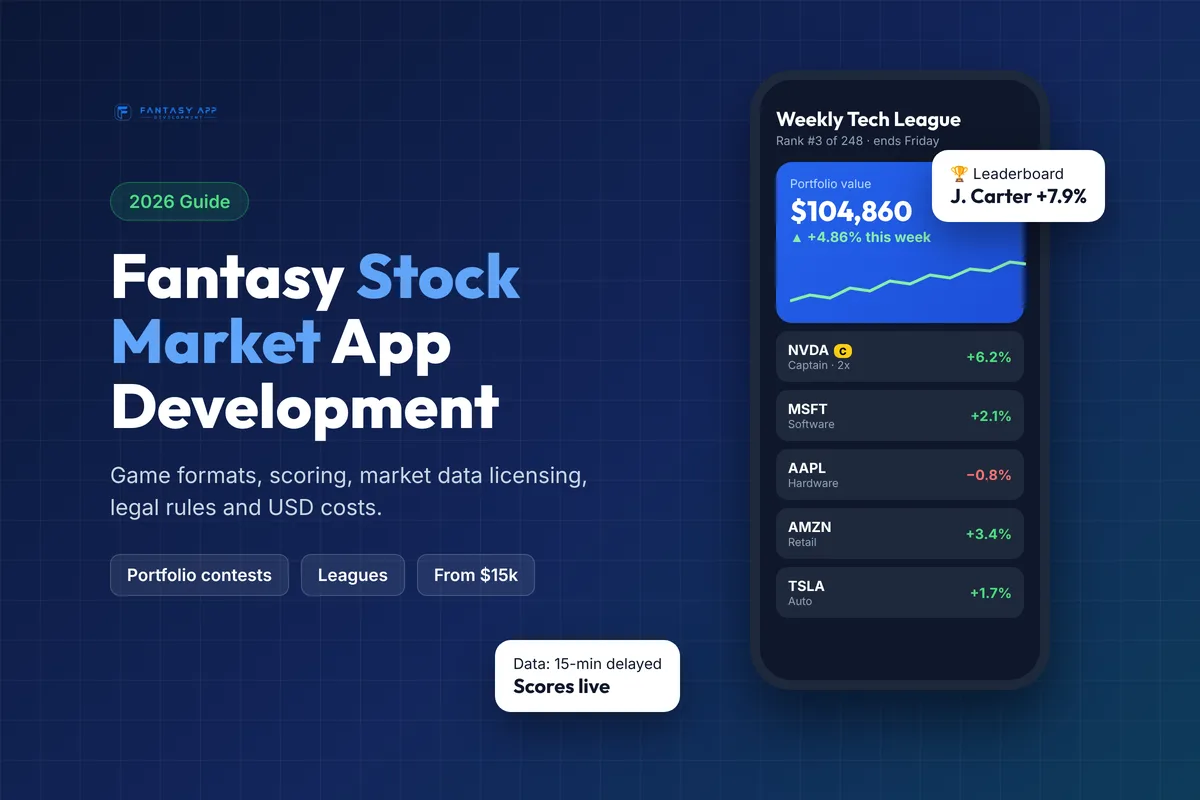
Quick answer: A fantasy stock market app lets players build a virtual portfolio of real stocks, crypto or indices with fake money, then compete on returns in daily, weekly or season-long leagues. To build one you need a portfolio builder with a virtual budget, a scoring engine based on percentage price change, a licensed market data feed (usually 15-minute delayed or end-of-day data), leagues and leaderboards, and an admin panel for contests and stock lists. A free-to-play MVP usually costs $15,000 to $30,000 and can launch in about 30 days on a ready fantasy base, while an advanced app with live scoring, social features and sponsor tools costs $30,000 to $60,000. The two things that decide success are market data licensing and the legal model in your country, so this guide covers both in detail.
Key takeaways
- Fantasy stock games swap players for stocks: users pick a portfolio under a virtual budget and score on returns, not on goals or runs.
- Market data is licensed, not just bought. Displaying prices to the public needs display or redistribution rights, and real-time data costs far more than 15-minute delayed or end-of-day data.
- Free-to-play, educational and sponsor-funded games are the safest model in most countries. Paid-entry contests on stock prices can raise gambling and securities questions.
- In India, SEBI's May 2024 circular stops exchanges and brokers from sharing real-time price data with fantasy and virtual trading platforms, and paid online games are banned under the 2025 Online Gaming Act.
- Good use cases: brokers and banks (investor education), media brands, universities and schools, fintech startups and corporate engagement.
Last updated: November 13, 2026. Author: Karan Saini.
What is a fantasy stock market app?
A fantasy stock market app is a game that uses the rules of fantasy sports on financial markets. Instead of drafting athletes, players pick stocks, ETFs, indices or cryptocurrencies with a virtual budget (for example $100,000 of play money or 100 credits). Their score is the gain or loss of that portfolio over a contest period, and they compete against friends, classmates, colleagues or the whole community on a leaderboard.
The idea is not new. Virtual trading simulators such as Investopedia's Stock Simulator, Wall Street Survivor and How the Market Works have taught people investing for years, and apps like Invstr mixed trading games with delayed market data and news. What a fantasy sports approach adds is short contests, team-style rules, captains, leagues and prizes, which make the game feel like daily or weekly fantasy rather than a slow paper-trading account.
How does a fantasy stock market game work?
- Pick a contest: a daily, weekly, monthly or season-long contest, often around a theme such as "Tech stocks", "S&P 500" or "Crypto top 20".
- Build a portfolio: choose a fixed number of assets (for example 8 to 11) under a virtual budget or credit cap, with limits per sector.
- Choose a captain: the captain's return counts 2x and the vice-captain's 1.5x, just like a fantasy cricket or football team.
- Lock and track: the portfolio locks at market open (or a set time), and points update as prices move, using delayed or end-of-day data.
- Win: at the end of the contest, the leaderboard ranks players by portfolio return, and winners get badges, points, sponsor prizes or, only where it is legal, cash.
Which game formats can you build?
| Format | How it works | Best for |
|---|---|---|
| Daily portfolio contest | Pick a portfolio before market open, score on the day's percentage change | Fast, daily engagement for brokers and fintech apps |
| Weekly or monthly league | Hold a portfolio for a week or month with a few trades allowed | Media brands, communities, schools |
| Season-long virtual trading | Trade freely with a virtual cash balance for a semester or quarter | Universities, investor education, corporate challenges |
| Head-to-head | Two players draft portfolios and the higher return wins | Social and friends-based apps |
| Prediction or pick'em | Predict up or down, beat-the-index or earnings results | Simple games for beginners and sponsor campaigns |
| Crypto fantasy | Same as above but with crypto assets that trade 24/7 | Crypto exchanges and Web3 communities |
These follow the same logic as sports formats. If you are new to fantasy game design, our guide to fantasy league formats explains daily, season-long, head-to-head and pick'em models in more depth.
How should scoring work?
Most fantasy stock games score on percentage return so that a $20 stock and a $900 stock are treated fairly. Here is a sample scoring model you can start with:
| Rule | Example scoring |
|---|---|
| Base points | 1 point for every 0.1% price gain, minus 1 point for every 0.1% loss |
| Captain | 2x the captain's points |
| Vice-captain | 1.5x the vice-captain's points |
| Beat the index bonus | +10 points if the portfolio beats a benchmark index for the period |
| Diversification rule | Maximum 3 stocks from one sector, at least 4 sectors in the portfolio |
| Dividends and splits | Adjust prices for splits; add dividends only in total-return contests |
| Halted or delisted stock | Freeze at last traded price and flag it in the app |
Keep the rules simple and show them on every contest screen. Corporate actions such as stock splits are where most scoring disputes come from, so your data feed and admin panel must handle them.
What features does a fantasy stock market app need?
| Area | MVP features | Advanced features |
|---|---|---|
| Users | Sign-up, profile, KYC-light age check | Social login, follow players, referral program |
| Portfolio builder | Stock search, budget cap, sector limits, captain | Watchlists, AI portfolio suggestions, saved teams |
| Market data | Delayed or end-of-day prices, company info | Live prices (licensed), charts, news, earnings calendar |
| Contests | Public and private leagues, leaderboard | Head-to-head, themed contests, school and company leagues |
| Rewards | Points, badges, sponsor prizes | Tiers, streaks, loyalty store |
| Learning | Glossary and tooltips | Lessons, quizzes, portfolio analysis after each contest |
| Admin panel | Stock list, contest setup, lock times, user management | Corporate-action tools, fraud checks, sponsor reports |
Where do you get stock market data?
Data is the biggest technical and legal decision in this kind of app. Exchanges license their data, and display, redistribution and "derived use" (such as scoring) can be separate permissions with separate fees. Your data plan must allow showing prices to the public inside a consumer game, not just personal or internal use.
| Data type | What it is | Cost level | Good for |
|---|---|---|---|
| End-of-day (EOD) | Closing prices once per day | Low | Weekly, monthly and season-long contests |
| Delayed (15 to 20 min) | Intraday prices with a delay | Low to medium; often no per-user exchange fees | Daily contests and live-feeling leaderboards |
| Real-time | Live prices from the exchange | High; needs exchange licensing and user reporting | Large, funded platforms only |
| Crypto prices | Prices from crypto exchanges and aggregators | Low to medium | Crypto fantasy, 24/7 contests |
Commercial market data vendors include providers such as Intrinio, EODHD, Benzinga, Alpha Vantage and Market Data, each with different plans for display rights. Before you sign, ask the vendor three questions in writing: can we display these prices to the public in an app, can we use them to calculate game scores, and what does the license cost as users grow. For a deeper look at feed design, caching and fallbacks, see our fantasy sports data API guide, as the same patterns apply to market data.
Is a fantasy stock market app legal?
The legal answer depends on two things: whether players pay to enter, and what data you use. This is general information, not legal advice, so check with a lawyer in each market you launch in.
| Market | Free-to-play / educational | Paid entry with cash prizes |
|---|---|---|
| United States | Common and widely used (school, broker and media games) | Risky; may be treated as gambling under state law, and anything close to real trading can draw SEC or CFTC attention |
| UK and Europe | Allowed with clear prize terms | Likely needs a gambling license (UK Gambling Commission or local regulator) |
| Middle East | Allowed for sponsor and education games | Generally not allowed in most Gulf states |
| India | Allowed only without real-time exchange data; SEBI's May 2024 circular stops exchanges and brokers from sharing real-time prices with such platforms | Banned: the Online Gaming Act 2025 prohibits real-money online games |
| Australia | Allowed with clear prize terms | Treated as wagering in most cases; needs a license |
In India, the National Stock Exchange also sent notices in 2022 and 2023 to stock gaming apps that used its data for contests. So if you are building for Indian users, plan for end-of-day or lagged data and a free, educational model. For a country-by-country view of fantasy gaming law in general, read is fantasy sports legal.
Simple rules that keep most games safe: no real money in, no securities ever bought or sold for the user, prizes paid by a sponsor rather than from entry fees, a clear "for education and entertainment only, not investment advice" note, and an age check.
How to build a fantasy stock market app: step by step
- Pick your market and model: decide the country, asset types (stocks, ETFs, crypto) and whether you are free-to-play, sponsor-funded or B2B.
- Secure data rights: choose EOD, delayed or real-time data and get display rights in writing before you build.
- Design game rules: contest types, budget, scoring, sector limits, lock times and how to handle splits and halts.
- Design the UX: a fast portfolio builder, clear charts and a leaderboard that is easy to read on mobile.
- Build the backend: price ingestion, a scoring engine that runs on every price update, contests, leaderboards with Redis, notifications and the admin panel. Our fantasy sports app tech stack guide covers the usual choices.
- Test with real market days: replay historical days, including volatile days, splits and market holidays, to check scores.
- Launch and grow: start with private leagues for schools, clubs or company teams, then add public contests and sponsors.
How much does a fantasy stock market app cost?
| Version | What you get | Typical cost (USD) | Time |
|---|---|---|---|
| MVP | Portfolio builder, EOD or delayed data, daily and weekly contests, leagues, leaderboard, admin panel | $15,000 to $30,000 | About 30 days on a ready base |
| Advanced | Live-updating scores, charts and news, head-to-head, learning module, rewards, sponsor tools | $30,000 to $60,000 | 2 to 3 months |
| Enterprise or B2B | White-label for brokers and banks, multi-market data, SSO, compliance reports, high scale | $60,000+ | 3 to 5 months |
Running costs come on top: market data plans (from tens of dollars a month for EOD or delayed plans to thousands for licensed real-time data), cloud hosting, notifications and maintenance. Starting on a white-label fantasy platform and adding a stock module is often the fastest and cheapest route.
How does a fantasy stock market app make money?
- B2B licensing: brokers, banks and fintech apps pay to run the game for their customers as an onboarding and education tool.
- Sponsorship: a brand sponsors contests and prizes.
- Premium subscription: extra portfolios, advanced analytics, AI insights and ad-free use.
- Advertising: finance and fintech ads, which usually pay well.
- Education partnerships: paid league tools for schools, universities and investing clubs.
See more revenue ideas in how do fantasy sports apps make money.
Build your fantasy stock market app with us
Fantasy App Development has built fantasy apps for 400+ clients worldwide and can launch an app in about 30 days. We can build a fantasy stock market, crypto or investing game for your market, with portfolio builders, return-based scoring, leagues, learning modules and sponsor tools, on a data plan that fits your budget and local rules. See our portfolio or contact us for a free plan and quote.