
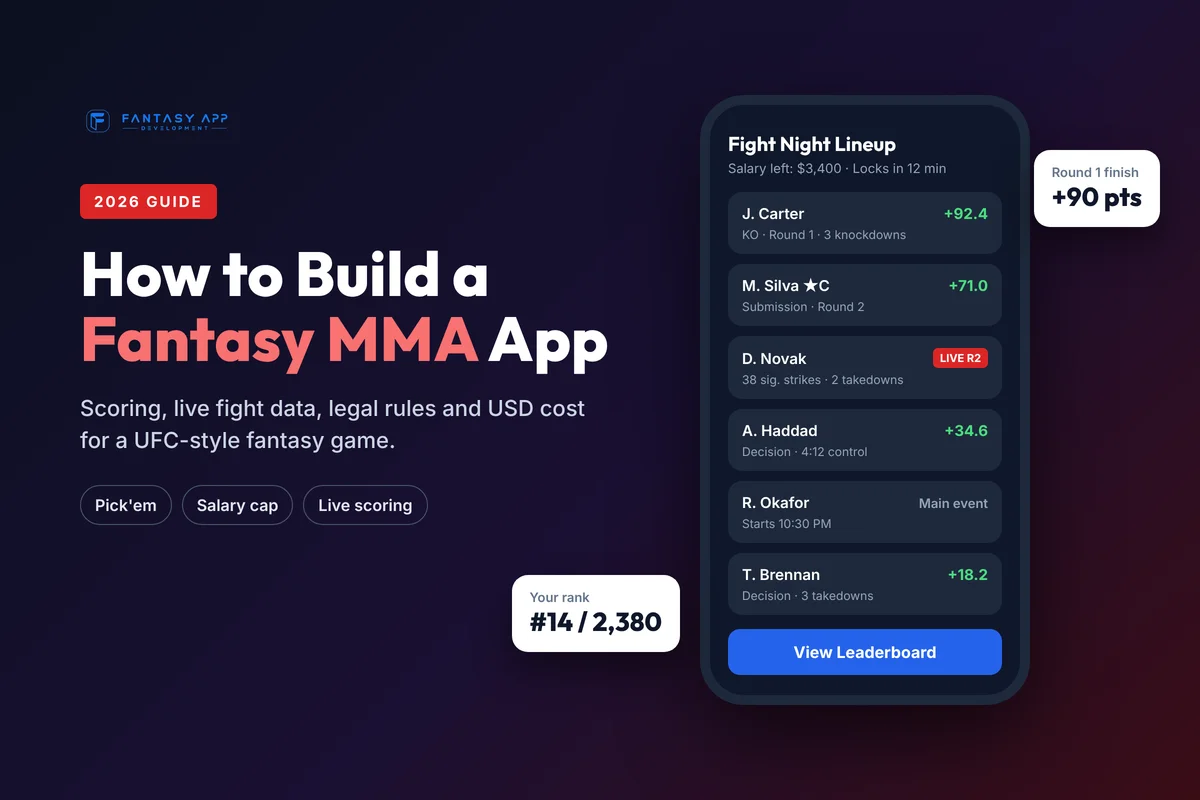
Quick answer: To build a fantasy MMA app (often called a fantasy UFC app), pick your promotions (UFC, PFL, ONE Championship, Oktagon, BKFC or RIZIN), choose a game format (salary-cap fight-card lineups, pick'em with method and round, or season-long fighter leagues), design a stat-based scoring system around strikes, takedowns, control time and finish bonuses, connect a live MMA data feed, then build the lineup builder, contests, live leaderboards and admin panel. A fantasy MMA app MVP usually costs about $15,000 to $30,000 and can launch in around 30 days on a ready fantasy base. A full multi-promotion platform with live scoring and paid contests costs about $50,000 to $100,000 or more. Below is the full guide with a sample scoring table, feature list, data providers, legal rules by market and a cost breakdown.
Key takeaways
- Fantasy MMA is a low-competition niche next to fantasy football or NFL, with a global, young and highly engaged fan base.
- MMA runs on fight cards, not seasons, so most fantasy MMA games are weekly: pick fighters for one event, score live, settle the same night.
- Scoring must reward both styles: strikers (significant strikes, knockdowns) and grapplers (takedowns, control time, submission attempts), plus big bonuses for finishes.
- Live fight data is the single biggest technical dependency. Licensed feeds such as Sportradar and SportsDataIO give per-round stats.
- Free-to-play with sponsors is the safest global model. Paid contests need a licence in the UK and Australia and differ by state in the US.
Last updated: November 9, 2026. This guide is general information, not legal advice.
What is a fantasy MMA app?
A fantasy MMA app lets fans pick real fighters from an upcoming fight card. Those fighters earn fantasy points based on what they do in the cage: strikes landed, takedowns, control time, knockdowns and, most of all, how and when they win. Fans compete in public contests or private leagues, and the highest score after the main event wins.
The market already has daily fantasy MMA on large US platforms, card-based UFC games, pick'em apps and official promotion games. For example, the Czech promotion Oktagon MMA publishes its own fantasy league rules, which shows that promotions see fantasy as a way to keep fans watching every bout on the card, not only the main event.
Why build a fantasy MMA app in 2026?
- Low competition: far fewer fantasy MMA products exist than fantasy football, cricket or NFL products, so it is easier to rank, get press and attract sponsors.
- Global audience: MMA has big fan bases in the US, Brazil, the UK and Ireland, Australia, Eastern Europe, the Middle East (Abu Dhabi and Riyadh host major events), Japan and Southeast Asia (ONE Championship).
- Events almost every week: between UFC, PFL, ONE, Oktagon, BKFC and regional promotions, there is a card to play nearly every weekend, all year round. No off-season.
- Fast, exciting sessions: a card lasts a few hours, so fans get a complete fantasy cycle (pick, watch, win) in one night. That is great for retention and push notifications.
- Sponsor appeal: MMA audiences are young and male-skewed, which suits energy drinks, supplements, gaming, apparel and fintech sponsors.
Which fantasy MMA format should you choose?
| Format | How it works | Best for | Build effort |
|---|---|---|---|
| Salary-cap fight-card lineup | Pick about 6 fighters from one card under a salary cap; points from live fight stats | Daily fantasy (DFS) operators, US and Canada | Medium to high |
| Pick'em (winner, method, round) | Pick the winner of each bout, plus method (KO/TKO, submission, decision) and round for bonus points | Casual fans, media brands, free-to-play | Low |
| Season-long fighter league | Draft a stable of fighters for a season; they score whenever they fight | Hardcore fans, private leagues | Medium |
| Captain / multiplier card | Lineup game where one "captain" fighter scores 1.5x | Adding strategy to any lineup game | Low (add-on) |
| Predictor / judge game | Fans score rounds like a judge or predict stats such as total significant strikes | Engagement inside a promotion or broadcaster app | Low to medium |
Most new apps start with a pick'em game (cheapest, simplest rules, works everywhere) and add a salary-cap lineup game once they have a live data feed. If you are unsure which model fits, read our guide on season-long vs daily fantasy sports apps.
How does fantasy MMA scoring work?
Fantasy MMA scoring turns each fighter's official stat sheet into points. A good system rewards both strikers and grapplers, so neither style dominates, and gives large bonuses for early finishes because that is what fans remember. Here is a sample scoring table you can use as a starting point (adjust the values after testing on past fight data):
| Action | Sample points | Why it matters |
|---|---|---|
| Significant strike landed | +0.5 | Main volume stat for strikers |
| Other strike landed | +0.2 | Rewards ground-and-pound and clinch work |
| Knockdown | +10 | Big momentum moment |
| Takedown landed | +5 | Balances the game for wrestlers |
| Control time (per minute) | +1 | Rewards top control |
| Submission attempt | +3 | Rewards grapplers who threaten finishes |
| Reversal / sweep | +3 | Rewards scrambles |
| Win by decision | +20 | Base win bonus |
| Win by KO/TKO or submission, round 1 | +90 | Early finish bonus (largest) |
| Finish in round 2 / 3 / 4 / 5 | +70 / +45 / +40 / +40 | Bonus falls the later the finish |
| Point deduction | -5 | Penalises fouls |
Two rules make or break MMA scoring. First, decide how to handle late replacements and cancelled bouts (common in MMA): usually the fighter scores zero and the app lets users swap until the bout starts, or auto-swaps to a bench pick. Second, decide what happens on a no contest or draw: most games keep the stat points and remove the win bonus. Write both rules into your terms before launch.
What features does a fantasy MMA app need?
| Area | MVP features | Advanced features |
|---|---|---|
| Users | Sign-up (email, Google, Apple), profile, KYC if paid | Social login, referrals, levels and badges |
| Fight cards | Event list, bout list, fighter profiles with record and reach | Fighter comparison, odds, tale of the tape, news |
| Game | Lineup builder or pick'em, salary cap, lock at bout start | Captain, late swap, multiple entries, bench fighter |
| Live | Live points per round, leaderboard | Round-by-round push alerts, live chat, watch-party mode |
| Contests | Public and private leagues, invite codes | Head-to-head, tournaments, season-long ladders |
| Payments (paid only) | Wallet, deposits, withdrawals | Geo-fencing, responsible gaming limits, multi-currency |
| Admin | Event and bout setup, scoring rules, contest management | Fraud checks, sponsor placements, analytics dashboard |
Where do you get live MMA data?
Your scoring engine is only as good as your data feed. Main options:
- Sportradar MMA API: licensed enterprise feed with event schedules, results and live fight statistics. Pricing is by quote and suits funded or licensed operators.
- SportsDataIO MMA/UFC API: covers schedules, fighter stats, scores and odds. Its documentation says fight stats are collected per round and final stats usually appear a few minutes after a bout ends. Pricing is by quote for commercial use.
- Lower-cost self-serve APIs: several smaller providers offer UFC and regional promotion data with free or cheap tiers, but many update only after events, not live. They work for a pick'em MVP but not for live lineup scoring.
- Manual admin entry: for a pick'em game, an admin can enter the winner, method and round after each bout. This keeps an MVP very cheap.
Always check the data licence: some feeds are licensed for media use only and cost more for fantasy or paid-contest use.
Is fantasy MMA legal?
| Market | Free-to-play | Paid contests |
|---|---|---|
| United States | Legal | Rules differ by state; some states license DFS, others restrict it. Geo-fencing is needed. |
| Canada | Legal | Provincial rules; Ontario has a regulated iGaming market. |
| United Kingdom | Legal | Usually needs a Gambling Commission licence. |
| European Union | Legal | Country by country; many treat paid fantasy as gambling. |
| Australia | Legal | Treated like wagering; needs a state licence. |
| Middle East (UAE, Saudi Arabia) | Legal with sponsor or rewards model | Cash-prize contests are generally not allowed. |
| India | Legal (free-to-play) | Real-money online games are banned under the 2025 online gaming law. |
For a full country-by-country view, see our guide: Is fantasy sports legal? Get local legal advice before you launch paid contests.
How to build a fantasy MMA app: step by step
- Pick your market and promotions. UFC for global reach; ONE for Asia; Oktagon for Central Europe; PFL and regional promotions for niche loyalty.
- Choose the format and revenue model. Pick'em or lineup; free-to-play with sponsors or paid contests in licensed markets.
- Design and test scoring. Back-test your table on 20 to 30 past cards so strikers and grapplers score fairly.
- Sign a data feed. Match the feed to your format: post-event data for pick'em, live per-round data for lineups.
- Design the UX. Fight card first, fast lineup building, clear live scoring per round.
- Build the apps and admin panel. iOS, Android and web, plus a scoring engine and admin. Our fantasy sports tech stack guide covers the stack.
- Plan for traffic spikes. Lineups lock minutes before the first bout and everyone checks scores during the main event. See how to scale a fantasy sports app.
- Test on a live card, then launch. Run a closed beta on one event, fix edge cases (late replacements, no contests), then launch before a big pay-per-view.
How much does it cost to build a fantasy MMA app?
| Version | What you get | Typical cost (USD) | Timeline |
|---|---|---|---|
| Pick'em MVP | Fight cards, picks, leaderboards, private leagues, admin results entry | $10,000 to $20,000 | 3 to 5 weeks |
| Lineup MVP | Salary-cap lineups, live scoring from a data feed, contests, admin | $15,000 to $30,000 | About 30 days on a ready base |
| Advanced | Multi-promotion, captain and late swap, push alerts, sponsor tools | $30,000 to $50,000 | 2 to 3 months |
| Enterprise / paid contests | Wallet, KYC, geo-fencing, responsible gaming, high-scale backend | $50,000 to $100,000+ | 3 to 5 months |
Running costs include the MMA data feed, cloud hosting, app store fees and support. A white-label fantasy sports platform is the fastest way to launch before a major pay-per-view.
How can a fantasy MMA app make money?
- Sponsorship: a title sponsor for the game, branded contests and prizes for each card.
- Advertising: display and rewarded video ads on fight cards and leaderboards.
- Premium subscription: fighter analytics, projections and extra entries.
- B2B licensing: run the game for a promotion, gym brand, broadcaster or media site.
- Paid contests: entry-fee rake, only in licensed markets.
More ideas in our guide: how do fantasy sports apps make money.
Build your fantasy MMA app with us
Fantasy App Development has built fantasy sports apps for 400+ clients worldwide and can launch an app in about 30 days. We can build a fantasy MMA, UFC-style pick'em or multi-sport app for your market, with live scoring, private leagues and sponsor tools. Explore our fantasy football and fantasy basketball app development services, see our portfolio, or contact us for a free fantasy MMA app plan and quote.