
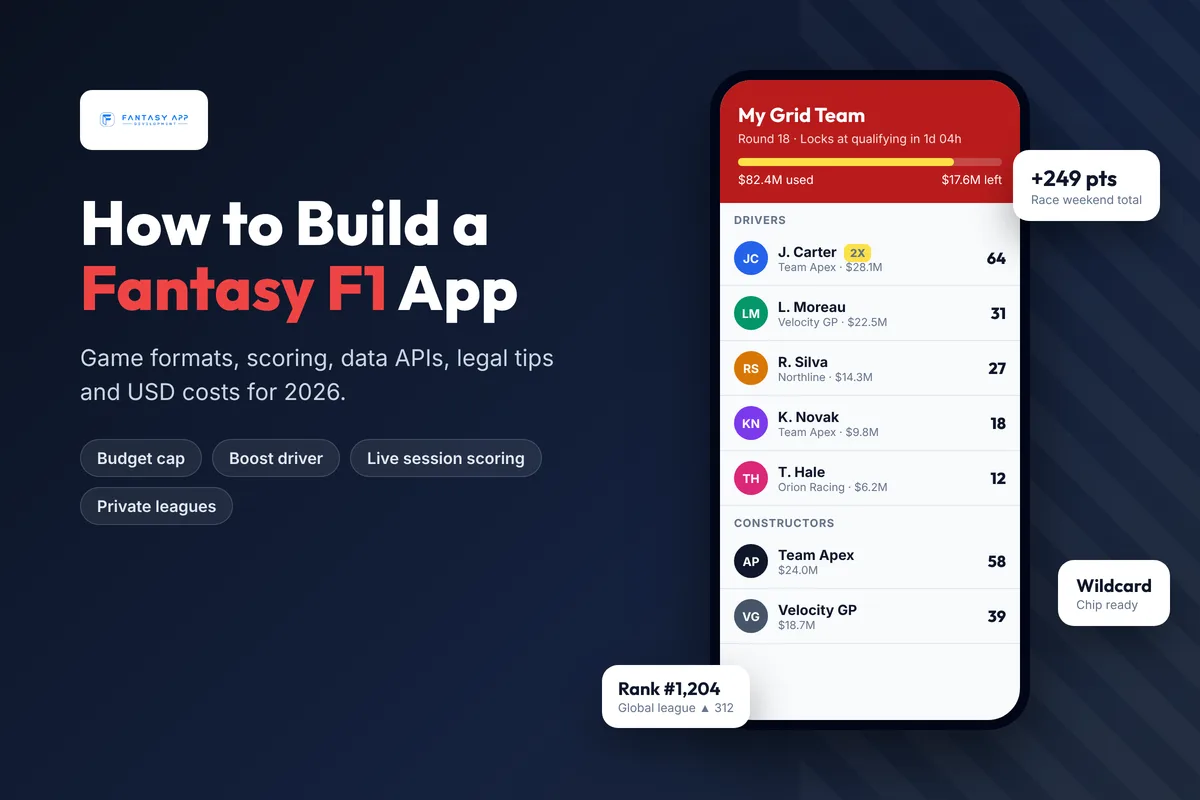
Quick answer: To build a fantasy F1 app, you need five core parts: a team builder with a budget cap (for example 5 drivers and 2 constructors under a $100M cap), a race-weekend scoring engine that covers qualifying, sprints and the Grand Prix, a Formula 1 data feed for results and live timing, leagues with leaderboards, and an admin panel to set driver prices and lock times. A free-to-play fantasy F1 MVP usually costs $15,000 to $30,000 and can launch in about 30 days on a ready fantasy base, while an advanced app with live scoring, chips, price changes and sponsor tools costs $30,000 to $60,000. Below are the game formats, a sample scoring table, data API options, legal points such as F1 trademarks, the build steps and full USD cost tables.
Key takeaways
- Fantasy F1 is a weekly game with only 20 to 24 rounds a year, so retention depends on transfers, price changes, chips and private leagues between races.
- The 2026 grid has 11 teams and 22 drivers (Cadillac joins, Audi replaces Sauber), and new technical rules make early-season form hard to predict, which is great for fantasy.
- Score qualifying, sprint and race separately, and add positions gained, fastest lap, overtakes and DNF penalties for a richer game.
- Free data options exist (Jolpica-F1 for results, OpenF1 for timing data), but a commercial app should use a licensed feed and check terms.
- Do not use the official F1 logo, the "Formula 1" brand or team logos without a license. Use neutral names such as "Fantasy Grand Prix".
Last updated: November 12, 2026. Author: Radhika.
What is a fantasy F1 app?
A fantasy F1 app lets fans pick a team of real Formula 1 drivers and constructors (teams) and earn points from how they perform each race weekend. Players stay under a budget, make transfers between races, use one-time boosts, and compete in global or private leagues. The best-known example is the official F1 Fantasy game, which uses a $100M cost cap, five drivers, two constructors and a set of chips such as Wildcard and Limitless. Many other fantasy motorsport games run on media sites, sponsor apps and community platforms around the world.
Formula 1 has a large global fan base, strong growth in the US and the Middle East, and races on five continents. That makes fantasy F1 a good fit for media brands, sponsors, betting-free fan engagement apps and fantasy platforms that want a sport beyond football and cricket.
Which fantasy F1 game formats can you build?
| Format | How it works | Best for |
|---|---|---|
| Season-long budget game | Pick 5 drivers and 2 constructors under a cap, make limited weekly transfers, prices rise and fall with form | Main game for fans and media brands |
| Race-weekend (daily-style) contests | A fresh lineup for each Grand Prix, with a captain or boost driver and a lock at qualifying | Short contests, sponsors, paid contests where legal |
| Predictor / pick'em | Predict pole, podium, fastest lap, first DNF or safety car | Casual fans and quick sign-ups |
| Head-to-head leagues | Two managers score against each other each weekend with a season table | Friends and office leagues |
| Draft league | Each driver can belong to only one manager in the league | Small, hardcore groups |
| Multi-series | Add F2, F3, IndyCar, MotoGP or Formula E as extra games | Motorsport media and platforms with year-round content |
For a deeper comparison of these models, read fantasy league formats explained and season-long vs daily fantasy sports.
How should fantasy F1 scoring work?
Good fantasy F1 scoring rewards both results and racecraft. A driver starting 18th who finishes 9th should score well even without a podium. Here is a sample scoring table you can adapt. It is our example, not the official F1 Fantasy scoring.
| Event | Sample points (driver) | Notes |
|---|---|---|
| Qualifying position | P1 = 10 down to P10 = 1 | Optional small penalty for a Q1 exit |
| Sprint finish | P1 = 8 down to P8 = 1 | Only at sprint weekends (usually 6 a season) |
| Grand Prix finish | P1 = 25 down to P10 = 1 | Mirrors the real points system, easy for fans to follow |
| Positions gained or lost | +1 / -1 per place | Rewards midfield drivers and recovery drives |
| Overtakes made | +1 each | Needs a feed with position data per lap |
| Fastest lap | +10 | Keep even if the real series drops the bonus |
| Driver of the Day | +10 | Can be admin-entered after the race |
| DNF or disqualified | -20 (race), -10 (sprint) | Big swing that makes "No Negative" chips valuable |
| Constructor | Sum of both drivers, plus pit stop and both-in-Q3 bonuses | Pit stop times need a feed or manual entry |
Most fantasy F1 games also let the user pick one boost driver each weekend who scores double points, plus a few one-time chips per season, such as an unlimited-transfer wildcard, a no-budget-limit week, a triple boost, a no-negative-points shield and an autopilot that gives the boost to the top scorer. Chips create big decisions between races, which is when most users open the app.
What features does a fantasy F1 app need?
| Area | MVP features | Advanced features |
|---|---|---|
| Team builder | 5 drivers + 2 constructors, budget cap, boost driver, lock at qualifying | Multiple teams per user, chips, team templates |
| Prices | Admin-set prices per round | Automatic price changes based on points and ownership |
| Scoring | Qualifying, sprint and race points after each session | Live points during sessions, overtakes, pit stop bonuses, stat corrections |
| Leagues | Global league, private leagues with invite codes | Head-to-head, country and team-fan leagues, sponsor leagues with prizes |
| Content | Race calendar with local times, results | Stats, driver form, ownership %, AI team suggestions, push alerts before lock |
| Admin | Drivers, teams, races, prices, results override | Rule editor, contest builder, sponsor placements, fraud checks |
| Real-money (only where legal) | Not in MVP | Wallet, KYC, geo-fencing, responsible gaming tools |
Mid-season driver swaps happen (injuries, reserve drivers, team changes), so the admin panel must let you add a driver, transfer them between teams and protect users who owned the old driver.
Where do you get Formula 1 data for a fantasy app?
Your app needs the calendar, entry list, session results, grid positions, lap and position data for overtakes, fastest laps, pit stops and DNFs. Common options:
| Source | What it gives | Cost | Watch out for |
|---|---|---|---|
| Jolpica-F1 | Ergast-compatible results, standings and schedules from 1950 to today | Free | Community project with rate limits; cache data and check usage terms |
| OpenF1 | Timing data: laps, positions, pit stops, stints, weather, from 2023 | Free historical; check current terms for live access | Not an official feed; plan a fallback |
| Commercial sports data providers (for example Sportradar) | Licensed Formula 1 data with SLA and support | Custom quote, often hundreds to thousands of dollars per month | Best choice for commercial, sponsored or paid-contest apps |
| Admin entry | Driver of the Day, penalties, late changes | Staff time | Always keep a manual override for steward decisions |
Steward penalties can change results hours after a race, so your scoring engine should support recalculation and show users "provisional" points until results are final. Compare more providers in our guide to the best fantasy sports data APIs.
Is a fantasy F1 app legal?
Free-to-play fantasy F1 games with prizes are legal in most countries, as long as your terms and prize rules are clear. Paid-entry contests follow the same rules as other fantasy sports: allowed in many US states, licensed by the Gambling Commission in the UK, and restricted or banned in some countries, including India since the Online Gaming Act 2025. See our country-by-country guide: is fantasy sports legal.
The bigger F1-specific risk is intellectual property. "F1", "Formula 1", the F1 logo, the official F1 Fantasy name and team logos are trademarks. Without a license:
- Use a neutral game name (for example "Fantasy Grand Prix" or "Grid Manager").
- Use driver and team names as plain text facts, not logos, liveries or official photos.
- Add a line saying your game is not affiliated with or endorsed by Formula 1.
- Get a legal review before launch if you plan paid contests or big sponsors.
How do you build a fantasy F1 app step by step?
- Pick your market and format: free-to-play season-long game, race-weekend contests or a predictor.
- Write the rules: budget, squad size, transfers per round, boost driver, chips, scoring table and lock times.
- Choose the data feed and confirm commercial use, latency and sprint/qualifying coverage.
- Design the UX: a quick team builder, clear budget bar, race countdown in local time and a points breakdown per session.
- Build the backend: a scoring engine that runs per session, price-change jobs, league leaderboards and caching for race-day spikes. See our fantasy sports app tech stack.
- Build the apps: iOS, Android and web, usually with Flutter or React Native.
- Test on past races: replay last season's results to check scoring, penalties and leaderboards.
- Launch before pre-season testing so users build teams before round 1, then add chips and features during the season.
Race weekends create sharp traffic peaks right before qualifying lock and right after the chequered flag. Read how to scale a fantasy sports app to plan for them.
How much does it cost to build a fantasy F1 app?
| Version | What you get | Typical cost (USD) | Timeline |
|---|---|---|---|
| Predictor MVP | Race picks (pole, podium, fastest lap), leaderboards, private leagues, admin results | $10,000 to $20,000 | 3 to 5 weeks |
| Fantasy F1 MVP | Budget team builder, boost driver, session scoring from a data feed, leagues, admin | $15,000 to $30,000 | About 30 days on a ready base |
| Advanced | Chips, automatic price changes, live points, H2H leagues, push alerts, sponsor tools | $30,000 to $60,000 | 2 to 3 months |
| Enterprise / multi-series / paid contests | F1 plus other series, wallet, KYC, geo-fencing, high-scale backend | $60,000 to $120,000+ | 3 to 5 months |
| Running cost | Typical monthly range (USD) |
|---|---|
| F1 data feed | $0 (free community APIs) to $2,000+ (licensed feed) |
| Cloud hosting | $100 to $1,500, depending on users and live features |
| Push notifications, email, analytics | $0 to $300 |
| Maintenance and season updates | 15% to 20% of build cost per year |
Want the fastest route? A white-label fantasy sports platform with an F1 module can go live before the season opener.
How does a fantasy F1 app make money?
- Sponsorship: a title sponsor for the game and sponsored race-weekend contests with prizes.
- Advertising: ads on team pages, results and leaderboards, which get the most views on race weekends.
- Premium subscription: extra teams, advanced stats, price-change predictions and AI team tips.
- B2B licensing: run the game for a broadcaster, media site, team partner or brand.
- Paid contests: entry-fee rake, only in licensed markets.
See more models in how do fantasy sports apps make money.
Build your fantasy F1 app with us
Fantasy App Development has built fantasy sports apps for 400+ clients worldwide and can launch an app in about 30 days. We can build a fantasy F1 or multi-series motorsport game for your market, with budget team builders, session scoring, chips, private leagues and sponsor tools. Explore our fantasy football and fantasy cricket app development services, see our portfolio, or contact us for a free fantasy F1 app plan and quote.